DayTradeToWin Review

Trade Smart: Harnessing AI for Successful Trading Strategies

Greetings Traders! Today, we’re immersing ourselves in the realm of autopilot trading. Buckle up as we guide you through seven trades, from start to finish, utilizing our cutting-edge automated trading system. This strategy handles all the heavy lifting for you – from executing buys and sells to managing trailing stops – all on autopilot. However, before we plunge into the trades, it’s essential to remember the inherent risks associated with trading. Only invest funds that you can afford to lose. Our Autopilot System: Now, let’s dive right in. Trade 1: Long 50/50 Quarter We kick things off with a long position, with our autopilot system promptly establishing a trailing stop and break-even point. Witness how the trailing stop adjusts as the market moves in our favor. Additionally, we’ve integrated a two-bar loss strategy for added security. Trades 2 – 7: Continuous Triumphs Each trade seamlessly transitions into the next, with our autopilot system effortlessly navigating the markets. Whether it’s securing profits or mitigating losses, our system performs with unwavering precision. Throughout these trades, we’ll spotlight some key features and options of our autopilot system. From trailing stops to accelerated mentorship, we offer a comprehensive toolkit for traders. In Conclusion As we wrap up the day, we reflect on our successful trades and present viewers with an array of options, including discounted bundles and mentorship programs. If you’re intrigued by the potential of autopilot trading, visit daytradetowin.com to explore further. Don’t forget to sign up for a free member account to access exclusive discounts and resources. Until next time, may your trades be prosperous!
Market News

Insights from a Former Hedge Fund Star: The Next Bear Market Signal

What hangs in the balance with the release of Tuesday’s CPI data? Many in the financial world are expecting a decrease in inflation, but if the numbers surpass expectations, it could dampen hopes for a rate cut in May, potentially affecting the S&P 500’s climb towards 5,000, warn some analysts. Despite this, given Nvidia’s impressive 47% increase this year and the frenzy surrounding AI companies like ARM, it appears prudent to refrain from opposing the momentum, at least for now. Indeed, the latest fund manager survey from Bank of America shows continued enthusiasm for tech stocks. So, what might eventually trigger a downturn in this market? Former hedge-fund manager Russell Clark suggests looking to Japan, where loose monetary policy persists as a significant factor. Clark, despite stepping away from his consistently bearish RC Global Fund in 2021 after a decade of misjudgments on stock markets, presents a compelling argument regarding Japan’s importance. In his recent Substack post, Clark argues that the true catalyst for a bear market could arise when the Bank of Japan ends quantitative easing. He suggests that we’re in a “pro-labor world,” where certain economic trends should be emerging: increasing wages, declining unemployment, and interest rates trending higher than anticipated. In line with his analysis, real assets began surging in late 2023 as the Fed adopted a dovish stance and the yield curve steepened. However, subsequent events haven’t unfolded as expected. While Clark anticipated that higher short-term rates would divert money from speculative assets, funds instead flowed into cryptocurrencies like Tether, and the Nasdaq fully recovered from its 2022 decline. Returning to Japan, Clark offers a less conventional explanation for the resilience of financial and speculative assets. He points out that during the 1990s, despite the Fed maintaining high interest rates, the dot-com bubble thrived. However, the bubble eventually burst when the Bank of Japan raised rates in 1999. Similarly, Japan’s attempt to raise rates in 1996 is associated with the Asian Financial Crisis. According to Clark’s analysis, it seems that markets are more sensitive to the Bank of Japan’s balance sheet than to the Fed’s policies. He argues that the BOJ’s introduction of quantitative easing in the early 2000s preceded the subprime crisis, which erupted shortly after the BOJ withdrew liquidity from the market in 2006. In summary, Clark suggests that the Bank of Japan is the central bank that truly matters and that a bearish stance on the U.S. might be warranted when the BOJ raises interest rates. He closely monitors the BOJ’s actions as they could signal impending market shifts.

Market News

Investor’s Guide: Lunar New Year 2024 Insights on Stock Market Performance and Gold Trends

Tom Lee from Fundstrat points out that the U.S. stock market has historically flourished during the Years of the Dragon, boasting an average gain of 12.7% since 1871. This historical trend indicates that the recent uptrend in the S&P 500, which has propelled it to the significant 5,000-point milestone, may have further room to grow. Lee’s analysis suggests that by the end of 2024, the S&P 500 could potentially surge to 5,350 points, marking a projected 6.4% increase from its current level. As we approach the onset of the Year of the Dragon on February 10, 2024, Lee also highlights the promising performance of small-cap stocks during this period. Over the years, small-cap stocks have tended to outshine the S&P 500, prevailing in 88% of instances since 1979. Additionally, Lee draws attention to the current price-to-book ratio of the Russell 2000 index compared to the S&P 500, which mirrors conditions observed in 1999 when small-cap stocks outpaced their large-cap counterparts for the subsequent 12 years. Anticipating a reversal in the trend of investor outflows from equities, Lee foresees positive inflows into the market in 2024. This shift could further bolster small-cap stocks and potentially broaden the market rally beyond the “Magnificent Seven” mega-cap growth and technology companies. A more expansive rally could drive the S&P 500 towards the upper bounds of a projected range between 5,400 and 5,500 by the year’s end. In addition to equities, the Year of the Dragon typically sees heightened demand for gold, particularly from China during the Lunar New Year vacation season. This tradition, combined with ongoing geopolitical tensions and robust central bank demand, sets a favorable backdrop for gold prices in 2024.

Market News

Breaking Records: U.S. Stocks Reach Heights Not Seen Since 1972

U.S. stocks have achieved a rare milestone reminiscent of the era when President Richard Nixon occupied the White House. On Friday, the S&P 500 (SPX) clinched its 14th week of gains out of 15, a feat last seen on March 10, 1972, according to Dow Jones Market Data. This accomplishment is only the 13th since the index’s inception in 1957. But the significance of the index’s climb over this period doesn’t require a distant glance into history. With a 22.1% surge over the past 15 weeks as of Friday’s close, it marks the most substantial gain in such a timeframe since the period ending August 28, 2020, based on Dow Jones data. Friday also saw the index closing above 5,000 for the first time, marking its 10th record close of the year. Notably, the S&P 500 isn’t alone in its historic winning streak. The Nasdaq Composite (COMP) also joined the party, rising for the 14th week out of 15. For the Nasdaq, the last time it accomplished such a streak was during a 15-week period ending on August 8, 1997. As for the Dow Jones Industrial Average (DJIA), it barely managed to eke out a gain for the week on Friday, marking the first such instance since May 12, 1995. These types of winning streaks for the DJIA have occurred only 14 times since its inception in the late 19th century. For the Nasdaq, it was only the sixth time since its creation that it achieved such a milestone, with one instance being a 15-week winning streak ending on March 10, 1972. The rally in U.S. stocks has been robust since their recent near-term bottom in late October, when the S&P 500 hit its weakest level in five months. The primary driver behind this market surge has been the Federal Reserve’s pivot away from raising interest rates, leaning instead toward maintaining them or possibly cutting them later in the year, according to Chris Zaccarelli, chief investment officer at Independent Advisors Alliance. Zaccarelli also pointed to the surprising resilience of the U.S. economy as another factor bolstering stocks over the past year. U.S. stocks closed mostly higher on Friday, with all three major indexes notching weekly gains, even as the Dow lagged. The S&P 500 closed 0.6% higher at 5,026.61, while the Nasdaq Composite gained 1.3% to 15,990.66, and the Dow Jones Industrial Average finished down 0.1% at 38,671.69. The Russell 2000 also saw gains, closing up 1.5% at 2,009.99.

DayTradeToWin Review

Maximizing Profits: The Roadmap to Predictable Market Trends

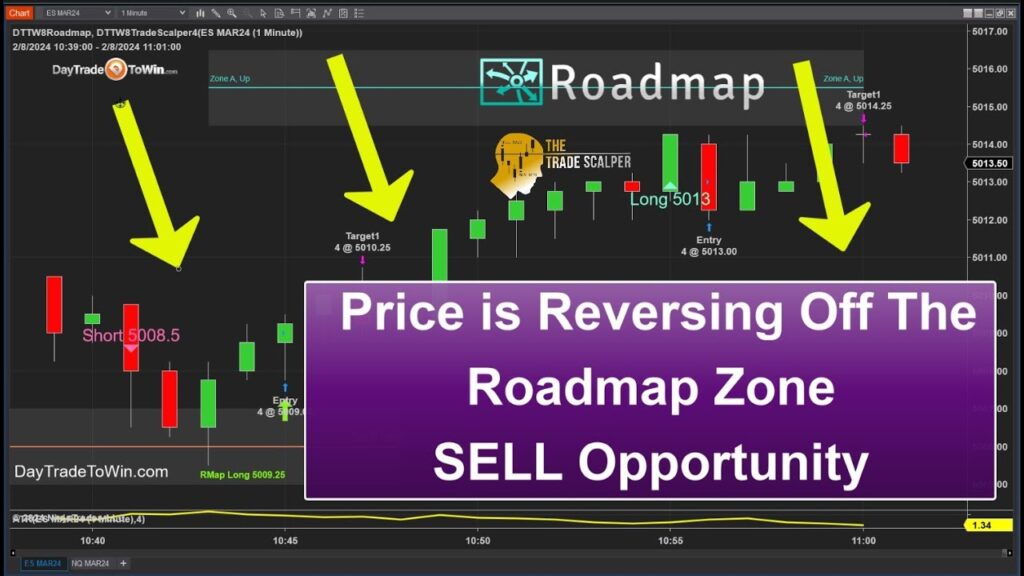
Greetings, Fellow Traders! Today, let’s dive into the dynamic realm of price action trading, guided by the sophisticated tools of the Trade Scalper and Roadmap software. But before we immerse ourselves, a gentle reminder: trading comes with inherent risks, so it’s crucial to only invest funds you can afford to lose. Let’s kick off by analyzing the signals and trades of the day: Trade Scalper Signal Price action trading offers a remarkable clarity and universality. The signals generated are identical for all users of the Trade Scalper and Roadmap software. With no complex optimizations involved, success hinges on our ability to interpret market movements effectively. For instance, today’s signal indicates a short position at 51050. In anticipation of this move, I exercise patience, avoiding impulsive actions. Instead, I await confirmation, seeking to capitalize on the downward momentum, aiming for the Roadmap. The Roadmap serves as a magnetic guide, directing prices towards specific zones. As the market gravitates towards these areas, my objective is to position myself strategically, ready to capitalize on potential reversals or continuations. Understanding Market Behavior A deep understanding of market behavior is essential. Markets frequently revisit previous levels, testing support and resistance. As a price action trader, I’m vigilant, always on the lookout for opportunities within familiar patterns and zones. Trading with Precision Each trade is meticulously planned, with well-defined entry and exit points. Whether it’s a short or long position, precision is paramount. Our goal is to capitalize on market movements with surgical precision. Adaptability is the hallmark of successful trading. The market is ever-evolving, requiring constant adjustments. Whether the market follows our projections or deviates, flexibility is key, enabling us to pivot our strategies accordingly. For those eager to deepen their understanding of price action trading, our Accelerated Mentorship package offers invaluable resources. With lifetime software access, daily training sessions, and exclusive access to our trading room, it’s the ultimate toolkit for mastering the markets. In conclusion, price action trading is both an art and a science. By harnessing the power of tools like Trade Scalper and Roadmap, alongside a comprehensive understanding of market dynamics, traders can navigate the ever-shifting landscape with confidence. Join us at DayTradeTowin.com and embark on your journey towards trading mastery. Until next time, may the markets be ever in your favor!

Market News

S&P 500 Makes History, Hits 5,000 – Dive into Market Dynamics

The S&P 500 flirted with a significant milestone just before Thursday’s market close, briefly crossing the 5,000 mark and notching its ninth record finish of 2024 at 4,997.91. While these round numbers lack technical significance, they carry psychological weight, impacting market sentiment. Mark Arbeter, president of Arbeter Investments, noted historical instances where such milestones acted as market ceilings. For instance, the Dow Jones Industrial Average struggled to surpass 1,000 until 1983, while the S&P 500 faced similar challenges until 1980. While surpassing 1,000 points is relatively easier for the Dow, requiring just a 2.6% increase, the S&P 500’s move from 4,000 to 5,000 represents a substantial 25% gain, underscoring its significance. Despite the attention lavished on the Dow, the S&P 500 holds more weight in the investment world, being the preferred benchmark for professionals due to its broader representation of the market. The current rally’s longevity since crossing the 4,000 mark in 2021 underscores the index’s resilience. However, concerns loom over the market’s increasing concentration, with the top five companies now dominating a larger share of the index than at any previous 1,000-point milestone.

Scroll to Top