tariff
Market News

Tariff Shock Hits Stocks as Trump Targets Europe

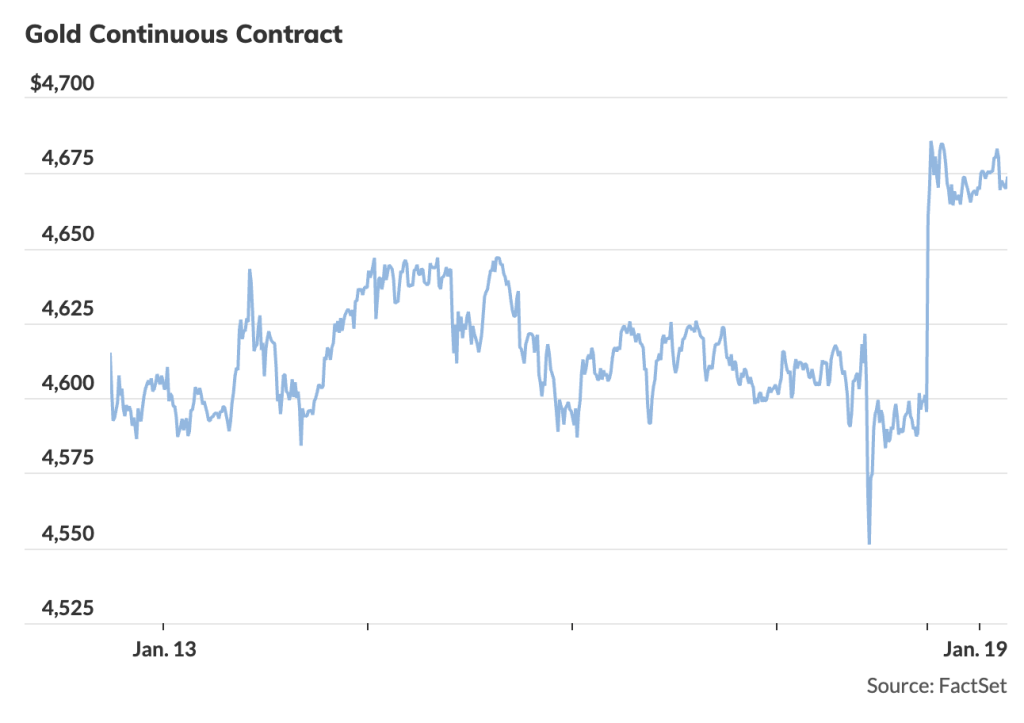
Global Markets Slide as Trump’s Europe Tariff Threats Ignite Trade War Fears, Gold Hits Record Global financial markets came under heavy selling pressure on Monday after U.S.President Donald Trump threatened new tariffs on several European countries, reigniting fears of a widening trade conflict and sending investors rushing into safe-haven assets. U.S. stock futures led global equities lower, while gold and silver surged to record highs as traders reduced risk exposure following Trump’s weekend announcement linking tariffs to negotiations over Greenland. “President Trump’s actions have reignited geopolitical risks and brought trade uncertainty back to the forefront,” said Kyle Rodda, senior financial market analyst at Capital.com. E-mini S&P 500 futures fell around 1%, Hong Kong’s Hang Seng Index dropped about 1%, and Europe’s STOXX 600 slid more than 1% in early trading. U.S. cash markets were closed for the Martin Luther King Jr. holiday. Safe Havens Rally as Risk Assets Sell Off Gold futures climbed above $4,670 an ounce for the first time on record, while silver surged past $94 an ounce to a new all-time high. Germany’s 10-year government bond yield, the euro zone benchmark, fell about two basis points as investors piled into sovereign debt. Trump Targets Eight European Countries On Saturday, Trump said the United States would impose 10% tariffs on imports from Denmark, Norway, Sweden, France, Germany, the United Kingdom, the Netherlands, and Finland starting February 1. He added that the tariff rate would rise to 25% on June 1 unless a deal is reached for the “complete and total purchase of Greenland,” according to a post on Truth Social. European officials are reportedly preparing countermeasures that could include up to €93 billion in tariffs on U.S. goods or restrictions on American companies’ access to European markets. Escalation Risks Cloud Global Outlook The eight countries targeted by Trump accounted for about $350 billion in U.S. imports in 2024. Holger Schmieding, chief economist at Berenberg, said a 10% tariff could lift U.S. consumer prices by as much as 0.15%. “Trump’s threat puts the entire U.S.-EU trade framework at risk,” Schmieding said. “If this escalates further, the damage to U.S. consumers could be nearly three times as severe.” Europe May Deploy Anti-Coercion Measures Analysts say the European Union could respond by activating its Anti-Coercion Instrument, a legal framework designed to counter economic pressure from foreign governments. “That could mean retaliatory tariffs — potentially against U.S. Big Tech — as well as investment restrictions,” said Ipek Ozkardeskaya, senior analyst at Swissquote. “That helps explain why Nasdaq futures are under heavier pressure than the broader market.” Precious Metals Remain in a Strong Bull Trend Strategists said the renewed trade tensions strengthen the bullish case for gold and silver. “With geopolitical and trade uncertainty rising again, investors are naturally moving to hedge risk, which further supports precious metals,” said Michael Brown, senior research strategist at Pepperstone. Markets Expect Familiar Negotiation Tactics Some analysts cautioned that markets may be seeing a familiar pattern. “This looks like another ‘escalate to de-escalate’ strategy that ultimately ends in a deal, though not without significant volatility along the way,” said strategists at Evercore ISI. Trump is expected to meet European leaders at the World Economic Forum in Davos this week, while markets also await a U.S. Supreme Court ruling on the legality of his use of emergency powers to impose tariffs. Defense Stocks Outperform European defense stocks bucked the broader market decline, with shares of Rheinmetall, BAE Systems, and Thales all trading higher on expectations of higher regional defense spending.

market
DayTradeToWin Review

January Stock Market Outlook: S&P 500 Near Key Highs

U.S. equity markets are showing renewed strength as January trading continues, with major indexes signaling that the early weeks of the year could set a constructive tone for the months ahead. The E-mini S&P 500, Nasdaq, and Dow Jones Industrial Average are all trading higher than their opening levels for the year, reinforcing the view among many traders that the broader market remains in an established uptrend. Historically, January has played a critical role in shaping investor expectations. Market participants often look to see whether the first month of the year closes higher or lower than it opens, as a strong January has frequently been associated with positive performance for the rest of the year. So far, price action suggests that a higher January close remains the more likely outcome, barring a major external shock. Markets Move Toward Key Resistance Levels Recent price behavior indicates that markets are attempting to revisit previous highs. In the E-mini S&P 500, traders are closely watching the area near the 7,000 level, a zone that represents a key psychological and technical reference point. Similar patterns are visible across other asset classes. The Nasdaq continues to hold above its January opening range and appears positioned to challenge recent highs. Gold and crude oil have also displayed comparable behavior, with prices gravitating back toward their most recent peaks. This tendency to retest prior highs is a well-known feature of market structure, particularly during trending environments. Pullback Seen as Normal Consolidation Despite the broader uptrend, markets have recently experienced a modest pullback. Rather than a sharp sell-off, the decline has taken the form of a multi-day consolidation, which many traders view as a normal retracement within a continuing trend. Such pullbacks typically unfold over several sessions rather than a single large move, allowing the market to digest recent gains before attempting another push higher. Similar price action earlier in the cycle was followed by a renewed rally toward previous highs. Breakout Could Trigger Short-Term Volatility If markets succeed in trading above recent highs, analysts note that a brief acceleration in price could follow. Breakouts often trigger a wave of stop orders and momentum-driven buying, which can result in a short-term surge in prices. This type of move is frequently accompanied by increased volatility, as rapid buying is sometimes followed by short-term profit-taking before the broader trend resumes. January’s Broader Implications From a longer-term perspective, a strong January has historically increased the probability of a positive year overall, even though periods of volatility and correction remain inevitable. While markets rarely move in a straight line, the current structure suggests that pullbacks may continue to be viewed as part of a broader upward trend rather than the start of a sustained reversal. For now, the dominant theme across major U.S. indexes remains one of resilience, with price action continuing to favor the upside as the year gets underway.

inflation
Market News

Inflation Risks Grow Amid Metals and AI Boom

Will a Trump-Led Fed Step In If Inflation Spikes in May? Rising metals prices, mounting geopolitical risks, and growing concerns over the Federal Reserve’s independence are stoking fears that inflation could accelerate more than expected in 2026 — potentially putting interest-rate cuts and market optimism at risk. That’s a big deal for investors. Inflation is already running above the Fed’s 2% target, and a renewed surge could derail the two quarter-point rate cuts markets currently expect this year. While some portfolio managers are taking steps to protect against inflation, broader markets appear complacent. On Thursday, the benchmark 10-year Treasury yield hovered around 4.16%, still stuck in the same range it has traded in since late August — a sign that inflation fears are not yet fully reflected in bond prices. At the same time, inflation traders expect headline CPI to peak near 2.8% in May before easing later in the year. Stocks also show little sign of stress. The Dow Jones Industrial Average and S&P 500 remain near record highs, lifted by enthusiasm for artificial intelligence and a rebound in bank shares. Metals Are Sending a Warning Signal Commodities — especially metals — are flashing early warning signs. Gold is already up 6.7% in 2026 after soaring 64% in 2025. Silver has jumped 31% this year following a stunning 141% surge last year. The rally is now spreading to industrial metals like copper and steel, which are critical inputs for construction, cars, and infrastructure. “Portfolio managers are whispering about this and trying to figure out how to position themselves,” said Ryan Weldon of IFM Investors. He warned that rising metals prices are “acting as a floor” under many consumer goods, especially automobiles — and could force inflation back into the Fed’s spotlight. A New Fed Chair Brings New Uncertainty Markets are also watching President Donald Trump’s upcoming choice to replace Jerome Powell when his term ends in May. Trump has said he wants a chair who “believes in lower rates by a lot,” reviving fears about political influence over monetary policy. Chicago Fed President Austan Goolsbee recently warned that undermining the Fed’s independence could cause inflation to “come roaring back.” For investors, the concern isn’t just who leads the Fed — it’s whether the central bank will still be willing and able to act if inflation starts rising again. Geopolitics and AI Add More Fuel Beyond metals, several new inflation risks are building: Marta Norton of Empower notes that the AI buildout is not only increasing power costs but also pushing up construction and equipment expenses — creating multiple pathways for inflation to spread. The Bond Market Will Blink First Despite the growing risks, traders still see about a 64% chance that the Fed’s next rate cut comes by June. But some managers think the real danger is that no cuts happen at all this year. Weldon says a quick move in the 10-year Treasury yield above 4.3% would be a clear warning sign that inflation fears are finally hitting the bond market. A sustained rise in yields — especially if the yield curve steepens — would signal that investors are being forced to reprice inflation risk. “Not a Crisis — But the Risks Are Rising” Some managers remain cautious rather than alarmed. Vincent Ahn of Wisdom Fixed Income Management says the bigger issue is whether higher input costs become sticky — pushing wages and long-term inflation expectations higher. “My base case is metals can create uncomfortable upside surprises,” he said, “but it’s more likely to be sparks than a forest fire.” Others, including GuideStone Funds’ Josh Chastant, now see a real risk that inflation stays above the Fed’s 2% target for much of the year. The Bottom Line Investors began 2026 confident inflation would keep cooling. That confidence is now being tested. With metals surging, geopolitical risks rising, AI driving up demand for energy and materials, and a potentially more politically influenced Fed leadership on the horizon, the margin for error is shrinking fast. If inflation reaccelerates this spring, markets may soon find out whether a Trump-era Federal Reserve will prioritize fighting inflation — or keeping rates low.

blackrock
Market News

BlackRock AUM Jumps to New All-Time High

BlackRock’s Assets Hit $14 Trillion as Market Rally Fuels Record Inflows BlackRock’s assets under management (AUM) surged to a record $14 trillion at the end of last year, lifted by strong global stock markets and a wave of investor money flowing into the company’s exchange-traded funds. The world’s largest asset manager said it attracted $698 billion in net inflows for the full year, including $342 billion in the fourth quarter, marking one of the strongest growth periods in the firm’s history. Chairman and CEO Larry Fink said BlackRock is heading into 2026 with “accelerating momentum across our entire platform,” following the integration of newly acquired businesses Global Infrastructure Partners, HPS Investment Partners, and Preqin, which significantly expand its presence in private markets and alternative assets. “Our business pipeline continues to broaden across products, regions, public and private markets, as well as technology and data,” Fink said. “We’re seeing strong fundraising activity as we move toward our goal of $400 billion in private markets fundraising by 2030.” BlackRock also delivered better-than-expected financial results. Fourth-quarter revenue climbed 23% to $7 billion, pushing full-year revenue to $24.2 billion, up 19% from the previous year. Adjusted earnings per share reached $13.16, beating analysts’ expectations of $12.19, according to FactSet. Markets reacted positively to the earnings report. BlackRock shares rose more than 2% in premarket trading and are now up roughly 10% over the past year, reflecting growing investor confidence in the company’s long-term strategy.

sonic
DayTradeToWin Review

Sonic Strategy: Which Timeframe Really Works?

Successful trading is not about being in the market all day. It’s about waiting for the right setups and executing them with discipline. In today’s market update, we’ll break down how the Sonic Trading System is identifying high-quality trading opportunities across multiple timeframes — from short-term scalping to swing trading — using nothing but price action, structure, and intelligent risk management. 🔹 A Strong Session: Consecutive Winning Long Trades Looking at the E-mini and Micro E-mini markets through the Sonic system, the latest sequence shows exactly what traders want to see: While this kind of streak is great, disciplined traders know that more trades doesn’t mean more profits. On a 1-minute chart especially, after five or six trades, it’s wise to become more selective. If you capture just two or three high-quality trades from a session like this, you’re already ahead. 🔹 Why the 3-Minute Chart Often Delivers Better Setups Many Sonic traders prefer the 3-minute chart because it provides: In the most recent sequence, a short trade appeared — but the following long trade was the superior setup. Why? Because the profit target was significantly larger than the stop loss. This is a core principle of professional trading: When your potential reward is greater than your risk, you give yourself a mathematical edge before the trade even starts. And if you can also get a better entry price? That edge becomes even stronger. 🔹 How to Think Like a Professional Trader The Sonic Trading System is built on structure and momentum, not lagging indicators. Here’s what we look for: If you ever find yourself wondering whether to take a trade or not, remember this: The market will always give another opportunity. Wait for the better one. 🔹 Swing Trading with the Sonic System: The Daily Chart View The Sonic system isn’t just for day traders. It works extremely well for swing trading on higher timeframes like the daily chart. The most recent daily trade from January 6 showed: Ideally, you want trades where the reward is greater than the risk — because that’s how you build a high-probability trading approach over time. 🔹 The Real Advantage: Price Action Over Indicators Most traders struggle because they rely on: The Sonic Trading System focuses on what actually moves the market: ✅ Pure price action ✅ Market structure ✅ Objective entries and exits ✅ Built-in risk management ✅ Works on any market, any timeframe 🚀 Get Lifetime Access to the Sonic Trading System If you’re serious about becoming a consistently profitable trader, the Accelerated Mentorship Program gives you everything you need: 🔥 Start Trading the Right Way Create your FREE member account and get instant access to trials and training: 👉 Visit daytradetowin.com👉 Join Accelerated Mentorship👉 Start trading using price action instead of indicators 🏁 Final Thought Trading success doesn’t come from trading more.It comes from trading better setups with better risk-to-reward — consistently. That’s exactly what the Sonic Trading System is designed to help you do.

gold
Uncategorized

Gold ETF Sees Nearly $1 Billion Inflow in One Day

Nearly $1 Billion Floods Into Gold ETF as Investors Pile Back Into the Metal Investor appetite for gold is roaring back in 2026, even as Wall Street strategists question whether the precious metal still deserves its reputation as a reliable portfolio hedge. On Monday, investors poured $950 million into SPDR Gold Shares (GLD), one of the world’s largest gold-backed exchange-traded funds, according to FactSet data. The massive one-day inflow erased the fund’s earlier losses for the year, pushing its net inflows in 2026 to $118 million. The buying spree comes after gold’s spectacular performance in 2025, when the ETF surged nearly 64%, marking its strongest annual gain since its launch in 2004. That rally easily topped its previous record year in 2007, when the fund climbed just over 30%. Still, not everyone is convinced gold belongs in long-term portfolios. In its 2026 outlook, Goldman Sachs’ wealth-management investment strategy team warned that gold has suffered deep and prolonged drawdowns, in some cases falling as much as 70%. Compared with U.S. bonds — which are traditionally seen as a stabilizer during periods of market stress — gold’s track record looks far more volatile. “Gold has higher volatility than U.S. equities, much larger drawdowns, and only effectively hedges inflation about half the time over rolling 20-year periods,” said Brett Nelson, head of tactical asset allocation at Goldman Sachs. By contrast, Nelson noted that U.S. equities have consistently beaten inflation over similar time frames. Despite those concerns, investors continue to rush back into the trade, signaling that demand for perceived safe havens remains strong as uncertainty lingers across global markets. With nearly $1 billion flowing into GLD in a single day, it’s clear that for many investors, the gold story is far from over in 2026.

Scroll to Top