S&P 500
Market News

S&P Hits 6,000, Dow Breaks 44,000 — What’s Next?

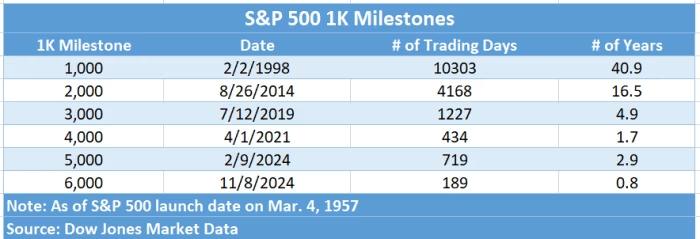
Tony Roth, Chief Investment Officer at Wilmington Trust, projects that the S&P 500 could climb into the mid-6,000s over the next two months, as recent market optimism shows no signs of slowing. On Monday, the S&P 500 closed above 6,000, while the Dow Jones Industrial Average topped 44,000 for the first time. Both indexes are riding the momentum from last week’s rally following Donald Trump’s presidential victory and a 25 basis point rate cut by the Federal Reserve. Clark Geranen, chief market strategist at CalBay Investments, highlighted the S&P’s 6,000 milestone as “a psychologically significant level” that could draw in more investors still holding cash in money-market funds and bonds. He attributes the market’s recent strength to a combination of easing volatility, boosted by a drop in the VIX, and renewed optimism in the economy. On Monday, the S&P 500 gained 5.81 points, or 0.1%, to close at 6,001.35—marking its first close above 6,000. The Dow rose 0.7% to 44,293.13, reaching another historic milestone. According to Dow Jones Market Data, this marks the quickest 1,000-point climb for the index in its history. Leading this surge were stocks like Vistra Corp., Palantir Technologies Inc., Targa Resources Corp., Nvidia Corp., and United Airlines Holdings Inc. The recent rally gained strength after Trump’s return to the White House and prospects of a Republican-led Congress, with the Fed’s rate cut providing an extra boost. The Nasdaq Composite Index also showed resilience, inching up 0.1% on Monday after a strong week of gains. Yet some analysts urge caution. Paul Christopher, head of global investment strategy at Wells Fargo, warns that while the market has latched onto specific policy hopes, these selective reactions may not guarantee lasting gains. He suggests waiting for a clearer picture of the administration’s main policy directions. Bond markets, closed Monday for the Veterans Day holiday, are also on investors’ minds. The 10-year Treasury yield recently ended at 4.307%, raising concerns over inflation and potential impacts of higher borrowing costs on equities. Roth remains bullish in the near term but notes that once Trump takes office, the market will be looking closely at his plans for lowering taxes without excessively increasing deficits.

Wall Street
Market News

The Wall Street-Main Street Divide in 2024

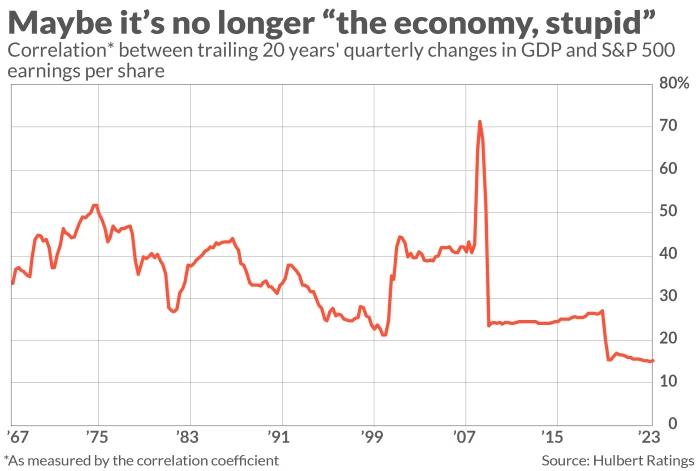
This year’s strong gains in the Dow Jones suggested an advantage for the Democrats and Kamala Harris in the presidential election, but it underscored an important reality: Wall Street and Main Street are drifting further apart. Historically, the stock market has been viewed as a bellwether for election outcomes, but this election proved otherwise, raising the question of why it failed to predict the results. Over recent months, I tracked a model that connected the incumbent party’s chances of staying in office to the Dow Jones Industrial Average’s performance. Leading up to the election, this model gave Vice President Kamala Harris, the Democratic candidate, a 70% likelihood of defeating former President Donald Trump. When models like this one falter, it’s an opportunity to reassess their assumptions. Is this merely an example of a model’s natural limitations? Or does it reflect fundamental shifts in the economy and markets, diminishing the model’s relevance? In retrospect, the breakdown seems to stem from a widening gap between Wall Street’s performance and the realities of the broader economy—often referred to as the Wall Street-Main Street divide. In the past, the Dow was a fairly reliable indicator of the economy’s health and, by extension, voters’ economic sentiment. But that connection has weakened considerably over the years. To highlight this shift, I examined the long-term relationship between quarterly U.S. GDP growth and S&P 500 earnings per share (EPS) going back to 1947, using a 20-year trailing correlation. This correlation, which reached about 40% in the early 1990s, is now just 15%, showing a steady decline, with the only notable exception being the brief alignment during the 2008-09 financial crisis. This declining correlation sheds light on why this year’s stock market surge didn’t translate into stronger support for Harris. While Wall Street rallied, many Americans are still grappling with financial hardships. The implications are clear: traditional economic indicators may be losing their forecasting power, and analysts may need to focus more on company-specific factors rather than broad economic cycles. Vincent Deluard, StoneX’s director of global macro strategy, recently echoed this sentiment, observing that “investors spend far too much time worrying about the next recession. Economic growth is just one small driver of stock prices. Margins and multiples matter a lot more.” In other words, understanding stock performance today may require focusing on the profitability and valuation multiples of companies rather than macroeconomic indicators. This shift doesn’t simplify forecasting; profit margins and price-to-earnings ratios are challenging to project. However, by recognizing the diminishing role of economic growth in market performance, analysts can refocus on these crucial factors driving stock prices in the current economy.

sonic
DayTradeToWin Review

22 Wins, 1 Loss with the Sonic Trading System

Hello, Traders! Yesterday, on November 8th, the Sonic Trading System delivered an exceptional session, yielding 22 winning trades with only one loss. Let’s dive into the trade details and see how the system effectively captured these winning setups. Trading the Friday Afternoon Market: Is It Worth It? While many traders focus on the Asia, London, or U.S. sessions, Friday afternoons can present strong trends that are often overlooked. Even as the week winds down, we found that the Sonic System still identified solid trade opportunities after 12:30 p.m. (New York time). Here’s how we used it to lock in win after win. Uninterrupted Wins: 16 Trades in a Row Right after noon, the system signaled a short trade, hitting the target right away. This was just the start; trade after trade lined up, each meeting its target in sequence: This pattern continued until we had 16 trades in a row, all winners. Maximizing Success with Smart Trade Management Managing each trade entry was essential to achieving these results. By allowing trades to retrace slightly before entering, we improved the risk-to-reward ratio, reducing potential losses. For example, rather than entering immediately at a specific level, we let the price come back to a more favorable point, making the stop-loss smaller and the reward more significant. Why Entry Timing Makes a Difference In trading, when you enter is just as important as where you place your stop and target. Well-timed entries can significantly reduce losses, as we saw with each of these trades. Entering at retraced levels increased our odds of success and enabled better risk management. Flexibility with the Sonic System: Manual and Semi-Automated Options While these trades were executed manually, the Sonic System offers the flexibility to use semi-automated tools, allowing you to set automated targets and stops right after entering a trade. You can choose your preferred approach based on how hands-on you want to be with each trade. Wrapping Up a Productive Day By the end of the day, the Sonic System proved once again to be a powerful tool, helping us capture high-quality setups in the final hours of the trading week. Whether trading long or short, this system’s reliable signals supported a productive session. If you’re interested in learning more about the Sonic System, visit daytradetowin.com and sign up for a free membership. You’ll get access to our ABC software trials and other unique strategies to help you build a consistent, price-action-focused approach. Let’s work together to make every trade count.

S&P 500
Market News

S&P 500 Surge Sparks Bubble Worries on Wall Street

Stifel’s Barry Bannister Warns: “The Train is Approaching Crazy Town” Wall Street bear Barry Bannister cautioned Thursday that the S&P 500 is entering “mania” territory, as surging valuations push stocks to expensive and potentially unstable levels. This rally, he says, may lead to a further near-term surge before a significant pullback looms on the horizon. In a report titled, “This is your conductor … the train is approaching Crazy Town,” Stifel’s chief equity strategist Bannister warns that even under a favorable scenario, where the U.S. achieves a “soft landing,” various factors—such as increased U.S. fiscal spending, China’s economic stimulus, and global geopolitical tensions—are amplifying the risks. These factors are pushing the S&P 500 toward valuation highs unseen in nearly 80 years. With the S&P 500 recently closing above 5,970, Bannister suggests a fair valuation would be closer to 5,250. He argues that the index is overvalued by about five multiples based on the financial conditions index and the cyclically adjusted price-to-earnings (CAPE) ratio. Reflecting on historical “manias,” Bannister believes the S&P 500 could climb into the low 6,000s this quarter before retracing to fair value around 5,250 by early 2026. He’s also closely watching for a possible resurgence in inflation, noting similarities to the late inflationary stages of past periods like 1932-39, 1945-52, and 1967-74. If inflation does rise in a similar pattern, Bannister sees a high-risk period ahead for investors, especially during the final year of Fed Chair Jerome Powell’s term (May 2025 to May 2026). He adds that political pressures around the 2026 U.S. midterm elections could further amplify these risks. Bannister also notes that the S&P 500’s rising price-to-earnings (P/E) ratio, alongside the performance of growth stocks over value stocks, both appear overstretched. “Following recent political shifts, we may see a pullback in growth as fiscal populism, potential reflation, and geopolitical factors come into play,” he says. Historically, defensive stocks have tended to perform well during periods of slowing economic growth. Bannister suggests that the current environment favors “defensive value” sectors, including healthcare, utilities, and consumer staples, along with high-quality stocks.

nasdaq
DayTradeToWin Review

Master NASDAQ Pre-Market Trading with the Sonic System

Today, we’re analyzing NASDAQ’s pre-market movements using the Sonic trading system. By request, we’re breaking down a real-time setup on a 3-minute chart, where a buy signal was triggered at 20,961.25. When entering trades, I avoid market orders due to the NASDAQ’s volatility and risk of slippage. Instead, I opt for limit orders to secure a precise entry at or near my target price. Setting Targets and Stops With the trade in place, it’s essential to set well-defined targets and stops. For this entry, I maintained a balanced risk-to-reward ratio, with a minimum 1:1 to avoid unnecessary risk. Even in pre-market, careful adjustment of stops and targets is crucial for effective trade management. Avoiding Overtrading One important rule for traders, particularly with systems like Sonic, is to avoid overtrading. After three or four successful trades in a row, it’s often wise to pause. Sonic frequently yields consecutive wins, but overextending can lead to diminishing returns. With four wins in the pre-market today, it’s a good point to hold off until the market opens or a new high-quality setup emerges. Trading During Volatile News Events Keep an eye on key news events, often scheduled around 8:30 or 10:00 am ET, which can lead to rapid price changes. I use a news indicator on my chart to help prepare for these shifts. If you’re interested, this indicator is available for free on our website at daytradetowin.com. Enhance Your Skills in Our Training Room For those ready to learn more, our members-only training room offers in-depth strategy sessions. We cover techniques like optimizing the Sonic system and mastering price action. Practicing with micro contracts is an excellent way to build experience while managing risk. Join Our Friday Mentorship Sessions Each Friday, we host a full day of mentorship for members, providing hands-on guidance in risk management, trade selection, and strategy refinement with the Sonic system. This is a great way to deepen your trading knowledge and make the most of our resources. For additional insights, subscribe to our YouTube channel and explore our resources, courses, and software at daytradetowin.com, where many offerings have limited availability.

inflation
Market News

Inflation, Rates, and Deficits: Druckenmiller’s Take

The Fed’s latest interest-rate decision comes on the heels of a historic post-election stock market rally. Reflecting on recent market trends, Druckenmiller, a former top advisor to George Soros and now head of the Duquesne Family Office, shared that while he accurately predicted a decline in inflation, his concerns about an economic downturn were off the mark. Legendary investor Stanley Druckenmiller has projected that if the U.S. faces a major budget deficit issue, it could surface in late 2025 or early 2026. Now, he’s more concerned about inflation’s potential resurgence than about economic weakness. Druckenmiller observed that inflation in the 1970s dropped temporarily before surging again, and with U.S. inflation having peaked in June 2022 before easing, he believes the Fed might be declaring victory too early. With tight credit spreads, record-high gold prices, and a robust stock market, he worries that recent rate cuts could risk another spike in inflation. Commenting on fiscal policy, Druckenmiller warned of an eventual “reckoning” over the growing budget deficit. While the U.S. has avoided a crisis due to the dollar’s status as the global reserve currency, he pointed out that recent policies are even more aggressive than those that triggered bond market volatility in the U.K. For now, refinancing has prevented serious debt issues, but he suggests that as debt rolls over, a fiscal crisis could emerge in the next couple of years if left unaddressed.

Scroll to Top