market
Market News

Stock Market Veteran: Rate Cuts May Not Prevent Recession

On Wednesday, the U.S. Federal Reserve made waves by cutting interest rates by half a percentage point. While market responded positively, whether this marks a successful move remains uncertain. David Rosenberg’s Top Picks: Long-Term Treasury Bonds, Gold, Utilities, Real Estate, Financials, and Dividend Growth Stocks “The Fed’s 50-basis-point rate cut is merely an admission that it had kept policy too tight for too long.” David Rosenberg, former chief North American economist at Merrill Lynch and now president of Rosenberg Research, remains cautious. A vocal critic of Fed Chair Jerome Powell, Rosenberg believes that while the rate cut was the right move, it was long overdue. “The Fed’s decision acknowledges that they stayed too tight for too long,” said Rosenberg. In an interview with MarketWatch, Rosenberg explained that while the move addresses some economic pressures, it’s unlikely to prevent a recession. He argues that the Fed, having been slow to combat inflation, will also struggle to avert an economic slowdown. As a result, Rosenberg advises investors to focus on rate-sensitive assets that can benefit from a prolonged easing cycle, predicting that the federal funds rate will fall to its pre-pandemic level of 1.75%. “The recession has been delayed, but it’s not off the table,” Rosenberg said. Investment StrategyRosenberg recommends investors shift toward sectors that traditionally perform well in times of slower growth, lower inflation, and declining interest rates. His top choices include long-term Treasury bonds, gold, utilities, real estate, financials, and dividend-paying growth stocks. Rosenberg is skeptical that the Fed’s easing measures will create a “soft landing” for the economy, warning that past missteps make a recession likely. For investors, he suggests focusing on assets that can weather the storm.

ATR
DayTradeToWin Review

Maximize Trades with ATR and News Insights

In today’s trading session, we’re diving into critical market factors, including news events, the Average True Range (ATR), and practical trading strategies. Let’s explore how to interpret these elements for a successful trading day. 1. Monitoring News Events: The Backbone of Market Movements When entering a trading session, it’s essential to check for upcoming news events. Market-shifting announcements, particularly those from the U.S., often drive significant price movements. By focusing on high-impact news, such as those released by the Federal Open Market Committee (FOMC), you can anticipate periods of increased volatility and plan your trades accordingly. For example, during today’s session, a 2:00 PM FOMC event was highlighted as a key moment to watch for market movement. Pro Tip: Adjust your news calendar to filter for only high-impact U.S. events. Medium- or low-impact events tend to clutter your charts without offering much trading value. 2. Understanding the ATR: A Guide to Market Speed The Average True Range (ATR) is a vital indicator that tells you whether the market is moving quickly, slowly, or somewhere in between. This information is especially useful when planning your trades for the day. The market often moves in cycles, with days of high volatility followed by quieter periods. Typically, after three to four days of fast or slow movement, the market shifts gears. For instance, if yesterday’s market was slow, you can expect a similarly slow environment today. Conversely, if the previous day was chaotic, brace yourself for more volatility. The ATR helps you quantify this pace, enabling you to set realistic trade targets based on current conditions. Key Takeaway: When the ATR is around 2.5, it indicates that each candle (on a 1-minute chart) is moving by about 2.5 points from high to low. Understanding this can help you set achievable trade targets. If the ATR increases to 5 or 6, expect sharper, quicker movements that require faster decision-making. 3. Setting Trade Targets: The Power of ATR-Based Planning Now that we understand how to read the ATR, let’s apply it to trade targeting. If the market’s ATR is 2.5 points, you can expect the market to move approximately 2.5 points in either direction within the next few bars. This information is crucial when setting your profit targets. For day traders, hitting a target just under the ATR (e.g., 2 points when the ATR is 2.5) is often more achievable than aiming for 5 points in a slower market. If the ATR rises to 3 points, adjust your strategy accordingly, recognizing that it’s easier to achieve a target of 2 points than to push for larger profits when the market may not have the momentum to sustain that. Pro Tip: To maximize profits while minimizing risk, set trade targets slightly below the ATR, as this allows for quicker, more consistent exits. 4. Upgrading Your Tools: Maximizing Version 4 of Sonic For those using Sonic, it’s important to ensure you’re using the latest version. Version 4 includes essential upgrades, including customizable ATR-based trade targets, making it easier to adapt your strategy based on real-time market conditions. When setting your target, adjusting it to half of the ATR (0.5) allows for faster exits with smaller targets. Conversely, setting it at 1x ATR offers a larger target but takes longer to achieve and comes with increased risk. Key Insight: Whether you’re using Sonic, Trade Scalper, or your own strategy, leveraging ATR-based targets can help you exit trades at the optimal moment. 5. Refining Your Entry: Using Limit Orders for Better Prices In fast-moving markets, precision is key. Avoid chasing trades with market orders, which can lead to bad fills, especially in volatile conditions. Instead, use limit orders to secure a better entry price. For example, if a signal is triggered and the market moves up a few ticks, using a limit order allows you to enter at a better price and improves your potential return. When looking at signals from tools like Trade Scalper, waiting for the price to move up a few ticks before entering a short trade gives you a more favorable entry point. This small adjustment can significantly impact your overall profit, especially when dealing with tight ATR-based targets. Pro Tip: Always strive for better entries by using limit orders and avoiding slippage, which can cost you valuable ticks in fast-moving markets. 6. The Road Map: Aligning Your Strategy with Market Conditions The Road Map tool is another essential resource for traders. It offers a clear visual of market direction and helps you anticipate reversals or continuations. For those using the Sonic system, coupling it with the Roadmap provides an extra layer of confidence in your trades. For example, when you receive a Sonic signal to short the market, wait for a slight price uptick before entering your trade. This approach increases your odds of a favorable entry and allows you to align your strategy with market momentum as shown by the Road Map. Final Thoughts: Trading is a game of precision and patience. By using tools like news event calendars, ATR indicators, and the Roadmap, you can create a comprehensive strategy that maximizes your chances of success. Stay disciplined, and always adjust your targets and entries based on the real-time conditions of the market. By understanding how news events impact market movements, leveraging ATR for better target-setting, and refining your entry points, you’ll be well-equipped to make smarter, more profitable trades. Happy trading!

Bond Market
Market News

Bond Market Reacts: Fed vs. Recession Outlook

Long-term bond yields rose even after the Federal Reserve made a significant move to cut interest rates. Here’s why. On Wednesday, the Fed reduced short-term borrowing costs by half a percentage point, lowering the target range to 4.75%-5%. This was the central bank’s first rate cut in four years, aimed at providing relief to the economy. However, Wall Street’s reaction was mixed. Instead of dropping, longer-term Treasury yields, which influence rates on mortgages, auto loans, and other credit products, climbed from their lows earlier in the week. This rise in yields suggests the market was less than thrilled with the Fed’s overall message about future rate cuts. Cindy Beaulieu, Chief Investment Officer at Conning, explained that rates had likely fallen too quickly in recent weeks. Although the Fed’s 50 basis point cut surprised many, Fed Chair Jerome Powell signaled a cautious approach to future cuts during his press conference, indicating that the Fed isn’t in a rush to lower rates further. Powell referred to the cut as “the beginning of this process,” and stressed that the Fed will take its time in future decisions. While this approach may seem wise, Beaulieu noted that it wasn’t exactly what investors had hoped for. She added that, given the strength of the economy and resilient consumer spending, it makes sense for long-term rates to move higher. The 10-year Treasury yield, for example, rose 4 basis points to 3.704%, coming off its yearly lows. Beaulieu expects the 10-year yield to potentially rise above 4%, possibly reaching 4.25% by the end of the year. She warned that keeping rates too low risks signaling a recession rather than the “soft landing” investors are hoping for. Bond market volatility has been high since the Fed began hiking rates in 2022, leading to sharp losses and disruptions across financial markets. While inflation and rate hikes no longer dominate investors’ concerns, sudden shifts in interest rates can still impact portfolios. Karen Manna, a fixed-income portfolio manager at Federated Hermes, pointed out that both bond and stock markets often try to anticipate economic trends, but they can’t always predict what’s coming. With uncertainty still lingering, especially around a potential recovery in the housing market, Manna advised caution. Beaulieu remains hesitant to add longer-duration bonds to portfolios, doubting the Fed’s ability to bring inflation back to its 2% target. She also expects credit spreads to widen as the November presidential election approaches, adding further volatility to the bond market. Manna echoed these concerns, suggesting that the Fed’s next steps and the outcome of the election will likely fuel continued uncertainty. She also advised monitoring liquidity in portfolios to avoid getting stuck in illiquid assets if markets take an unexpected turn. Stocks closed the day lower, with the Dow Jones down 0.3%, the S&P 500 losing 0.3%, and the Nasdaq Composite also dipping 0.3%.

Ninjatrader
DayTradeToWin Review

Master NinjaTrader: Remove, Restart, and Import Indicators

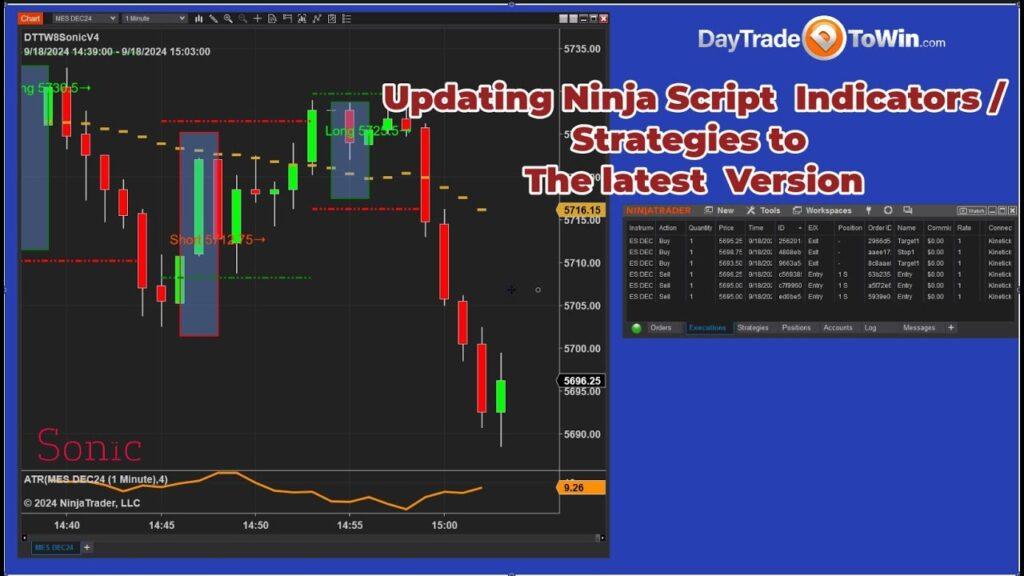
Keeping your NinjaTrader indicators and strategies up to date is crucial for efficient trading. In this guide, we’ll walk you through how to upgrade an indicator or strategy, such as the Sonic indicator, in just a few simple steps. Step 1: Remove the Old Indicator Before installing the new version, you need to remove the old one from both your charts and NinjaTrader’s system. Step 2: Import the Latest Version Now that the old version is gone, you can install the latest one. Step 3: Verify the Installation After importing the new version, double-check that everything is working correctly. Final Steps Once your licensing is confirmed and the new version is in place, you’re ready to start using the upgraded indicator or strategy. Remember, the only time you’ll need to update your Machine ID is if you’re using a different computer or if there’s been a major system update on your PC. By following these straightforward steps, you can easily upgrade any indicator or strategy in NinjaTrader. Should you run into any difficulties, reach out to support for help. Keep your tools up to date, and trade confidently with the latest versions! Happy trading!

small-cap
Market News

Small-Cap Stocks: Ready to Soar After Fed Rate Cut?

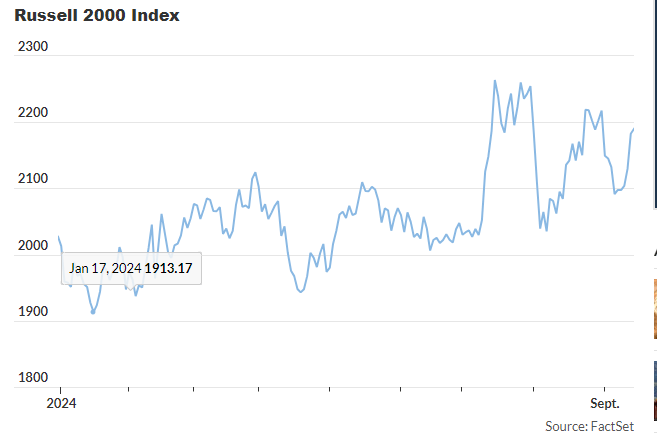
Small-cap stocks are navigating a fog of uncertainty surrounding the U.S. economy and Federal Reserve policy, analysts say. Despite a strong rally over the past month, where the Russell 2000 Index (RUT) climbed 3%, outpacing the S&P 500’s 1.4% gain, questions remain about the sustainability of this momentum. Investors are grappling with concerns over the broader economic outlook and the Fed’s upcoming decisions on interest rates. After an impressive 13% surge in July, the Russell 2000 has been on a volatile path, retreating nearly half of those gains in August. Market experts, however, suggest that the bullish momentum in small-cap stocks could persist, driven by the potential for rate cuts and hopes for a “soft landing” for the U.S. economy—where growth slows but avoids recession. Why Rate Cuts Matter for Small Caps Smaller companies often benefit more from rate cuts than larger ones due to their higher debt levels and reliance on external financing. With the Federal Reserve expected to start reducing rates, many market participants are optimistic about small caps continuing to outperform the broader market. Furthermore, small-cap valuations appear attractive. For example, the S&P SmallCap 600’s forward price-to-earnings ratio is 16.7, compared to 23.4 for the S&P 500. Analysts expect earnings for small caps to grow at a faster pace, with forecasts of a 20% rise by 2025, versus around 15% for large caps, according to FactSet. “The Fed’s rate cuts could be a key catalyst for renewed interest in small-cap stocks,” said Matt Palazzolo, senior investment analyst at Bernstein Private Wealth Management. Impact of the Size of Rate Cuts While the Fed is expected to ease monetary policy, the size of the rate cut remains uncertain. Traders are split between expecting a 25 or 50 basis point reduction. A larger cut could support small-cap stocks further, though some worry it might signal a sharper-than-expected economic slowdown, potentially impacting corporate earnings. Jordan Irving, portfolio manager at Glenmede Investment Management, highlighted that sustained earnings growth for small caps is still needed for the rally to have long-term traction. However, Palazzolo noted that the magnitude of the cut is less important for small-cap performance in the long run, advising investors not to get too caught up in the near-term debate. ‘Value Versus Growth’ in Small-Cap Stocks The recent outperformance of small caps is also seen as part of the “value versus growth” trend. Sectors like financials and real estate, which are heavily represented in small-cap indices, have been key contributors to this rally. In the past three months, the S&P SmallCap 600’s financials sector rose 21.6%, while real estate advanced 18.1%. These sectors also outperformed within the large-cap S&P 500. This trend reflects broader shifts in the market, as large-cap tech stocks have faced headwinds, while value-oriented and income-generating sectors have gained favor.

U.S. Dollar
Market News

U.S. Dollar Drops: How a Fed Rate Cut Shapes the Future

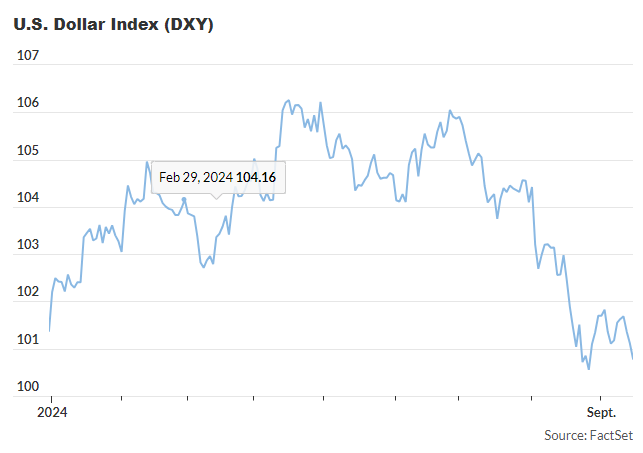
Analyst Joe Tuckey suggests that a larger rate cut from the Federal Reserve may indicate “growth concerns and economic trouble ahead.” The U.S. dollar has been sliding as markets brace for the Fed’s anticipated interest rate cut on Wednesday. The size of the cut could determine whether the dollar weakens further or presents a buying opportunity. On Monday, the ICE U.S. Dollar Index hit 100.77, its lowest level this year, down from a peak of 106.26 in April. The dollar also reached a one-year low against the yen. Market sentiment shifted significantly, with a 63% chance of a 50-basis-point cut — the largest in 16 years — up from 50% last week. This shift followed commentary from Wall Street Journal’s Greg Ip and former New York Fed President Bill Dudley. The odds of a 25-basis-point cut dropped to 37%. Tuckey, head of FX analysis at Argentex, believes a larger cut could drive the dollar to new lows, while a smaller 25-basis-point cut might lead to less volatility. He explained that “a larger cut points to concerns about growth and potential economic trouble.” The U.S. dollar performance hinges on U.S. growth prospects and interest rate trends relative to other global economies. The yen has gained strength against the dollar, with the Bank of Japan expected to raise rates again by year-end, following its exit from negative rates in March. Their next policy announcement comes two days after the Fed’s decision. Uncertainty surrounds whether the Fed will opt for a bigger cut to fend off recession risks or stick with a more measured 25-basis-point reduction. According to TD Securities strategist Mark McCormick, while initial market reaction will hinge on the Fed’s move, data in the coming months will ultimately drive the dollar’s direction. TD also anticipates a potential rebound for the dollar if the Fed takes a gradual approach to rate cuts.

Scroll to Top