Small-Cap Stocks
Market News

Why Small-Cap Stocks Are Beating the S&P 500 Now

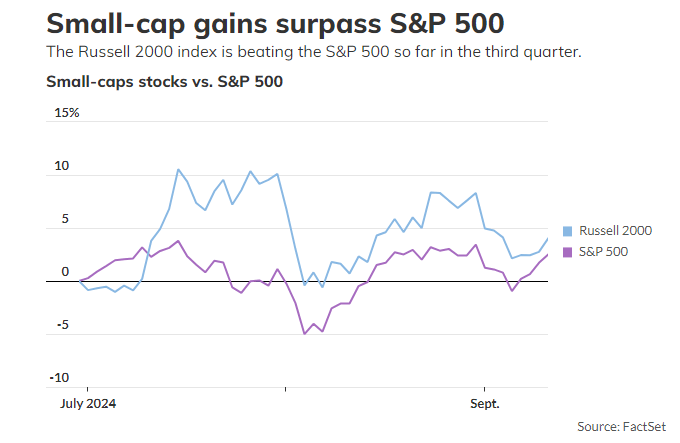
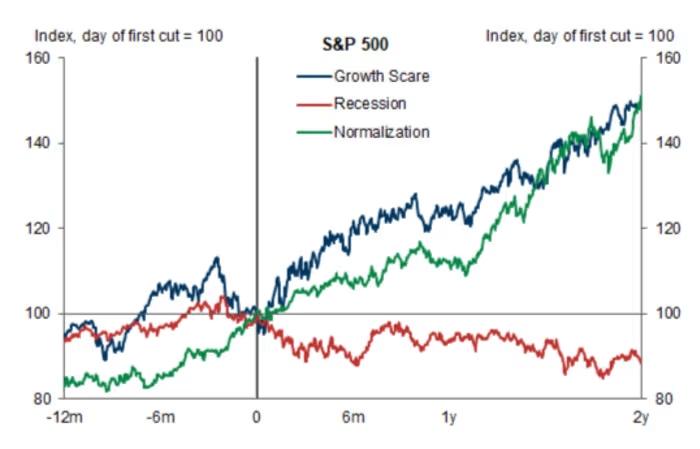
On Thursday, the Russell 2000 index, which focuses on small-cap stocks, saw a strong rise, underscoring the recent outperformance of U.S. small-caps over the S&P 500 in the third quarter. Despite experiencing steeper losses than large-cap stocks in September, small-caps have shown resilience. “Small-cap stocks got a boost when the Federal Reserve signaled a shift toward easier monetary policy,” said Liz Ann Sonders, chief investment strategist at Charles Schwab, in a Thursday phone interview. This shift became evident at the Jackson Hole Economic Symposium in late August. “Small caps tend to benefit during rate-cutting cycles,” she explained, though the effect is usually stronger when cuts are made in response to a recession. “But we’re not in a recession,” Sonders pointed out. Despite some economic slowing, “the economy is still performing relatively well,” she added. The Russell 2000 has risen 4% this quarter, even after a 4% slide in September. By comparison, the S&P 500, which tracks large-cap stocks, has gained 2.5% for the quarter, though it has outpaced small-caps over the course of the year, according to FactSet data. Investors are looking ahead to the Federal Reserve’s policy meeting next Wednesday, anticipating an announcement of rate cuts. The Fed has kept rates at elevated levels since July 2023 after aggressively hiking them to combat inflation, which peaked in 2022 and has since cooled toward the central bank’s 2% target. As of Thursday, traders in the federal funds futures market placed a 69% probability that the Fed would lower rates by a quarter percentage point, bringing them to a target range of 5% to 5.25%, based on data from the CME FedWatch Tool. Sonders cautioned that those hoping for larger cuts should “be careful what you wish for,” as deeper cuts tend to occur during recessions or financial crises. The recent rally in small-caps has lost some momentum after traders adjusted their rate-cut expectations from half a point to a quarter point, triggering profit-taking. Sonders noted that small-cap stocks generally benefit more from lower interest rates than large-cap companies. She also advised focusing on higher-quality stocks within the small-cap space. “Small-cap stocks aren’t a monolithic group,” Sonders emphasized. There is a wide range of performance across the sector, typically driven by differences in quality. “As the economy slows, investors should seek opportunities in higher-quality small-caps,” she suggested. The S&P Small Cap 600 index, which applies a profitability filter, tends to consist of higher-quality stocks than the Russell 2000, Sonders noted. She suggested using the S&P 600 as a base when screening for investment ideas. On Thursday, small-cap stocks outperformed the broader market, with both the Russell 2000 and S&P Small Cap 600 gaining 1.2%, outpacing the S&P 500’s 0.7% increase. U.S. stocks overall rose, with the Dow Jones Industrial Average climbing 0.6% and the Nasdaq Composite advancing 1%. So far in 2024, the S&P 500 has gained 17.3%, significantly outpacing the Russell 2000’s 5% year-to-date rise, even as both stumbled in September. According to FactSet, the S&P 500 is down 0.9% this month, while the Russell 2000 has fallen 4%.

nvidia
Market News

Nvidia CEO Addresses Investor Concerns: What’s Next?

Nvidia stock has rebounded, climbing 4%, but investors are still asking a crucial question: Can artificial intelligence drive enough revenue to justify the massive spending on GPUs and other AI hardware? CEO Jensen Huang has faced this question repeatedly. While he addressed it during Nvidia’s August earnings call, the market reaction was lukewarm, with shares dropping after the report. Huang revisited the issue at a Goldman Sachs event, emphasizing the strong returns from AI infrastructure investments. According to Jensen Huang, every dollar spent on Nvidia’s AI hardware yields $5 in rentals worldwide, and demand is outstripping supply. He also highlighted how AI is boosting productivity within Nvidia, with software engineers using AI tools to streamline code development, essentially working alongside “digital companions.” Huang acknowledged that GPU costs can rise for customers, but with a 20x reduction in computing time, users still see a 10x return on investment. Despite Huang’s optimism, the question remains: Can Nvidia maintain its growth trajectory through 2026 and beyond, as tools like ChatGPT and Microsoft’s Copilot continue to transform industries?

Financial Stocks
Market News

Can Financial Stocks Maintain Their Bullish Run?

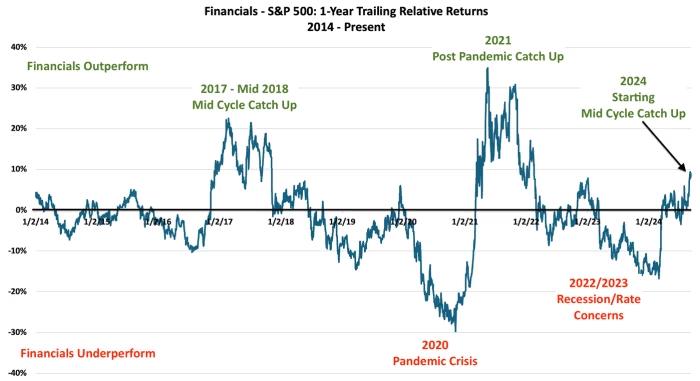
“The financial sector is much more than just banks,” says DataTrek Research. Financial stocks in the S&P 500 have outperformed the broader U.S. stock market over the past year, reflecting optimism about the economy, according to DataTrek. “Even if you’re not overweight on financials, their continued leadership reassures that equity markets are confident in further growth,” said Nicholas Colas, co-founder of DataTrek. The Financial Select Sector SPDR Fund (XLF), which tracks financial stocks in the S&P 500, surged 31.1% over the past 12 months, outpacing the S&P 500’s 22.7% rise, FactSet data shows. While the U.S. stock market has gained in 2024, investors are wary that the Federal Reserve’s tight monetary policy might trigger a recession. Despite this, Colas noted that the Atlanta Fed’s GDPNow model predicts solid economic growth in the third quarter, with a 2.5% estimate. “The financial sector extends beyond just banks, which only account for 25% of the index,” wrote Colas. It also includes growth-oriented companies like Visa, Mastercard, and S&P Global, as well as asset managers such as BlackRock, Blackstone, and KKR. Financials have continued to shine in 2024, with the Financial Select Sector SPDR Fund up 19.6%, outpacing the S&P 500’s 14.7% rise. However, Colas pointed out that while financials have outperformed by 8.4 percentage points, it’s still lower than past midcycle periods, such as 2017-18 when they led by as much as 20 points. On Tuesday, the financial sector in the S&P 500 faced a sharp drop as banks like JPMorgan, Goldman Sachs, and Citigroup saw steep losses. Investors are now looking ahead to new inflation data, set to be released Wednesday by the Bureau of Labor Statistics.

Goldman Sachs
Market News

Navigating Market Corrections: Goldman Sachs’ Guide

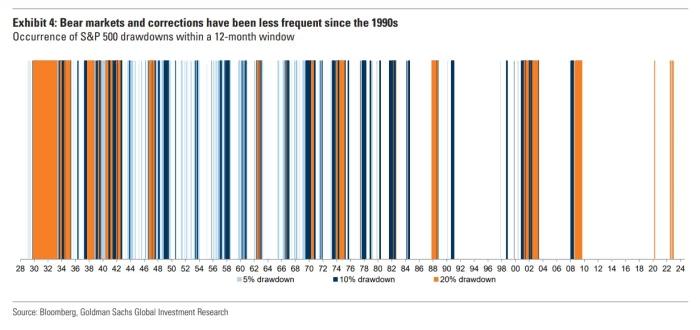
The S&P 500 had its worst week in 18 months, followed by its best day in three weeks on Monday, despite little new information. This highlights how uncertainty around interest rates and politics is likely to keep markets volatile in the coming months. Last month, 94% of global equity indexes experienced a drawdown of at least 5%, according to Goldman Sachs. Goldman Sachs strategists, led by Christian Mueller-Glissmann, now question whether the bull market will continue with strong returns or if there’s more volatility ahead and increased risk of drawdowns. Since 1928, the S&P 500 has faced 22 bear markets, with 20% declines happening roughly every four to five years. In the U.S., drawdowns of 10% to 20% occurred 15% of the time over any rolling 12-month period since 1973, with even higher frequency internationally. During these 10%-to-20% declines, the average drop was 13% and lasted about four months. However, they’ve become less frequent since the 1990s. Is buying the dip a smart move? It depends on the timeframe. Since 2010, buying corrections has generally paid off, but that wasn’t the case if you go back to the 1990s. After a market drop, lower valuations and bearish sentiment can create opportunities, but there’s always a risk of further economic and market downturns. Equity drawdowns also tend to tighten financial conditions, which can slow economic momentum further. Goldman Sachs has developed a model to predict drawdowns using various factors like economic indicators, volatility, inflation, and valuations. While the model’s accuracy is limited, with a correlation of 0.2 on a 0-to-1 scale, it shows stronger predictive power when the score rises above 30%. Right now, it’s at 20%, indicating moderate risk. In terms of portfolio strategy, the classic 60/40 split between stocks and bonds is performing well as concerns over economic growth help bonds, despite recent inflation. Goldman Sachs believes negative correlations between stocks and bonds will persist, but they suggest going beyond bonds for diversification. They recommend gold, the Japanese yen, and the Swiss franc, and favor defensive equities, especially in the U.K.’s FTSE 100.

sonic
DayTradeToWin Review

Sonic System: Strategies to Recover from Trading Losses

Today, we’re going to discuss an inevitable part of trading—losing trades—and more importantly, how to recover from them using the Sonic Trading System. Whether you’re a beginner or an experienced trader, losses are part of the process. However, how you manage these losses and recover is key to long-term success. Let’s break down a real trading scenario and learn from it. Facing a Losing Trade This morning, before the market opened, we had five successful trade signals between 9:15 and 9:35. These were winning trades based on Sonic’s signals. Yet, many traders fall into a common trap—they try to jump back into a trade they’ve missed. Don’t chase a trade after it’s gone. If you miss it, be patient and wait for the next signal. Now, here’s an example of a losing trade: I received a signal to go long at 5466, but instead of following the system’s suggested target, I aimed higher out of greed. This mistake cost me, as my target wasn’t hit, and I eventually got stopped out. The lesson here is simple—stick to the system. Deviating from the recommended target rarely ends well. The Danger of Overtrading One of the most common mistakes traders make is re-entering a trade after a loss. You may think you can make back your money by trying the same trade again, but this often leads to further losses. If you get stopped out, accept the loss and move on to the next trade without trying to force it. Recovering from a Loss Here’s where the Sonic Trading System really shines. After that initial loss, I refocused and followed the system exactly. The next trade was a winner, and by sticking to the plan, I began to recover. When recovering from a loss: This approach helped me recover after a single loss by following the system faithfully. Consistency is Key Another important point: If you’ve had a streak of 3, 4, or more winning trades in a row, consider stopping for the day. It’s tempting to keep trading, but more trades don’t necessarily mean more profits. Sometimes, the best move is to lock in your gains and return the next day. The Importance of Sticking to the Plan When you’re recovering from a losing trade, the temptation to adjust targets or stops is strong, but resist it. Stick to the system and trust the process. The Sonic Trading System is designed to avoid the kind of emotional flip-flop many traders struggle with. By sticking to the system, you can avoid unnecessary losses. Final Thoughts: Turn Losses into Lessons Losing trades are part of the journey, but how you respond is what matters. Stick to a solid strategy like the Sonic Trading System, and you’ll find that recovery is possible—even after a tough loss. It’s not about perfection; it’s about persistence and discipline. If you’re ready to elevate your trading game, consider joining the Accelerated Mentorship Program. You’ll get access to the Sonic Trading System and all of our exclusive tools designed to help you trade with confidence. Start your trading journey today! Visit daytradetowin.com for a free membership and get access to proven trading methods and software.

market
Market News

Is a Fed Misstep Behind the Market Decline?

Investors are uncertain about a potential market recession and the extent of the Fed’s forthcoming rate cuts. As September lives up to its reputation as a rough month for the stock market, concerns are rising that the Federal Reserve may have waited too long to ease monetary policy. Ivan Martchev, an investment strategist at Navellier & Associates, remarked that while the Fed has been slow to cut rates, Fed Chair Jerome Powell may avoid blame if he manages to prevent a recession. However, with weak economic data and a mixed August jobs report, the size of the next rate cut—whether 25 or 50 basis points—remains in question. The stock market reflected this uncertainty. The S&P 500 tumbled 4.3%, the Dow fell 2.9%, and the Nasdaq dropped 5.8% in their worst week since early 2023. Technology stocks took a major hit, with Nvidia leading the losses. Meanwhile, the bond market sent a potential recession signal as the yield curve shifted, raising alarm among investors. Despite this, experts like Chris Graham of Nationwide Financial and Larry Adam of Raymond James believe the Fed still has the tools to avoid a recession by adjusting rates. As the market eyes upcoming inflation data, investors hope for clearer signals on the Fed’s next move.

Scroll to Top