stocks
Market News

From Ugly Ducklings to Golden Geese: Finding Potential in Undervalued Stocks

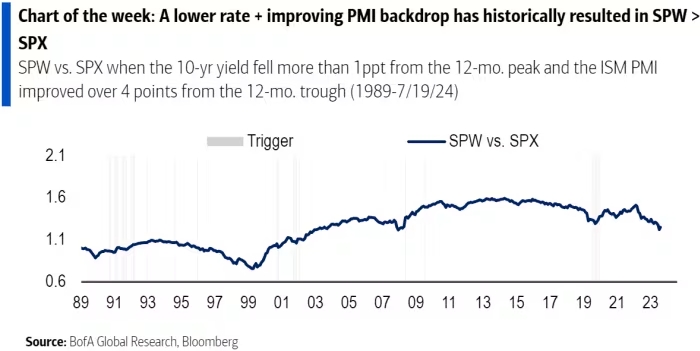
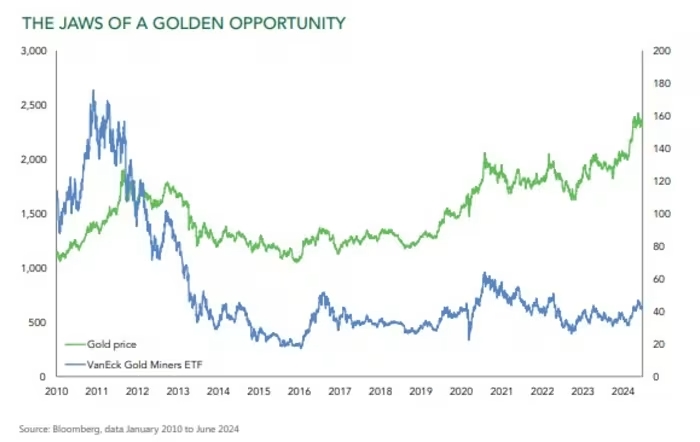
Not long ago, investors were confident in the continuation of the big-tech trade and expected former President Donald Trump to win the upcoming election. Now, the landscape has shifted. The market is rotating from tech-based momentum trades to the previously unpopular small caps. Investors who were banking on a “Trump-trade” now face the higher probability of a Democratic victory after President Joe Biden exited the race. This environment of increased volatility and uncertainty is exactly what Ruffer Investment Company has positioned its portfolio for. The London-based fund is wary of equity market valuations, especially in the U.S., and expects global inflationary pressures and growing fiscal deficits to negatively impact bond prices, driving yields higher. “The risks of a correction in equity and credit markets are high given the level of real interest rates alongside the uncertainty driven by elections, central bank policy decisions, liquidity risks, and a softening U.S. economy,” says Ruffer in its fiscal year-end review. Ruffer’s portfolio includes what it calls deeply unloved “ugly ducklings.” These assets, often overlooked by investors, have the potential to transform into valuable investments. Among the ugliest ducklings are Chinese shares, which are under-owned due to reputational risks. Ruffer finds these equities attractive because they are among the cheapest globally, despite bad news being priced in. Ruffer allocates only a quarter of its funds to stocks, with Chinese equities comprising around 4% of its portfolio. U.K. equities account for 11.2%, benefiting from low valuations and the potential for a re-rating driven by a stable new Labour government, increased pension fund stock holdings, and foreign takeover interests. Precious metals miners are also part of Ruffer’s portfolio, with 4% in gold mining equities and another 3% in silver and platinum. Ruffer sees value in this sector due to geopolitical concerns, inflation worries, and tax avoidance strategies. They believe earnings revisions in the sector could be spectacular if gold prices rise significantly. Ruffer also holds a long position in the Japanese yen, viewing its current valuation as a “historic opportunity” and expecting the yen to benefit from its haven status during market volatility. Finally, U.S. treasury inflation-protected securities (TIPS) and UK inflation-linked gilts make up 19% of Ruffer’s portfolio, reflecting the fund manager’s concerns about persistent inflation. Investors can currently secure a return of inflation plus 2% by lending to the U.S. for the next 10 years, which Ruffer considers a sensible core holding for capital preservation.

market
Market News

Despite Market Fluctuations, This Firm Boosts S&P 500 Target – Here’s Why

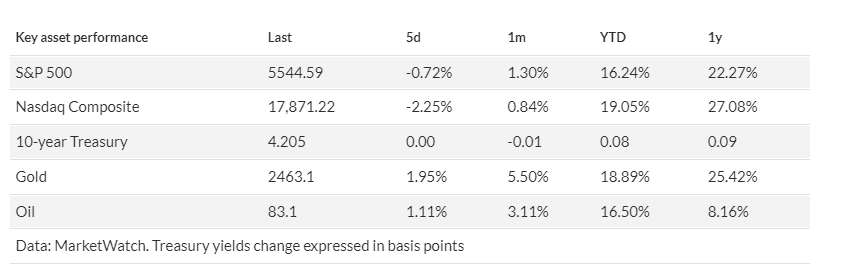
Good morning! If you’re reading this, congratulations on successfully booting up your personal computer, a feat not everyone around the globe has managed today. More on that later. Correction: Thursday’s Need to Know newsletter incorrectly reported the Nasdaq Composite’s performance. The decline on Wednesday was the sharpest since mid-December 2022. Despite recent market turbulence, the S&P 500 is only 2% away from a record high, and the Nasdaq Composite is just 4% from a new peak. Taking an optimistic stance, the UBS chief investment office has raised its S&P 500 target to 5,900 by the end of the year and 6,200 by mid-2025. Previous targets were 5,500 for December and 5,600 for June 2025. UBS cites several positive factors for U.S. equities: strong earnings growth, disinflation, the Fed’s anticipated rate cuts, and increasing investments in artificial intelligence. “While economic growth readings have cooled, we believe growth remains on solid footing. Healthy labor market dynamics should continue to support further gains in consumer spending,” said strategists led by David Lefkowitz. UBS, like many others, expects the Fed to start cutting rates in September. They note that the second-quarter earnings season has started well, though the mega-cap tech companies have yet to report. “We think trends in this segment will remain favorable with strong demand for AI infrastructure as tech companies jockey for leadership positions in the emerging AI ecosystem, and companies across the economy look to deploy AI tools into their business processes,” they say. Consequently, UBS has maintained its S&P 500 earnings per share target at $250 and raised next year’s target to $270 from $265. Addressing concerns about high valuations, UBS argues that they are reasonable given the macro environment. “Historically, when the Fed is cutting rates in the context of a soft landing, equities tend to perform well in the 12 months before and after the first Fed rate cut.” In their optimistic scenario, UBS sees the S&P 500 surging to 6,500 this year if the Fed cuts rates amid an investment and innovation boom. Their downside scenario predicts the S&P 500 could drop to 4,800 if inflation remains stubborn, higher rates weigh on growth, or geopolitical tensions escalate. Markets U.S. stock-index futures (ES00, YM00, NQ00) are inching up, with benchmark Treasury yields mixed. The dollar index is higher, oil prices (CL) have slipped, and gold (GC00) is trading around $2,417 an ounce.

roadmap
DayTradeToWin Review

Innovation in Motion: Roadmap Software Redefines Fresh Market Analysis

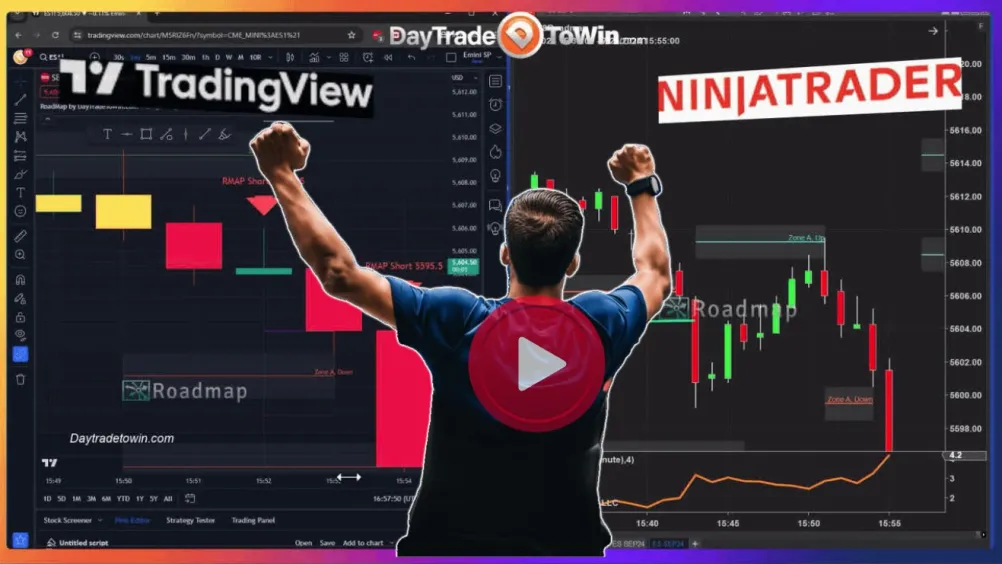
Today, we’re diving into the trading day with a fresh market analysis using the Roadmap software. The market has just opened, and I’ve already spotted a fantastic opportunity to go long. This occurred right before the market opened, so I missed the initial move. However, it’s currently 10:00 AM, which is my preferred trading time as the market typically stabilizes unless there is a significant news event. Trading Disclaimer: Before we begin, a reminder: trading is risky. Only trade with funds you can afford to lose. Initial Analysis and Trade Setup As of now, the market has surpassed a Roadmap zone, making it an ideal moment for trade number one. The opportunity to go short is clear because the market not only passed the Roadmap zone but also closed on the opposite side, indicating that the zone is not holding and the market is strong. Trade Strategy: Short Entry Here’s the reasoning behind the short trade: We have two potential scenarios when the market surpasses a zone: Trade Examples and Confirmation To illustrate, here are a few trades using the Roadmap: Trade Management and Patience It’s essential to: Example: Long Entry When the market approaches Zone B to the downside, observe for a potential reversal or continuation: Final Thoughts and Trading Room Invitation Today, within just 20 minutes of market activity, several trading opportunities emerged. Not every signal needs to be acted upon; select trades that align with your strategy and market conditions. Always be aware of market volatility, news events, and economic announcements, such as speeches from the Federal Reserve. For those interested in further learning and live trading, consider joining

Treasury Market
Market News

Treasury Market Turbulence: Are Stocks on the Brink of a Downturn?

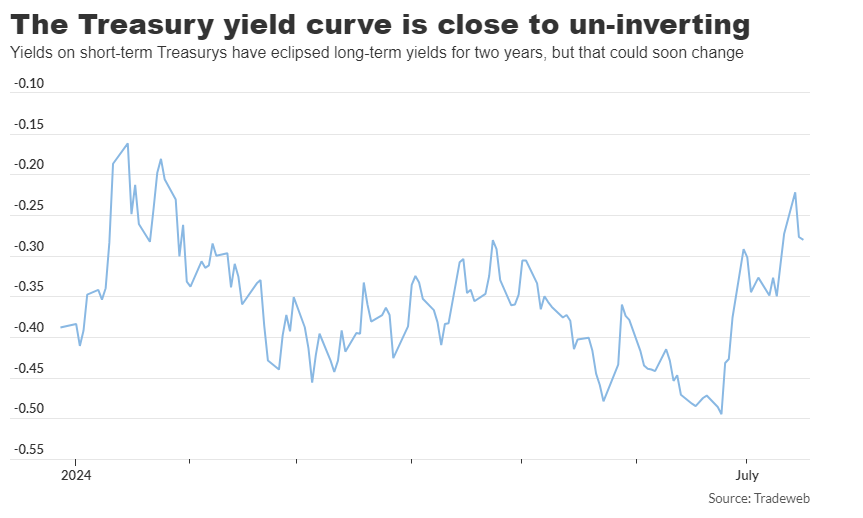
An inverted Treasury yield curve is typically seen as a harbinger of recession, although the U.S. economy has held up so far. An inverted Treasury yield curve is often viewed as a signal of an impending recession. But does the curve’s return to normalcy signal an all-clear for the market? History suggests otherwise. According to Tom Essaye, a former Merrill Lynch trader and founder of Sevens Report Research, the reversal of a yield-curve inversion has frequently signaled upcoming economic and stock market troubles. This potential shift is significant as the gap between short-term and long-term Treasury yields has narrowed recently. On Monday, the gap between the 2-year and 30-year yields briefly turned positive for the first time since January, according to Dow Jones Market Data. Additionally, the gap between the 2-year and 10-year yields reached its narrowest point in a similar timeframe. Analysts at Macquarie attribute these bond movements to the broader “Trump trade,” which encompasses higher tariffs, tax cuts, and restrictive immigration policies proposed by former President Donald Trump. They argue these measures could revive inflation and push up long-term bond yields. Since 1998, the spread between the 2-year and 10-year Treasury yields has inverted six times, including the current episode that began in July 2022. Previous inversions occurred in June 1998, February 2000, January 2006, June 2006, and August 2019. Only three of these instances, including the current one, saw the yield curve remain inverted for a significant period, with the others occurring in February 2000 and June 2006. In both cases, the un-inversion preceded stock market turbulence. When the 2s10s spread returned to positive territory on Dec. 29, 2000, the S&P 500 traded around 1,320 but then declined for 22 months, bottoming at around 785 in October 2002. Similarly, when the spread returned to positive on June 6, 2007, the S&P 500 was at 1,517, but the index fell over the next 21 months as the housing market collapse triggered the 2008 financial crisis, bottoming out in March 2009. It took four years for investors to recoup these losses. Essaye explains that when the 2s10s spread turns positive, it usually means the 2-year Treasury yield is dropping quickly as investors anticipate aggressive rate cuts. These cuts typically happen because the Federal Reserve is worried about economic growth. This is currently happening, with the market pricing in a 100% chance of rate cuts in September and December, and a growing likelihood of a third cut this year. Despite warnings of an imminent recession due to the Federal Reserve’s aggressive rate hikes, the U.S. economy has shown resilience. Recent data hints at slowing growth and a softening labor market, but a stronger-than-expected retail sales report on Tuesday offered some reassurance. Many stock-market experts doubt a recession is imminent, believing that Fed Chair Jerome Powell might achieve a soft landing by cutting rates later this year. Early Wednesday, Treasury yields were rising, with the 2-year up 4 basis points at 4.47% and the 10-year up 2 basis points at 4.18%. Bond yields move inversely to prices. Meanwhile, U.S. stocks opened mostly lower, with a sharp selloff in technology stocks. The S&P 500 was down 1% at 5,610, the Nasdaq Composite down 1.7% at 18,186, and the Dow Jones Industrial Average traded about 30 points, or 0.1%, higher at 40,989.

roadmap
DayTradeToWin Review

Roadmap: Is This the Ultimate Indicator for TradingView?

In the world of trading, finding the right indicators to guide your decisions is crucial. Among the myriad of options available, the “Roadmap” indicator from Day Trade to Win stands out as a game-changer for many traders. This blog post will delve into why this indicator might be one of the best on TradingView. What is the Roadmap Indicator? The Roadmap indicator is designed to highlight critical price zones on your TradingView charts. These zones, known as Roadmap Zones, help traders anticipate whether the price will break through or bounce off, providing valuable signals for making trades. Risk Disclaimer: Trading involves significant risks. Only trade with funds you can afford to lose. Key Features of the Roadmap Indicator Practical Application of the Roadmap Consider a scenario where the market hits a zone but doesn’t break through. Instead, it moves sideways, indicating that the support is holding. This could be a signal to go long. Conversely, if the price breaks through the zone, it might be a signal to go short. The “Zone A Up” Feature The Roadmap also includes a feature called “Zone A Up.” If the market reaches this zone and then reverses, it indicates a potential short trade. If it breaks through, it suggests a long trade. Filtering Trades A standout feature of the Roadmap is its ability to filter out false signals, ensuring that you only act on high-probability opportunities. This filtering helps in both trend and counter-trend trading, providing entries in the direction of strong trends and opportunities for counter-trend trades when reversals occur. Tips for Using the Roadmap Conclusion The Roadmap indicator on TradingView is a powerful tool that brings clarity to trading. By identifying key price zones and offering clear signals, it helps traders make informed decisions, potentially leading to better trading outcomes. If you’re seeking an effective indicator to enhance your trading strategy, the Roadmap is worth considering. For more information and to sign up for a free member account, visit Day Trade to Win. Join their live trading room to see the Roadmap in action and learn from experienced traders. Happy trading!

U.S. Stocks
Market News

Calm Before the Storm? What the Calm in U.S. Stocks Means for Your Portfolio

U.S. stocks are experiencing an unusually tranquil stretch poised to hit a new milestone on Wednesday as the rally expands beyond a few megacap names. If the S&P 500 avoids a significant selloff, it will mark 352 consecutive sessions without a 2% decline, the longest streak since February 2007. ETF and technical strategist Todd Sohn from Strategas explained to MarketWatch that while many investors brace for a pullback, historical data shows that periods of market calm can last much longer than expected. Over the past 50 years, there have been four instances where the S&P 500 went even longer without a 2% drop, with the longest being a 1,044-day stretch ending in October 1979. Sohn emphasized that excessive worrying about potential threats can lead to missed opportunities. Staying on the sidelines often results in greater losses than the selloffs themselves. “In and of itself, it isn’t really something to worry about,” he said, advising investors to remain focused on their long-term investment strategies. Despite recent risks, the rally has shown remarkable resilience. Paul Hickey, an analyst at Bespoke Investment Group, noted that even significant events, like a near-assassination of a leading U.S. presidential candidate and unexpected inflation data, haven’t derailed the market’s upward trajectory. The S&P 500 continues to reach new highs, even without contributions from key stocks like Nvidia. Hickey also pointed out the low volatility, with the Cboe Volatility Index (VIX) near its lowest levels since before the COVID-19 pandemic. A low VIX indicates a solid rally but also hints at potential investor complacency, especially as stocks enter their historically weakest three-month period from mid-July to mid-October. While the S&P 500 hasn’t seen a 2% drop in a single day recently, there have been pullbacks, including a 10% correction ending in late October and a 5% drop in April. As fall approaches, the market faces risks from U.S. politics, a cooling economy, and potentially disappointing corporate earnings. Wall Street experts, including those from Citigroup and Goldman Sachs, warn that the market might be due for a selloff due to rapid gains and high valuations. However, a recent rally in lagging market segments like the Russell 2000 is sparking optimism for a rotation toward value stocks and cyclical sectors, potentially driving the next phase of the rally. The key question is whether this rotation will negatively impact the megacap stocks responsible for most of this year’s gains. Mike Dickson, head of research and product development at Horizon Investments, believes the market can continue rising even if tech stagnates, but not if it collapses. Both the S&P 500 and Dow Jones Industrial Average reached record highs on Tuesday, with the Nasdaq Composite achieving its second-highest close in history.

Scroll to Top