inflation
Market News

Inflation and Trump 2.0: Wall Street’s Mixed Signals

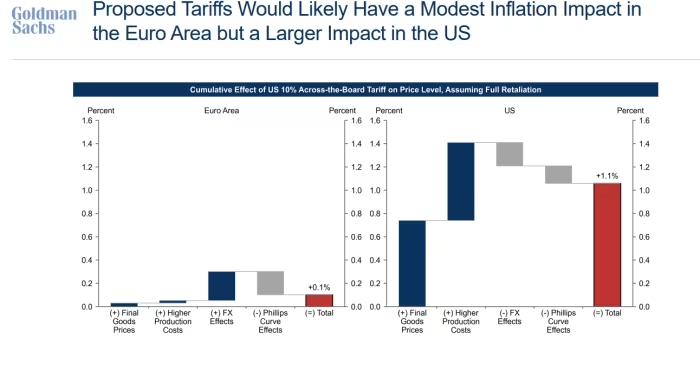
The upcoming election could fundamentally change the inflation outlook for the next three to four years, according to an inflation trader. While many investors and traders are optimistic about cooling U.S. inflation ahead of Thursday’s consumer-price index for June, Wall Street is concerned about the potential inflationary impacts of a second Trump presidency. Before the CPI report, there are conflicting views on the future of U.S. inflation, complicating the Federal Reserve’s analysis of the appropriate path for interest rates, which remain at 23-year highs of 5.25% to 5.5%. Major U.S. stock indexes closed mostly higher on Tuesday, sending the S&P 500 and Nasdaq Composite to record closes despite a selloff in U.S. government debt that pushed up 10- and 30-year Treasury yields for the first time in five sessions. One perspective is that inflation will likely continue easing as U.S. growth slows, allowing the Federal Reserve to cut interest rates as soon as September. Economists expect the annual headline CPI inflation rate to fall to 3.1% in June from 3.3% in May, with inflation traders predicting a drop to 2% by May 2025. Another perspective suggests that inflation could rise again if Trump is re-elected due to his trade and immigration proposals. Parts of the market have expressed concern about Trump 2.0, as seen in a two-day rise in Treasury yields on June 28 and July 1, despite four months remaining before Americans vote. “For good reasons, traders link Trump’s policy agenda with inflation,” said Thierry Wizman, a global FX and rates strategist at Macquarie. “They see policy rates being higher than otherwise under Trump 2.0.” Trump leads President Joe Biden in polls nearly two weeks after their June 27 debate, drawing attention to his proposals for 10% duties on all imports and minimum 60% tariffs on Chinese goods. Biden has also faced criticism for the U.S. inflation run-up that began in 2021, following his Covid-relief plan that added $1.9 trillion in federal spending. Goldman Sachs’ chief economist Jan Hatzius recently stated that Trump’s 10% tariff proposal could trigger reciprocal actions by other countries, potentially raising U.S. inflation by 1.1 percentage points and leading to five extra quarter-point rate hikes by the Fed. Additionally, Deutsche Bank strategist Steven Zeng highlighted the impact of Trump’s immigration policies on U.S. interest rates. He noted that increased immigration flows have acted as a positive supply shock, aiding the Fed in cutting rates, and that reversing these flows could lead to higher wage inflation and a more hawkish Fed stance. After Fed Chairman Jerome Powell’s congressional testimony on Tuesday, fed-funds futures traders priced in a 70% chance of a quarter-point rate cut by September. However, inflation trader Gang Hu of WinShore Capital Partners in New York doubts any rate cuts will occur in 2024. He emphasized that the outcome of the November 5 presidential election could drastically change everything, necessitating careful consideration by the Fed. “Right now, it’s all about Trump. That’s the major theme and the Fed cannot ignore the possible election results at all,” Hu said. “It’s about an election that can fundamentally change the inflation picture for the next three to four years, and parts of the market are already worrying about that picture.” The Fed’s role in controlling inflation means policymakers will likely consider Trump’s tariff proposals and immigration reforms, given their potential impact on the labor market and inflation. On Tuesday, Powell avoided discussing Trump’s tariff plans directly and instead highlighted the persistent nature of inflation after the 1970s and the current era’s supply and demand shocks from the post-Covid reopening of the U.S. economy. “The Fed is absolutely not going to go anywhere near Trump’s policies by talking about them,” said economist Derek Tang of Monetary Policy Analytics. He suggested that the Fed will use uncertain forecasts as a reason to avoid addressing Trump-related risks ahead of the November election. Tang predicted that the Fed might start easing rates by September or December but could reverse course if needed, potentially confusing investors.

inflation
Market News

Inflation Report: Impact on Stocks This Week

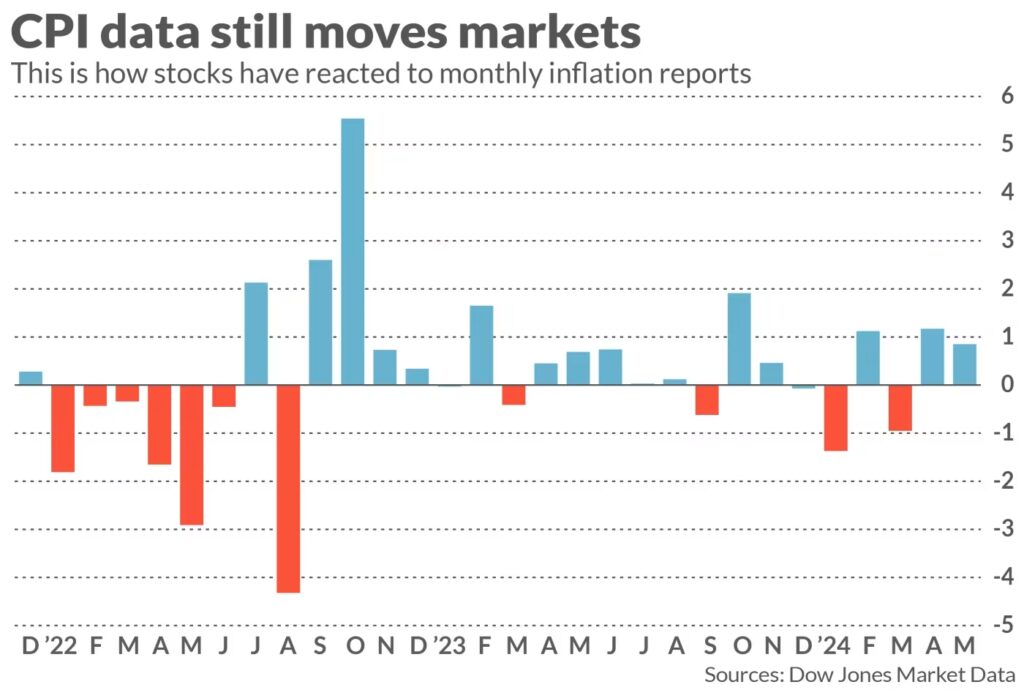
A softer-than-expected inflation report could pressure the Federal Reserve to signal an interest rate cut is likely in September, or even open the door to one later this month. Thursday’s inflation report is anticipated to be a key event for U.S. markets in a busy week that also includes the start of the second-quarter corporate earnings season, several Treasury debt auctions, and potential developments in the presidential election race. The June consumer price index (CPI) numbers could have significant market implications, with investors particularly focused on this month’s data as it may influence the timing of the Federal Reserve’s first interest-rate cut. A smaller-than-expected rise in inflation could encourage Fed Chair Jerome Powell to prepare the market for a rate cut at the Fed’s September meeting. Some analysts believe that a sufficiently weak number could even prompt a rate cut within weeks, despite futures-market traders viewing this as unlikely, according to CME Group data. Conversely, a higher-than-expected reading, deemed unlikely by most economists, could halt the stock-market rally. Tom Lee of Fundstrat and Neil Dutta of Renaissance Macro warned that Wall Street might be underestimating the possibility of a cut at the Fed’s July meeting. Lee suggested that another soft inflation reading could make a July cut possible, while Dutta noted that the chances of a July cut have been underpriced, arguing that the Fed should cut rates soon to avoid a more severe economic downturn. If Thursday’s CPI data undershoot expectations, stocks are likely to rally alongside bonds as Treasury yields continue their recent decline. CPI data releases have typically caused notable stock market reactions since the Fed started raising rates in early 2022. This year, stocks have seen an average move of 0.9% on CPI days, nearly twice the S&P 500’s daily average move of 0.5%. Any indication that the Fed might cut rates could boost lagging sectors of the market, such as small caps and interest-rate-sensitive stocks like those in the real-estate sector. Real estate has been the worst-performing S&P 500 sector over the past year, while the small-cap Russell 2000 index has moved slightly lower since the start of 2024. Joseph Gaffoglio, president of Mutual of America Capital Management, suggested that a Fed rate cut could broaden market gains, although he doesn’t expect a cut soon and sees one cut later this year as more likely. Economists polled by The Wall Street Journal expect headline inflation to slow to 3.1% year-over-year in June from 3.3% in May, with core inflation expected to remain steady at 3.4%. Friday’s jobs data added weight to Dutta’s argument for a sooner rate cut, showing the labor market cooling with the unemployment rate at its highest since late 2021 and slower wage growth. Despite over 200,000 new jobs, revisions to prior months’ numbers brought the three-month average down. Recent data indicate the economy is buckling under the highest interest rates in over 20 years. GDP growth in the first quarter was 1.4%, with the Atlanta Fed estimating 1.5% for the second quarter, down from 3.4% in the fourth quarter. Powell acknowledged that earlier inflationary fears had passed and the U.S. economy is back on a disinflation path, but stated inflation may not reach the Fed’s 2% target until late 2025 or 2026. The Fed remains divided on how much more evidence of slowing inflation is needed, and whether a soft June report will be enough is yet to be seen. Stocks rose on Friday as traders bet that the latest data would make a September Fed rate cut more likely. The S&P 500 gained 30.17 points, or 0.5%, to finish at 5,567.19, the Nasdaq Composite rose by 164.46 points, or 0.9%, to 18,352.76, and the Dow Jones Industrial Average gained 67.87 points, or 0.2%, to 39,375.87.

stock market
Market News

What Biden’s Departure Could Mean for Stock Market Stability

With President Joe Biden’s re-election campaign appearing to hang by a thread after last week’s debate debacle, investors understandably may wonder whether a change at the top of the Democratic ticket would move the stock market. To understand this, it’s useful to examine how the market has reacted to swings in the race between Biden and his Republican challenger, former President Donald Trump. “The market has been consistently trending in the same direction as President Trump’s odds of victory in November,” said Adam Turnquist, chief technical strategist at LPL Financial, in a phone interview. Turnquist first noted a change in this relationship in March, when the market and Trump’s prospects began to move in tandem. However, Turnquist cautioned that this doesn’t mean market participants are necessarily endorsing Trump’s policies. “I don’t think you can make the case that the market is moving higher because Trump’s odds are moving higher,” Turnquist said. “But we know the market doesn’t like uncertainty.” As Trump’s chances of winning have seemed more assured, the market has taken comfort in that certainty. Turnquist noted that earlier in 2024, when Biden was favored to win, the market had also shown a positive correlation with the president’s re-election chances. In essence, the market seems to react positively to the prospects of a decisive victory by either candidate. Uncertainty around the Democratic ticket, meanwhile, could further boost certainty around a Trump victory or even a Republican congressional sweep. Speculation about Biden’s candidacy has intensified since the June 27 debate, where his performance was widely criticized. Democratic politicians have expressed concerns about Biden’s condition and viability. White House Press Secretary Karine Jean-Pierre stated Wednesday that Biden was “absolutely not” withdrawing from the race. Vice President Kamala Harris on Wednesday moved ahead of Biden in some betting markets regarding who will be the Democratic presidential nominee. Meanwhile, Trump’s odds of victory were pegged at 59% on PredictIt as of Wednesday, while Biden’s fell to around 16%. Post-debate polls have shown some shift towards Trump, though the race remains close. A Suffolk University/USA Today poll published Tuesday showed Trump ahead of Biden by 3 percentage points in a six-candidate field, after previously finding the candidates tied a month ago. Turnquist shared a chart showing the rolling three-month correlation between Trump’s prospects, based on PredictIt’s prediction market, and the S&P 500, now standing at 0.31. While not particularly high (a correlation of 1.0 would mean they move in lockstep, while -1.0 would mean they move perfectly in opposite directions), the correlation is stronger than other factors. For instance, the correlation between moves in the 10-year Treasury yield and the S&P 500 index is roughly zero, indicating little current influence on each other. Jeff deGraaf, founder of Renaissance Macro Research, recently noted that the negative correlation between Biden’s standing in the polls, based on the RealClearPolitics polling average, and the S&P 500’s performance, while not statistically significant, explains stock-market performance this year better than other factors like oil prices, Treasury yields, Federal Reserve policy, corporate bond spreads, purchasing managers’ index readings, inflation data, and gross domestic product. Some investors and strategists argue that prospects of a Trump victory — which could bring a full extension of his 2017 tax-cut package and further deregulation — have been market positives. In a Monday note, equity strategists at Morgan Stanley led by Mike Wilson said that after last week’s debate, clients were showing interest in small-capitalization and cyclical stocks that benefited following Trump’s 2016 election victory. However, they warned investors to note important differences between now and then. “First, we think the data indicates that the cycle is more mature today, which supports a quality and large-cap bias,” they wrote. “Further, the market welcomed a reflationary/pro-fiscal playbook in 2016 as the economy was recovering from the manufacturing/commodity downturn of 2015, and inflation was broadly not a headwind for consumers.” While neither Biden nor Trump are expected to significantly rein in fiscal deficits, prospects for a broader extension of tax cuts and other measures were cited as reasons for a sharp rise in Treasury yields following the debate. An important thing for investors to keep in mind is that election years tend to see increased volatility as November approaches, Turnquist said. Another key point to watch is how the stock market performs in the three months leading up to Election Day on Nov. 5. Over the last 100 years, the market’s performance during that period has predicted 20 of 24 election outcomes, Turnquist noted — with the incumbent tending to win when the market rose, and losing when it fell.

JPMorgan
Market News

Legacy of JPMorgan’s Departing Bearish Strategist

Wall Street’s biggest bear, Chief Market Strategist Marko Kolanovic, is leaving JPMorgan Chase & Co. after 19 years. According to internal memos, Kolanovic is departing to pursue new opportunities, as first reported by Bloomberg News. Kolanovic’s exit comes after a challenging two-year period of market calls where he stayed bullish as stocks plummeted in 2022 and turned bearish just as the market began recovering in late 2023. Claudia Jury and Scott Hamilton, global co-heads of sales and research at JPMorgan, announced that Hussein Malik, previously co-head of global research with Kolanovic, will now lead the global research team solo. Dubravko Lakos-Bujas will take over as the new chief market strategist, overseeing the markets strategy group, while Steve Dulake and Nick Rosato will co-lead the newly unified credit and equity research team. Despite Kolanovic’s year-end S&P 500 target of 4,200 for 2024, which was the lowest among major Wall Street banks, many of his peers have raised their targets in response to the index’s rise. Kolanovic’s successor, Lakos-Bujas, has favored large-cap growth stocks but warned of the market’s increasing dependence on these megacap names. Kolanovic’s bearish outlook was based on concerns about a potential U.S. recession due to high interest rates and what he viewed as overly optimistic earnings expectations for U.S. stocks, particularly in the tech sector. He recommended defensive stocks and increasing exposure to commodities like gold. JPMorgan has not commented on whether Kolanovic’s bearish stance influenced his departure. His exit reduces the number of bearish voices among professional investors, though some like Peter Berezin of BCA Research and Barry Bannister of Stifel remain cautious about the market’s future.

S&P 500
Market News

Will Earnings Season Stall the S&P 500 Pullback? LPL Insights

On Tuesday, the S&P 500 closed at a record high, boosted by anticipation of a strong upcoming earnings season. LPL Financial expects this season to be “solid,” but increasing growth estimates for the latter half of 2024 might be challenging. Jeff Buchbinder, chief equity strategist at LPL Financial, remarked that there likely won’t be any setbacks in the AI sector during the second quarter results. He suggested that positive earnings news could delay the long-expected pullback in the S&P 500. Buchbinder’s research notes that Big Tech will be a significant contributor to the S&P 500’s earnings growth for Q2, with other sectors like healthcare, financials, energy, and utilities also playing important roles. The earnings season will start with major Wall Street banks, including JPMorgan Chase, Citigroup, and Wells Fargo, reporting their results on July 12. Analysts expect a 9.2% year-over-year increase in S&P 500 earnings per share (EPS) growth for Q2, and Buchbinder forecasts this growth to reach double digits for the first time since Q4 2021. After a 14.5% rally in the first half of 2024, the S&P 500 is continuing its upward trend in July. Buchbinder stressed that earnings growth is key to sustaining or building on these gains. While he believes a pullback is overdue, he advised investors to be patient as the next six weeks of earnings may not present a buying opportunity. Buchbinder highlighted the “Super Six” — Alphabet, Amazon, Meta, Microsoft, Nvidia, and Apple — as key drivers of the S&P 500’s Q2 earnings growth. He expects the broadening of earnings growth to extend into 2025, with Big Tech remaining influential this year. He also pointed out the importance of company guidance during earnings season to gauge potential earnings growth for the latter half of 2024. Given the steady economy and continued AI investments, executives are unlikely to significantly lower their outlooks. On Tuesday, the Dow Jones Industrial Average rose by 0.4%, the S&P 500 by 0.6%, and the Nasdaq Composite by 0.8%. The S&P 500 closed at a record 5,509.01, according to Dow Jones Market Data. Buchbinder anticipates that a market dip might not occur until August, after earnings news has been fully reflected in stock prices.

roadmap
DayTradeToWin Review

Mastering the E-mini S&P 500 (ES) Market Open: Strategies for Success

Navigating the E-mini S&P 500 (ES) market open can be both exhilarating and challenging. For traders looking to capitalize on early market movements, understanding how to effectively use breakout and counter-trend strategies is essential. In this blog post, we’ll delve into two real-world examples using the Roadmap software, demonstrating how to trade with the trend and against it. Breakout Trading: Riding the Trend When the market exhibits strong momentum, riding the trend can be highly profitable. Here’s a scenario that showcases this strategy: Example: Long Trade in a Strong Market In this scenario, the key is to stay in the trade as long as the trend remains strong. The software’s zones act as reliable indicators, helping traders make informed decisions. Counter-Trend Trading: Capturing Reversals Not all market scenarios will display a clear trend. Sometimes, the market encounters resistance and reverses. Knowing how to handle these situations can be equally rewarding. Example: Short Trade in a Reversing Market In this case, the market’s failure to break through the zone signals a potential reversal. By entering a counter-trend trade, you can take advantage of the market’s bounce and position yourself for a profitable move. Key Considerations for Successful Trading Conclusion Mastering the E-mini S&P 500 market open requires a combination of breakout and counter-trend strategies. By leveraging tools like the Roadmap software, you can confidently navigate various market conditions. Whether you’re riding a strong trend or seizing a reversal opportunity, understanding these strategies will enhance your trading skills. Join our live trading room and take advantage of our current promotions at daytradetowin.com. Learn from experienced traders, refine your strategies, and elevate your trading game. Happy trading! For more insights and to stay updated with the latest trading strategies, subscribe to the Day Trade to Win YouTube channel. Don’t miss out on our special deals on software packages, including the Roadmap, Atlas Line, Trade Scalper, and Autopilot. Visit daytradetowin.com today!

Scroll to Top