inflation
Market News

New Study: Demand Behind Post-Pandemic Inflation

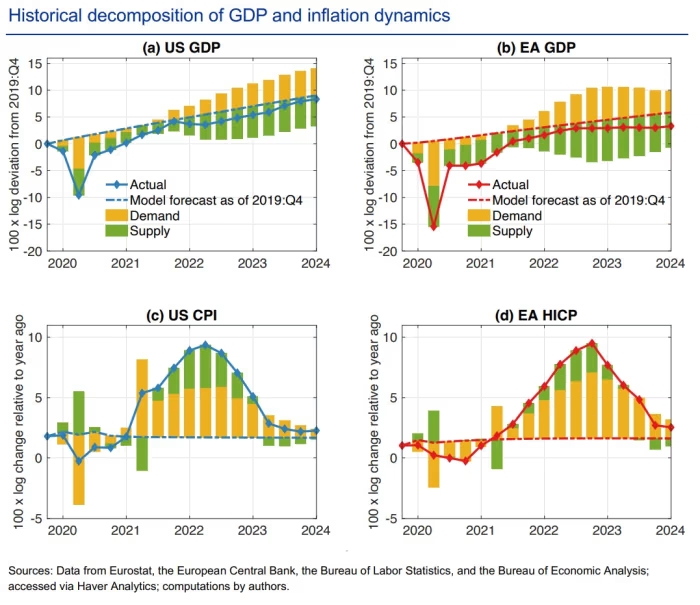
A new research paper asserts that demand, rather than supply, was the primary driver of post-pandemic inflation in both the U.S. and Europe. At the European Central Bank’s annual gathering in Sintra, Portugal, economists Domenico Giannone from the International Monetary Fund and Giorgio Primiceri from Northwestern University challenged the widely held belief that supply-chain disruptions were the main cause of inflation. “This popular narrative is difficult to square with all the evidence,” they stated in their presentation, held at the same conference where Federal Reserve Chair Jerome Powell is scheduled to speak. According to the economists, both the U.S. Federal Reserve and the European Central Bank are effective at targeting inflation, leading to a flat aggregate demand curve. They argued that for inflation to rise, the demand curve must shift upwards due to demand shocks or deviations from previous monetary policy. Their research indicated that in the U.S., more than half of the rise and fall in inflation could be attributed to demand disturbances. In Europe, while supply factors had a significant impact on GDP, demand shocks played a larger role in inflation. The researchers emphasized that their findings held true across various models and measures, including energy prices and monetary variables. They also referenced a separate study by former Fed Chairman Ben Bernanke and former International Monetary Fund chief economist Olivier Blanchard, which highlighted the impact of food and energy prices on inflation. Giannone and Primiceri noted that their conclusions were not contradictory, as energy prices are driven by fluctuations in aggregate demand. The study simulated the potential impact of stricter ECB policies. If the ECB had neutralized all demand shocks, inflation would have peaked at 3%, but GDP would have suffered a cumulative loss of 4%. Raising interest rates earlier would have resulted in a 6% inflation peak with a 1% output loss. The researchers did not conduct a similar analysis for U.S. monetary policy. Currently, their model predicts an “easy last kilometer” in reducing inflation. They found that the ECB has not experienced significant damage or loss of credibility from its pandemic policies, with public perception returning to pre-Covid norms. Recent data from Eurostat showed annual inflation easing to 2.5% in June from 2.6% in May, meeting economist estimates. The ECB made its first interest rate cut of the cycle in June.

S&P 500
Market News

Warning: What Last Week’s Stock Fluctuations Mean

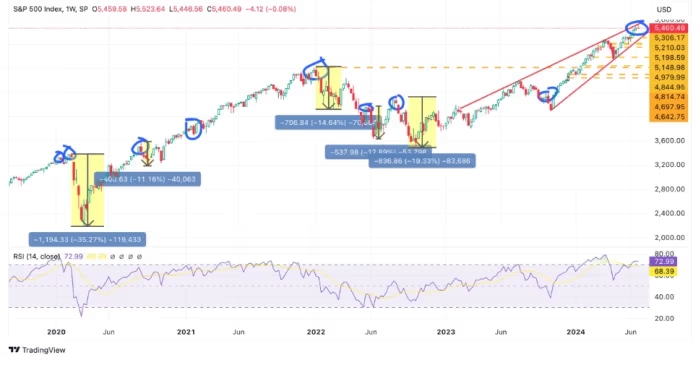
After a strong 14.5% rise in the first half of the year, S&P 500 futures indicate a challenging start for the second half of 2024, according to Michael Kramer, founder of Mott Capital Management. Kramer notes that the cautious start to July follows a concerning end to June, making stocks vulnerable to a pullback. Last Friday, the S&P 500 fell 0.4% after hitting a record intraday high, resulting in a bearish engulfing candle—a negative technical signal. A bearish engulfing candle occurs when a trading session’s range surpasses the previous session’s range but closes lower. This was the second such candle in a week, forming a “2b top reversal pattern.” This pattern suggests that an index or stock attempts a new high, fails to maintain it, and then closes below the previous high. Kramer highlights that last week’s high exceeded the previous week’s but ended lower over the five-session period. Since January 2020, this pattern has appeared only eight times, and in seven instances, the S&P 500 fell the following week. The only exception was in January 2021. For the ‘2b top’ pattern to be invalidated, the S&P 500 must close above 5,487.02 this week, according to Kramer. Other indicators also support Kramer’s caution. The CBOE 1-month implied correlation index, an options-based tool measuring market breadth, hit a record low of 5.59%, below the previous low of 6.78% in October 2017. Additionally, Kramer is wary of the VanEck Semiconductor ETF, which is holding at a 20-day moving average of around $255. A break below this level would signal a downward move. Kramer also notes that high-yield credit spreads, a measure of risk in corporate borrowing, are trending higher even as stock prices rise. Similar conditions in January 2020 and fall 2021 preceded significant market pullbacks. Addressing skepticism, Kramer acknowledges that some may find it hard to believe the S&P 500 could drop significantly. However, he argues that caution is warranted given the market’s rapid rise since October 2023, despite high overnight rates and Federal Reserve policies. “Being cautious isn’t about being bearish. It’s about assessing the odds and managing risk,” Kramer concludes.

bond
Market News

Deficit Watch: Bond Markets and Trump vs. Biden

A strategist warns that a lack of budget restraint from either Biden or Trump could result in more frequent weak Treasury auctions. A significant takeaway from Thursday night’s debate between President Joe Biden and Republican challenger Donald Trump is that the U.S. is unlikely to see fiscal restraint regardless of who wins the November 5th election. Both candidates are likely to extend parts or all of the 2017 Trump tax cuts, which include provisions for households set to expire at the end of 2025. Biden plans to extend these for individuals making under $400,000, while Trump aims for a full extension. However, the ability of either candidate to implement these policies will depend on their control of Congress. The Congressional Budget Office estimates that extending the Trump tax cuts for the next decade would add about $4.6 trillion to the deficit, which currently stands at around $1.2 trillion with two-thirds of the fiscal year completed. On Friday, U.S. government debt sold off, pushing yields on 10-year notes and 30-year bonds to their highest closing levels in over two weeks. “There’s a slim chance of fiscal restraint as both candidates aim to renew parts of the Tax Cuts and Jobs Act,” said Will Compernolle, a macro strategist at FHN Financial in New York. “I’m unsure where the political will to narrow the deficit will come from,” he added, noting that even a divided government that causes gridlock tends to maintain the status quo, which is a widening deficit. A lack of fiscal restraint usually leads to more issuance of U.S. government debt, raising concerns about the $27 trillion Treasury market and the potential for waning investor appetite leading to broader disruptions. Compernolle suggests, “We might see more frequent weak auctions, indicating low demand for higher supply. However, this will likely happen incrementally rather than as major disruptions.” Treasury auctions are a primary method for traders and investors to express their views on the growing government debt. Parts of Wall Street have been unsettled by the possibility that investors’ appetite for this debt might be limited. For instance, a poorly received 30-year auction in November briefly sent the corresponding Treasury yield up significantly and marked a period where weak demand at debt sales negatively impacted stocks. Similar shaky auction results were observed last month. BMO Capital Markets strategists Ian Lyngen and Vail Hartman point out two main risks for the Treasury market. One is a resurgence of inflation, pushing interest-rate expectations into 2025. The other risk is a sweep by either party in the election, allowing greater deficit spending without fiscal checks. “A split control between the White House and Congress would limit further deficit growth, although it could bring the debt ceiling debate back into focus,” Lyngen and Hartman wrote in a note this week. Earlier this month, the Congressional Budget Office updated its projections, expecting the federal budget deficit to reach $1.9 trillion in fiscal 2024, or $2 trillion with certain adjustments, and federal debt held by the public to reach 122% of GDP by 2034.

roadmap
DayTradeToWin Review

Unlocking the Power of Roadmap Trading Software

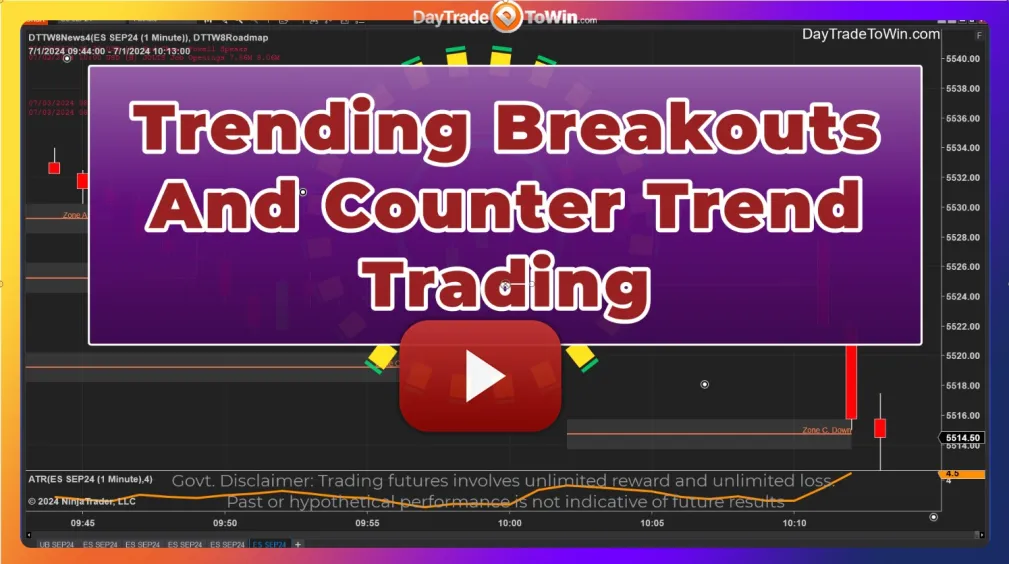
Hello Traders! It’s Friday, and like many of you, I’m eager to finish the week early. Today, I want to show you the incredible potential of the Roadmap proprietary software from Day Trade to Win in just four minutes. Before we begin, remember: trading carries risks. Never trade with money you cannot afford to lose. A Closer Look at Roadmap Trading Software On my screen, you can see the Roadmap Trading Software, available for both TradingView and NinjaTrader. Right now, there’s a strong opportunity to sell. The market is trending lower and has broken through the Roadmap zone, signaling a prime short trade. Identifying the Sell Signal Earlier, the market touched the edge of the Roadmap, hinting at a possible reversal or counter-trend trade. If you were quick, you could have gone long as the market rebounded to the Roadmap zone. However, the current situation shows the market moving lower, presenting a strong sell signal. At 10:55, the market broke the zone, indicating a short trade. How to Execute the Trade Here’s the step-by-step process: Setting Targets and Stops To set my target, I look at the ATR (Average True Range), which is 2.74. My stop loss is set similarly. I also use a time element—this trade should resolve (either hit the stop or profit target) within 10-15 minutes. I don’t want to hold this trade longer. Monitoring and Adjusting As the trade progresses, I watch for additional short signals. If another appears, I might hold the position longer. However, any long signals would prompt me to reconsider. Combining methods like the Blueprint, Atlas Line, or Trade Scalper helps us achieve the best results. Successful Trade Execution The target was hit, and I’ve marked the entry and exit points on the chart to show you this live opportunity. This isn’t a market replay—this is happening in real-time. The market breaking the zone again presents another sell opportunity. If you’re using the Roadmap, you’ll see the same potential. Wrap-Up Friday is a great day for quick trades—get in, get out, and enjoy your weekend. Today, I wrapped up by noon EST, after just two and a half hours of trading. Join us daily in the live trading room to master price action trading. Don’t miss out on these opportunities. Visit Day Trade to Win to learn more about our software, available for NinjaTrader and TradingView. Happy trading, and enjoy your weekend! Maximize your trading success with the Roadmap Trading Software and revolutionize your approach to the markets. Join our community and trade with confidence!

market
Market News

Debate Fallout: Markets Eye New Contender

Market Response Post-Debate Markets reacted swiftly to Thursday’s debate, anticipating a higher chance of former President Donald Trump defeating President Joe Biden. Stock-index futures and the U.S. dollar rose as Vice President Kamala Harris acknowledged Biden’s “slow start.” Scaramucci’s Shift in Perspective Anthony Scaramucci, managing partner of SkyBridge and former Trump spokesperson, now believes it would take something “seismic” for Trump not to win, reversing his previous expectation of a Biden re-election. Potential for a New Democratic Nominee New York Times columnist Ezra Klein suggested Democrats might consider a new nominee at the August convention, citing historical precedents like Lincoln and Roosevelt. Betting Market Movements On PredictIt, Trump’s contract rose from 53 to 61 cents, while Biden’s dropped from 48 to 31 cents. Other Democrats, such as California Gov. Gavin Newsom, saw gains. Despite this, Newsom affirmed his support for Biden. Possible Democratic Candidates Trending names included Pennsylvania Gov. Josh Shapiro, Michigan Gov. Gretchen Whitmer, former First Lady Michelle Obama, Commerce Sec. Gina Raimondo, Kentucky Gov. Andy Beshear, and Vice President Harris. Nate Silver’s Analysis Polling expert Nate Silver expressed a preference for Harris or Newsom over Biden, despite them not being his first choices. Intra-Party Challenges Grace Fan from TS Lombard highlighted the challenge of nominating Biden before Ohio’s August 7 certification deadline. Biden’s debate performance has intensified intra-party discussions. Goldman Sachs’ Market Forecasts Goldman Sachs outlined different market scenarios: a Republican sweep could lead to modest equity rallies, higher yields, and a stronger dollar, while a Democratic sweep might cause modest equity declines, higher yields, and a weaker dollar. Market movements will depend on shifts in the odds of a Democratic or Republican win and potential policy changes from any new candidate.

S&P 500
Market News

S&P 500 Breaks Records with Unmatched Gains in the First Half of 2024

As the U.S. stock market nears the end of June, Bespoke analyzed the typical first-half performance of the S&P 500. The S&P 500 index is on track to post significant gains for the first half of 2024, poised to surpass the historical average, according to Bespoke Investment Group. “The end of the first half of 2024 is rapidly approaching,” Bespoke said in a note emailed Wednesday, with the U.S. stock market in its final week of June trading. The S&P 500 index, a measure of U.S. large-cap stocks, finished Wednesday with a modest rise, boosting its year-to-date gain to 14.8%, according to FactSet data. While the index’s first-half performance in 2024 is similar to its gains in the first six months of last year and 2021, it significantly exceeds the historical average gain of 4.72% since 1953, Bespoke found. A handful of Big Tech stocks have driven the S&P 500’s rally this year. Nvidia Corp. shares have surged around 155% in 2024, according to FactSet data. Facebook parent Meta Platforms Inc., Google parent Alphabet Inc., Amazon.com Inc., and Microsoft Corp. have all seen their shares rise more than the S&P 500 index this year through Wednesday. The U.S. stock market closed higher Wednesday, with the S&P 500 up 0.2%, the tech-heavy Nasdaq Composite climbing 0.5%, and the Dow Jones Industrial Average eking out a less than 0.1% gain. The S&P 500 gained more than 4% in the second quarter, following a 10.2% jump in the first three months of this year, according to FactSet data. The S&P 500 has risen 3.8% so far in June. Looking ahead, “July is a great time of the year for equities,” historically, according to Bespoke. “The best month of the year for the S&P 500, both since its inception and over the past 20 years, is July,” the firm said.

Scroll to Top