Dow
Market News

What’s Driving October’s Market Drop?

The Dow and S&P 500 ended October with their first monthly declines since April, while Halloween brought more market scares than treats. A wave of tech-sector selling on Thursday pulled down the S&P 500, and the Nasdaq Composite posted its steepest one-day drop since early September. Analysts pointed to various factors behind the slide, including cautious guidance from Big Tech and potential pre-election anxiety. Thomas Martin, senior portfolio manager at Globalt Investments, noted that investors seem to be zeroing in on earnings reports from the “Magnificent Seven” tech giants, even though he felt most of their results were solid. The Nasdaq Composite dropped 2.8%, its sharpest one-day percentage drop since Sept. 3, while tech sectors led the S&P 500 down 1.9%. Meanwhile, the Dow Jones Industrial Average, more weighted toward cyclical sectors, lost 0.9%. The month marked the first declines since April for the S&P 500 and Dow and the first since July for the Nasdaq. The Invesco QQQ Trust, which tracks the Nasdaq-100, dropped 2.5%. Microsoft and Meta Platforms fell 6.1% and 4.4%, respectively, following strong earnings reports that were overshadowed by conservative revenue outlooks and continuing high costs linked to artificial intelligence. Louis Navellier, founder of Navellier & Associates, explained that tech companies with high price-to-earnings ratios must beat expectations and provide robust guidance, a situation he describes as “priced for perfection.” Navellier also pointed to rising uncertainty around the upcoming election, as reflected in a jump in the Cboe Volatility Index, which rose above its historical average. Despite Thursday’s losses, Microsoft remains up more than 8% this year, Meta has gained over 60%, and Nvidia is up nearly 170%. Still, rising Treasury yields—now around 4.3% on the 10-year note, up from 3.6% in mid-September—have intensified pressure on high-valuation tech stocks, as higher yields reduce the present value of future earnings. Jonathan Krinsky, chief market technician at BTIG, noted that the S&P 500 has broken its uptrend from the August lows. He previously warned of market vulnerability in mid-October, and now suggests that the next key support level could be around 5,500-5,650.

stocks
Market News

Election Outcomes That Could Boost Stocks Through January

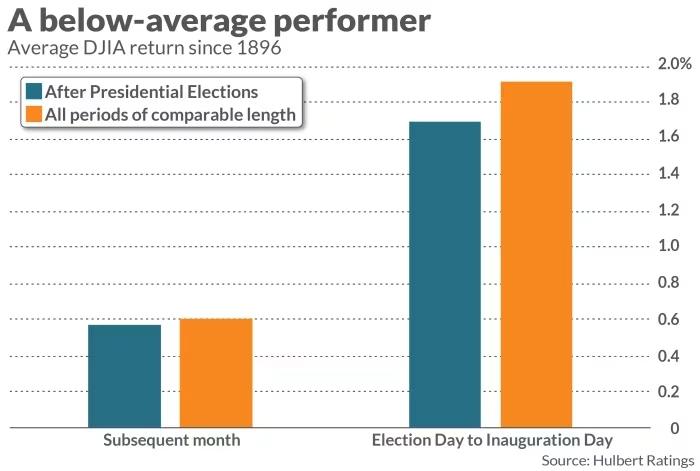
Following Election Day, U.S. stocks often face headwinds—not necessarily because of post-election uncertainty but due to a long-term trend of below-average performance in the immediate weeks afterward. Historically, stock markets tend to perform better when the incumbent party retains the White House, while declines are more frequent when the opposition takes over. On average, the Dow Jones Industrial Average has returned 4.4% between Election Day and Inauguration Day if the incumbent party wins, versus a 2.0% drop when it loses. Since 1900, in 42% of the periods between Elections Day and Inauguration Day, the Dow stocks have ended up lower than it started on Election Day. This serves as a reminder to exercise caution when assuming recent trends will continue uninterrupted. When the incumbent party loses, any initial rally is usually short-lived. After the campaign ends, the realities of governing set in, and many campaign promises remain unfulfilled, especially for key interest groups. In elections where the incumbent party lost, the Dow was lower on Inauguration Day 62% of the time, compared to only 28% of the time when the incumbent retained power. The takeaway? Expect potential volatility after the November 5 election, particularly if the incumbent party loses.

sonic
DayTradeToWin Review

Consistent Wins Using the Sonic System

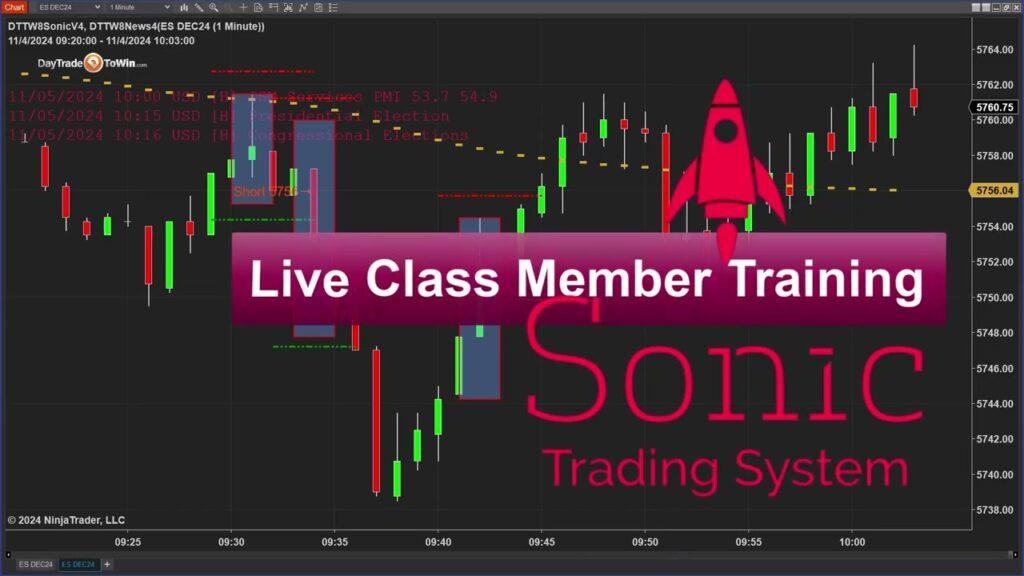
Hello Traders! Today, Wednesday, October 30th, we’re diving into a real-time look at the Sonic Trading System by Day Trade to Win. In this guide, I’ll share insights into setting up winning trades, handling losses, and managing risk—especially if you’re trading on a funded account or prop firm like Apex. Let’s dive in! Getting Started with the Sonic Trading System The Sonic Trading System, available on TradingView and NinjaTrader, is a price-action-based system designed for minute charts on the E-mini S&P 500 (ES). Whether you’re trading the E-mini or micro indices, Sonic is versatile and highly adaptable across various markets. Important Reminder: Always trade responsibly with funds you can afford to lose, as trading is inherently risky. Understanding the Sonic Short Trade Strategy Today’s focus starts with a few short trades. Two recent short trades were winners, while the current one is showing a loss. Here’s where Sonic’s flexibility shines: it allows traders to enter at a better price, improving risk-to-reward potential. Key Takeaways: Going Long with Sonic: Spotting Opportunities The Sonic System flagged a long trade today, providing an optimal entry at 5881.75. With Sonic, you can aim for a better entry price, which improves both profit potential and overall trade outcomes. Best Practices for Long Trades: Precision in Entry and Exit Management One of the most valuable aspects of Sonic is its manual entry and exit flexibility, allowing traders to fine-tune their entries and exits. Placing a limit order to secure a better price can lead to enhanced profit while managing risk effectively. Managing Trading Sessions with Sonic Today’s session, featuring five trades with four wins and one loss, demonstrates the advantage of managing trades as a group rather than in isolation. A block of consecutive trades reveals more about Sonic’s reliability over a single trade. Evaluate, Assess, Adjust: Enhanced Analysis: Sonic with Other Indicators For traders using the Atlas Line, Roadmap, or Trade Scalper, combining these tools with Sonic can increase trade confidence. Multiple indicators pointing to the same trade direction create a stronger setup and help confirm high-probability trades. Ready to Dive In? The Sonic Trading System is accessible to traders at all levels, and Day Trade to Win offers a live trading room where traders can ask questions and see Sonic in action. Interested traders can also sign up for a free member account to explore other tools like the ABC software. Final Thoughts Trading with Sonic is about mastering disciplined trade management, choosing optimal entries, and leveraging blocks of trades to reveal trends. If you’re ready to build your trading skills with price action and avoid conventional indicators, Sonic is a great place to start. Head to Day Trade to Win to learn more, join live mentorship, and take your trading to the next level!

market
Market News

2023’s Market Surge: Is More Growth Ahead?

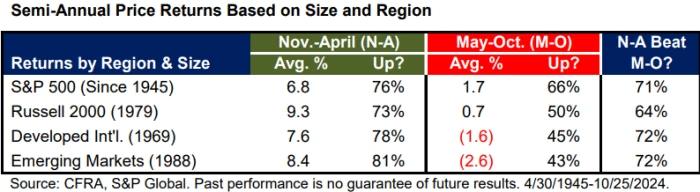
The U.S. stock market is gearing up for its historically strongest six-month period, November through April, following impressive gains over the summer months. Traditionally, investors adhere to the “sell in May and go away” adage, but this year’s performance defied that trend. Yet with rising Treasury yields and the looming presidential election, many wonder if the market rally has enough fuel to keep running. Historically, the November-April period is the best six-month stretch for stocks. Since 1945, the S&P 500 has averaged nearly a 7% return in this window compared to only 2% from May to October, according to Sam Stovall, CFRA Research’s chief investment strategist. This year, however, has been an outlier. Since April 30, the S&P 500 has surged more than 16%, setting up for the biggest May-October gain since 2009, on top of the previous November-April’s 20% gain. This two-part rally has raised questions about whether the market is due for a slowdown, yet history suggests the momentum could continue. Stovall notes that previous strong gains from May to October have often led to even stronger performance in the following November-April period. In fact, in the 12 instances since 1945 when the S&P 500 rose over 10% from May to October, it went on to climb an average of 13% in the subsequent November-April period. Additionally, in cases where double-digit gains occurred in both periods, stocks stayed on an upward trend in four out of five subsequent periods, with an average gain of 11%. Beyond the large-cap S&P 500, the November-April stretch has also been strong for smaller stocks and international markets, including the Russell 2000, MSCI EAFE, and MSCI Emerging Markets indices. However, election-related concerns and economic pressures are adding uncertainty. Recently, rising Treasury yields have triggered market volatility, with the yield on the 10-year note trading above 4.3%, a level that has challenged stocks in recent months. “With stocks up 23% year-to-date, many are questioning the remaining upside,” commented José Torres, senior economist at Interactive Brokers. Although this year has seen impressive growth, he pointed out that it trails some recent years like 2021, 2019, and 2013, each of which saw returns ranging from 24% to 30% in the first 10 months. Torres added that for stocks to keep their upward momentum, factors like favorable election outcomes, calmer interest rates, and strong AI-driven earnings could play a role. Sam Stovall is still optimistic, emphasizing that the market has historically risen through periods of uncertainty, driven by potential interest rate cuts and solid tech earnings. U.S. stocks closed mostly higher on Tuesday, with the Nasdaq up 0.8% for its 28th record close of the year. Meanwhile, the S&P 500 edged up 0.2%, while the Dow Jones slipped 0.4%.

DayTradeToWin Review

Maximizing Profit with Sonic on TradingView & NinjaTrader

Hello, Traders! Today, we’re exploring the Sonic trading system on two of the most popular trading platforms—TradingView and NinjaTrader. Whether you’re currently using one or both, this comparison will help you understand how each platform handles Sonic’s powerful signals and settings. Why Compare TradingView and NinjaTrader for Sonic? Setting Targets and Stops The Sonic system uses the Average True Range (ATR) to calculate targets on both platforms, allowing you to set targets at 1x, 2x, or even 0.5x the ATR based on your trading goals. Stops are placed just a few ticks above or below a shaded box on the chart—a visual guide that helps keep risk levels in check. Sonic System Features on Each Platform NinjaTrader NinjaTrader offers audio alerts for signals, ATR-based targets, and a five-tick stop above or below the shaded box. Customizing chart colors and styles is straightforward, letting you set up visuals that match your preference. Additionally, NinjaTrader is compatible with Apex and other funded accounts, since it doesn’t rely on automated trading bots. TradingView On TradingView, you get a similar range of options, with the ability to adjust colors, text size, and signal settings. Custom alerts help you stay on top of signals, and a built-in trend filter guides you to trade in the direction of the current market trend, only showing short or long entries depending on price movement. Key Tips for Trading with Sonic Sonic System Configuration: Customizing Your Settings In both platforms, the Sonic system uses dual alerts that you can activate or deactivate independently. Customizing the colors, styles, and text sizes can enhance your overall trading experience by creating a setup that best suits your trading style and strategies. How to Get Started with Sonic Interested in trying Sonic? You can subscribe for a yearly plan or invest in a lifetime license. DayTradeToWin also offers an accelerated mentorship program, which bundles the Sonic system with other trading tools and live trading room access, giving you hands-on experience with Sonic in real-time. To learn more or try a free member account with trial access, visit daytradetowin.com. Join today and start exploring a price-action-focused approach to trading.

market
Uncategorized

Ken Griffin: Market Rally Expected Post-Election

Citadel CEO Ken Griffin anticipates that the market will likely rally once the uncertainty surrounding the U.S. election fades. Speaking at Saudi Arabia’s Future Investment Initiative (FII), Griffin remarked, “The reduction in uncertainty is almost always positive for asset prices.” With the current tight race, in which Trump holds a slight edge but remains unpredictable, Griffin believes the resolution will lead to a “risk-on environment” as investors adjust to the incoming administration, be it under Trump or Harris. The FII, hosted by Saudi Arabia’s Public Investment Fund (PIF), managing $925 billion in assets, also featured BlackRock CEO Larry Fink, who discussed the vast capital needed for advancements in digitization and decarbonization. Highlighting Walmart’s use of AI in managing retail operations, Fink emphasized the long-term potential for equity markets, citing a “$9 trillion” reserve in money market ready for deployment into critical infrastructure growth. Fink also challenged conventional economic wisdom, suggesting that current high interest rates may no longer hamper economic growth as expected, due in part to an aging population that tends to save more. Additionally, the prevalence of 30-year fixed-rate mortgages among American homeowners may mean that rate hikes take years to impact the broader economy. Amid current global challenges, Saudi Arabia’s FII continues to attract major financial leaders, underscoring the region’s emerging role as a focal point for international investment.

Scroll to Top