stocks
Market News

Is a Market Nightmare Looming for U.S. Stocks?

The S&P 500’s recent dip hasn’t dampened investor enthusiasm for tech stocks, which remain crucial to market performance. This week’s earnings reports from major players—Alphabet on Tuesday, Microsoft and Meta on Wednesday, and Apple and Amazon on Thursday—will be watched closely, with Nvidia reporting later in November. High-Stakes Week Ahead for Markets with Election Jitters, Big Tech Earnings, and Key Economic Data The U.S. stock market’s recent record-breaking rally could be tested this week as investors brace for a series of high-impact events. The focus will be on Big Tech earnings, fluctuating U.S. Treasury yields, October’s jobs report, and a tense lead-up to the presidential election. Dec Mullarkey, head of investment strategy at SLC Management, highlighted the tension in bond markets: “The 10-year yield has surged over the past month,” reflecting worries that the election outcome may drive further volatility. Mullarkey noted that election anxiety is also driving up demand for safe-haven assets like gold, particularly with polls pointing to a close race. Big Tech Earnings Take Center Stage “These earnings will be pivotal,” said Eric Beiley, executive managing director at Steward Partners. “Stocks are trading at high valuations, so it’s critical that these companies show strong results.” The reliance on large-cap tech contrasts with weakness in small-cap stocks, as seen in the Russell 2000’s 3% drop last week. “Big Tech could be a trick or a treat,” observed Keith Lerner, co-chief investment officer at Truist Advisory Services, especially with Apple and Amazon’s results landing on Halloween, a day that often brings volatility due to month-end rebalancing. October Jobs Report in the Spotlight Friday’s jobs report will also command attention as the Federal Reserve seeks signs of a balanced labor market—neither too hot nor too cold. However, Boeing worker strikes and recent hurricanes may distort October’s numbers. September’s unexpectedly strong jobs data quelled fears of an economic slowdown, yet persistently high wages could complicate the Fed’s path to rate cuts. “The jobs report could be the day’s main focus,” said Lerner. “But afterward, all eyes will likely return to the election.” Election Uncertainty Fuels Debt Market Turmoil The upcoming election is adding pressure to U.S. debt markets, with Treasury yields on the rise. Yields on 10-year Treasury notes reached 4.23% on Friday, driven partly by uncertainty over how either presidential candidate would handle the U.S. deficit and debt levels. Some investors, including billionaire Paul Tudor Jones, have raised concerns over potential policies like tariffs and dollar penalties, should former President Trump return to the White House. Mullarkey pointed out that central bank gold purchases are pushing prices higher as investors seek protection from potential post-election volatility. As this critical week unfolds, markets may see increased volatility as investors navigate a challenging mix of earnings, economic data, and political uncertainty.

election
Market News

Why the Election Outcome Could Shock the Markets

Throughout most of 2024, stock-market investors showed little concern over whether Donald Trump or Kamala Harris might win the presidential race. However, with Election Day just two weeks away, political anxiety has finally begun to impact equities. This week, a notable climb in Treasury yields, which have been on the rise since September, rattled the U.S. stock market. The selloff raised worries that this surge might jeopardize what’s been a record-breaking year for stocks as the election draws near. On Wednesday, U.S. markets saw a dip with the S&P 500 and Dow Jones Industrial Average both falling nearly 1%, marking three consecutive days of declines — the longest losing streak since early September. The tech-focused Nasdaq Composite dropped by 1.6%, its sharpest daily decline since early September, according to Dow Jones Market Data. The selloff aligned with long-dated Treasury yields hitting their highest levels in nearly three months. Many investors worry that the election could exacerbate the fiscal deficit, while rising odds of a Trump victory in a close race, combined with expectations of less aggressive monetary easing from the Federal Reserve in November, weighed on the market. Concerns have heightened over both Trump’s and Harris’s economic policies, each seen as likely to increase inflation, interest rates, and deficits. However, Brad Neuman, senior VP at Fred Alger & Co., told MarketWatch that Trump’s proposals are anticipated to have a more inflationary impact. Treasury yields have been climbing since mid-September, following the Fed’s rate cuts and strong economic data, yet the stock market had remained relatively calm until now. Last Friday, the S&P 500 closed at a record high, marking its 47th such close this year and capping a six-week winning streak — the longest since last December. On course for its best first ten months of an election year since 1936, the S&P is defying the seasonal trend by showing gains in October, often a volatile month in election years, as per Dow Jones Market Data. Even as the Cboe Volatility Index (VIX), Wall Street’s “fear gauge,” has surged nearly 16% this month, it’s still below the “high volatility” threshold of 20. Until recently, stock prices have seemed unaffected by fluctuations in bond yields and the dollar. Jonathan Krinsky, chief market technician at BTIG, remarked that investors have been more focused on the pace of yield increases than their levels, pointing to a sense of market complacency. However, stocks now appear to be absorbing concerns over both the election and rates. Krinsky expects broad downside risk for stocks in the coming weeks and anticipates a pullback in the S&P 500 to between 5,500–5,650. The index closed Wednesday at 5,797.42. Aaron Clark, portfolio manager at GW&K Investment Management, told MarketWatch he doesn’t foresee a major selloff or spike in volatility before Election Day, as both candidates’ policies are likely to moderate post-election. He noted that “markets can’t predict which policies will actually be pursued or implemented,” suggesting that a divided Congress, which could temper drastic changes, would likely benefit markets and the economy. Clark believes that a split Congress would limit significant policy shifts. While there may be modest adjustments in taxes, tariffs, or immigration policies, he expects any changes to be less extreme than current campaign rhetoric. On Thursday morning, U.S. stock futures showed mixed movement: S&P 500 futures rose 0.4%, Nasdaq 100 futures climbed 0.8%, while Dow futures dropped slightly by 0.1%, per FactSet data.

market
Uncategorized

Can Higher Yields Trigger a Quick Market Rebound?

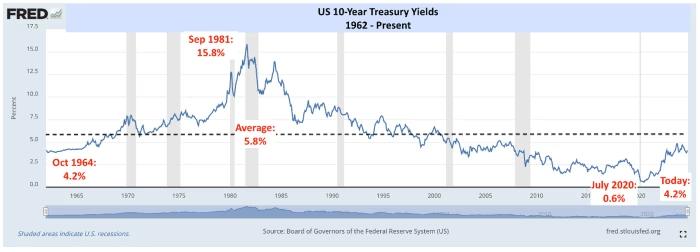
Despite rising bond yields putting pressure on U.S. stocks, many analysts remain optimistic about the market future. Nicholas Colas, co-founder of DataTrek Research, expressed confidence in a recent note, saying, “While higher yields are pressuring stocks, we remain bullish.” Colas views the increase in the 10-year Treasury yield as a sign of continued economic strength, expecting corporate earnings growth to persist in the coming quarters. Although the S&P 500 fell 1.2% this week, it’s still up 21.5% in 2024, supported by strong earnings and a resilient economy. Andrew Slimmon, senior portfolio manager at Morgan Stanley Investment Management, shared a similar sentiment, acknowledging that the market rally could pause due to higher Treasury yields but will likely pick up again. He believes that while next year’s returns may be more subdued, the strong economic backdrop will keep the momentum going. The 10-year Treasury yield climbed to 4.24% on Wednesday, its highest level since July. Colas pointed out that, from a long-term perspective, today’s yields align with historical trends, suggesting the recent rise is not unusual. Slimmon remains focused on cyclical sectors like financials and industrials, expecting the rally to continue into 2025, even with more moderate gains. While short-term headwinds exist, the overall outlook for U.S. stocks remains positive.

trader
Market News

Trader Confidence Back to Pre-Plunge Levels

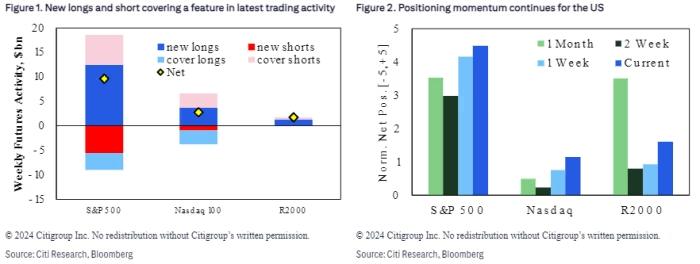
Citigroup strategists are growing concerned about the current bullish sentiment in the stock market but aren’t advising investors to reduce their positions yet. Chris Montagu, Citigroup’s global head of quantitative research, noted that net-long positioning in S&P 500 futures has reached its highest level since July 2023. At that time, such extreme bullish positioning was followed by a sharp three-month decline, with the S&P 500 falling 10%. Montagu warns that a similar pullback could happen if investors aren’t cautious. “The last time positioning was this stretched, the S&P 500 fell more than 10% over the next 2-3 months. While we aren’t suggesting reducing exposure, positioning risks increase when markets get this extended,” Montagu and his team said in a report shared with MarketWatch. Nasdaq-100 futures are less overextended than the S&P 500, avoiding the frothy conditions seen in mid-2023 and again in July 2024. The strategists also pointed out that recent short-covering in S&P 500 futures may have driven the market higher. A key difference from mid-2023 is that investors’ profit-and-loss positions are less stretched now, so they may be less inclined to sell off stocks to protect their gains, Montagu noted. Additionally, all short positions in both S&P 500 and Nasdaq-100 futures are currently underwater, which could force further buying as trader cover their short positions. While markets have been climbing in October, Tuesday saw the first consecutive losses for the S&P 500 since early September, as rising Treasury yields reignited concerns of a repeat of the 2023 selloff, when the S&P 500 dropped 10% between August and October. On Tuesday, the 10-year Treasury yield rose 2.5 basis points to 4.204%, its highest level since July. The S&P 500 fell slightly by 2.78 points (0.1%) to close at 5,851.20. The Dow Jones Industrial Average dropped 6.71 points, and the Nasdaq Composite lost 33.12 points (0.2%).

sonic
DayTradeToWin Review

How 8 Trades Prove the Sonic Trading System Works

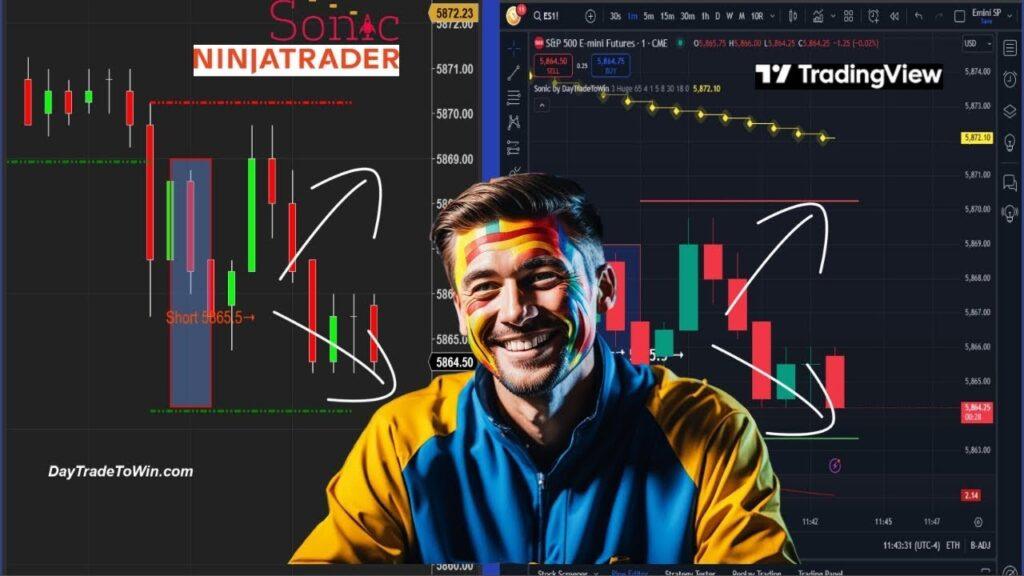
Today, we’re diving back into the Sonic Trading System, following up on yesterday’s session where we executed five trades consecutively. Our goal today is to build on that momentum, analyzing market activity from the opening bell and tracking trades throughout the day. Trading carries significant risk, and it’s important to only use capital you can afford to lose. Always be aware of the downsides and protect your capital by using stops strategically. Today’s Performance We kicked off the day around 11:00 AM with several trades on the Sonic system. Our first long signal appeared at 58.73, but I missed the fill by a tick while recording. Missing a fill is part of the game—never chase the market. Successful trading demands patience. Here’s how things stand so far: With a 5-to-1 win-loss ratio, today’s performance is exactly what you want from any trading system. The Sonic system has consistently demonstrated an ability to capture quick profits, and today is no exception. Example Trade Breakdown Our next trade came in at 58.78.50, with the target set at 58.88.75—a 2.25-point move, translating to over $100 per contract. Even accounting for slippage and fees, this trade yielded a solid profit, and it only took a few minutes to reach the target. The Importance of Price Action Price action trading focuses on reacting to the market rather than trying to predict its next move. In this case, we took a long position, and within minutes, the trade hit its target. Fast, decisive profits are ideal, and if a trade lingers too long or moves sideways, it’s often better to exit early and move on to the next opportunity. Sonic System Flexibility The semi-automated nature of the Sonic trading system makes it compatible with funded trading programs like Apex or Topstep, which often don’t allow fully automated strategies. The system is a hybrid approach, emphasizing price action over traditional indicators. The flexibility of Sonic is great for both NinjaTrader and TradingView users, as you can customize your stop losses and targets to match your trading style and risk tolerance. Whether you prefer tight stops or larger profit targets, the system allows you to adapt accordingly. Trade Recap This trade played out in less than 10 minutes, demonstrating the power of Sonic in fast-moving markets. When you’re on the right side of a trade, quick exits with profits in hand are the ultimate goal. Wrapping Up If you’re new to Sonic or price action trading, now is a great time to get involved. With a free membership at DayTradeTowin.com, you can access essential tools like free software and courses to get you started. Our system integrates seamlessly with both NinjaTrader and TradingView, and for those looking to dive deeper, we offer an Accelerated Mentorship program that bundles all our tools and training into one complete package. Be sure to subscribe to the DayTradeTowin YouTube channel for daily updates and insights, or visit our website to create your free member account. Trade smart, stay safe, and always prioritize risk management!

S&P 500
Uncategorized

Goldman Sachs Warns of Dismal S&P 500 Returns

A report from David Kostin, chief U.S. equity strategist at Goldman Sachs, recently added fuel to this discussion. Kostin cautioned that the S&P 500 could be heading for one of its weakest stretches of returns in nearly a century. His warning echoed earlier concerns from strategists at J.P. Morgan and GMO, as well as Apollo Global Management’s chief economist, Torsten Slok, who predicted that the S&P 500 might see average annualized returns of less than 3% over the next three years, based on current valuations. Stocks have enjoyed an extraordinary run over the past decade, but the coming years may not be as promising. Increasingly, market experts are warning of a potential “lost decade,” where returns could fall well short of the gains investors have grown accustomed to over the past 15 years. Kostin’s forecast is even more pessimistic, suggesting the S&P 500 could deliver average annual returns of just 3% over the next 10 years. This would significantly lag behind the average return of the past decade and would fall well below the long-term average since 1928. Goldman attributes this gloomy outlook to two main factors: elevated stock valuations and extreme market concentration. Currently, the cyclically adjusted price-to-earnings (CAPE) ratio for the S&P 500 stands at 38 times forward earnings, a level not far from its dot-com bubble peak. Even more concerning is the unprecedented concentration in the market, with a handful of large companies holding significant weight in the index. According to Goldman, this level of concentration is the highest seen since the early 1930s. High concentration has historically weighed on stock returns because dominant companies often struggle to maintain their competitive advantages over time. Kostin noted that, without this concentration, Goldman’s forecast for S&P 500 returns would be four percentage points higher. In light of these risks, Goldman suggests that Treasurys could outperform the S&P 500 over the next decade, while the equal-weighted version of the index is also expected to outperform its capitalization-weighted counterpart. Still, Kostin acknowledged that a few factors could improve the outlook. Stronger-than-expected productivity growth or corporate tax cuts could help support higher valuations and extend the market rally. Another recent analysis, from GMO’s Ben Inker, highlighted that periods of poor returns, or “lost decades,” have been more common than many investors realize. These periods typically begin when both stocks and bonds are trading at high valuations, much like today. While there are reasons for optimism—such as strong economic growth, falling inflation, and interest rate cuts—high valuations remain a point of caution. As Aya Yoshioka, portfolio consulting director at Wealth Enhancement, noted, “There are a lot of things to like about this market, but valuations aren’t one of them.” Despite recent record highs, U.S. stocks slipped earlier this week, with the S&P 500 and Dow Jones retreating while the tech-heavy Nasdaq Composite edged higher.

Scroll to Top