

day trading

Market News

Market Reaction: Weak China Data Causes Slip in U.S. Stock Futures

The U.S. stock index futures fell on Tuesday, reflecting a cautious market sentiment following the release of underwhelming Chinese international trade figures for July. Bank stocks grabbed attention after Moody’s Investor Service announced that it was considering downgrading its credit ratings for six significant U.S. banks. How are stock-index futures trading On Monday, the Dow Jones Industrial Average saw a 408 points increase, equivalent to 1.2%. At the same time, the S&P 500 experienced a 0.9% rise and there was a 0.6% hike in the Nasdaq Composite. What’s driving markets Concerns were spreading throughout global markets, which resulted in a decrease in US equity index futures, due to disappointing trade data from China. This only heightened the existing fears about a slowing global economy. China recorded an all-time low in exports, with a year-on-year drop of 14.5% up until July, representing the most significant fall since the onset of the COVID-19 pandemic in February 2020. There was also a considerable decrease in imports by 12.4%, a rate that exceeded previous predictions. Jim Reid, a strategist at Deutsche Bank, remarked on recent reports underscoring that the world’s second biggest economy is undergoing a slump due to diminishing worldwide demand and a local economic downturn. Assets reliant on China’s demand saw a decline, with industrial commodities like crude oil CL and copper HG00 falling. Stocks in mining companies listed in London also faced pressure. Investments deemed secure were performing better, as indicated by the rise in dollar value and the increasing attractiveness of government bonds to investors. This in turn resulted in a decline in Treasury yield rates. The ambiance was additionally affected by the potential demotion of six significant U.S. banks by Moody’s. This amplified concerns over the consistency of the financial sector, following the substantial rise in interest rates since March 2022. The income report for the second quarter is still in progress, with various companies presenting their data. Some of these include UPS, Barrick Gold, Eli Lilly, and Under Armour, who will share their reports before the stock market opens. Super Micro Computer and Lyft plan on disclosing their financial numbers after the market has closed for the day. The information showed a 4.1% reduction in the U.S. trade deficit, bringing it down to $65.5 billion in July. Patrick Harker, president of the Philadelphia Federal Reserve Bank, hinted that policymakers may be at a point where they can afford to wait and keep the rates stable. Companies in focus John PaulJohn Paul is the founder of DayTradeToWin, a trading education and software company established in 2008, supporting traders worldwide. His expertise focuses on price action-based futures trading strategies and structured market analysis. DayTradeToWin delivers trading education, indicators, and software tools designed to help traders apply disciplined, rule-based decision-making across global futures markets. He is the creator of multiple trading methodologies, including the Sonic System, Atlas Line, and Trade Scalper, which help traders identify structured opportunities in markets such as the E-mini S&P 500 (ES), Nasdaq (NQ), crude oil (CL), and gold (GC). Official website: https://daytradetowin.com daytradetowin.com


Market News

Reality Check for S&P 500’s Upward Surge: Strategists Advise Buying on Dips

Stocks have surged to unprecedented heights, prompting a reassessment of S&P 500 targets by Wall Street. However, exercising caution and resisting the allure of hype is prudent. At the onset of the week, several strategists recalibrated their S&P 500 projections. Citigroup adjusted its mid-2024 estimate from 4400 to 5000, while Piper Sandler raised theirs from 4625 to 4825. Even Mike Wilson of Morgan Stanley, who had previously predicted a significant 18% downturn, acknowledged the potential for a sustained market rally in a recent communication. Interestingly, the week posed challenges for the stock market. The S&P 500 experienced a dip of 2.3%, the Dow Jones Industrial Average declined by 1.1%, and the Nasdaq Composite slid by 2.8%. Notably, the S&P 500 had already surged by 28% from its low during the bear market in October. The sheer magnitude of this rapid upswing caught strategists off-guard, prompting them to adjust their forecasts to align with the current market dynamics. This adjustment is justified by recent events highlighting the economy’s resilience, even though it hasn’t reached a level that would compel unexpected actions from the Federal Reserve. The latest payroll report indicated a modest addition of 187,000 jobs in July and downward revisions for previous months. This suggests the possibility of a controlled deceleration. Earnings have outperformed predictions as well, with Amazon.com (AMZN) notably standing out with an 8.3% gain after its report. This accomplishment is particularly noteworthy considering the premium valuation of the S&P 500. Nevertheless, rushing to invest immediately after the S&P 500 achieved its strongest performance in the first seven months of a year since 1997 may be premature. The index remains relatively expensive, trading at over 19 times forward earnings for the next 12 months, up from approximately 15 times at the beginning of the rally. Moreover, certain stocks like Apple (AAPL), which played a pivotal role in the rally, exhibit signs of potential stagnation. This eagerness to invest appears to be driven by a sense of urgency and the fear of missing out. Michael Arone, Chief Investment Strategist at State Street Global Advisors, observes the emergence of “FOMO” (fear of missing out) as even bearish investors seem to be capitulating. This sentiment heightens his concern, as it could potentially lead to a market downturn. History validates Arone’s caution, not solely due to the typical summer market weakness. A comparison of the average S&P 500 target against the actual index reveals that Wall Street’s projections serve as coincidental indicators at best and lagging ones at worst. For instance, in 2022, these forecasts peaked shortly after the market reached its zenith in January. In the recent week, a surge in Treasury yields triggered the market’s retreat. While the exact catalyst remains uncertain, it could be attributed to a combination of increased Treasury debt issuance, alongside robust economic data prompting a reevaluation of growth projections. Elevated yields diminish stock valuations, assuming other variables remain constant. Yet, if the rise remains moderate, it could present a buying opportunity. This perspective gains further importance as the market sets its sights on 2024. According to Wells Fargo, a notable 61 S&P 500 companies that reported second-quarter earnings raised their profit guidance, while 23 lowered their outlooks. This contributes to analysts’ expectations of sales and earnings growth in the upcoming year. In essence, the market’s attention is fixed on 2024, as Doug Bycoff, Chief Investment Officer of the Bycoff Group emphasized. He suggests a 5% pullback could be an advantageous entry point. In conclusion, the pivotal lesson is not to hastily invest during periods of exuberance but to seize the opportunities presented by market downturns. John PaulJohn Paul is the founder of DayTradeToWin, a trading education and software company established in 2008, supporting traders worldwide. His expertise focuses on price action-based futures trading strategies and structured market analysis. DayTradeToWin delivers trading education, indicators, and software tools designed to help traders apply disciplined, rule-based decision-making across global futures markets. He is the creator of multiple trading methodologies, including the Sonic System, Atlas Line, and Trade Scalper, which help traders identify structured opportunities in markets such as the E-mini S&P 500 (ES), Nasdaq (NQ), crude oil (CL), and gold (GC). Official website: https://daytradetowin.com daytradetowin.com

bear market
Market News

Empire of the Bulls: Understanding Bearish Persistence Amid the U.S. Stock-Market Rally

The robust growth seen in the U.S. stock market during the first half of 2023 continued into the second half, encouraging optimistic investors to remain hopeful. This optimism has pushed the tech-heavy Nasdaq 100 index to increase by 42% for the year to date. On the other hand, conservative investors are trying to foresee when this positive trend will slow down and begin a downward trajectory. The gap between optimistic stock-market investors, known as bulls, who buy stocks anticipating a rise in value, and pessimists, known as bears, who anticipate a market downturn and attempt to profit from declining stock prices, has notably widened. Liz Young, SoFi’s chief of investment strategy, compared the current financial conditions to a contentious political environment, with both factions expressing hostility and failing to agree. She stated this was to be expected, given the overwhelming amount of conflicting data, such as the unexpected stock market boom despite negative economic and bond market signs. This week’s encouraging inflation statistics have increased the chances of the Federal Reserve stopping its interest-rate increases. There are growing indications of a soft landing, where inflation returns to approximately 2%, in line with the central bank’s target, without triggering a downturn. On Thursday, for the first time since April 2022, the S&P 500 surpassed 4,500 points, achieving a new peak of 15 months. According to FactSet data, it climbed 2.4% this week, while the Nasdaq Composite increased by 3.2%, and the Dow Jones Industrial Average rose by 2.3%. MarketWatch obtained insights from market experts who believe that the current disagreement between bullish and pessimistic investors is set to persist. They propose that total optimism will not be realized until there’s clarity over pressing issues related to monetary policy, economic indicators, and the volatility in the Treasury yield curve. “We persistently face a phase of financial reduction, the conclusion of which is unclear. There’s widespread prediction of a contraction based on multiple economic indicators. There are a variety of signs, such as inverted yield curves, indicating that our financial condition is still unstable,” Young commented in a Friday interview. “Discussions on this subject are continuing, and I am inclined to favor a cautious strategy, particularly in light of the current market assessments.” The head of applied research at Qontigo, Melissa Brown, indicates that market trends are expected to proceed at a steady yet cautious pace, moving in a two steps forward, one step back manner. However, an event sparking adverse investor emotions could upset this rhythm, much like various incidents that happened in the past year. A notable rise in the value of prominent technology stocks such as Nvidia Corp., Meta Platforms, and Alphabet Inc. has largely contributed to the S&P 500’s surge over 17% this year. This is majorly due to growing excitement around artificial intelligence (AI). However, Young warns that investors might be overestimating these stocks’ worth due to their infatuation with AI. If these stocks fail to produce the expected results within a year, their current value may not remain attractive. “When buying shares, your choices are typically grounded on the anticipated profits for the forthcoming year. Although AI could indeed instigate impactful alterations in a variety of sectors, it’s not expected to radically transform the tech ecosystem within this year,” she clarified. The predicted time frame might be the factor that doesn’t go as planned. Brown from Qontigo pointed out the ongoing volatility in the stock market, which has experienced significant declines since March’s end. This timeframe coincided with decreasing concerns about the banking industry, after the sudden downfall of Silicon Valley Bank. On Friday, The CBOE Volatility Index VIX was noted at 13.31, shortly after hitting the lowest level in more than three years. Typically, a sub-20 VIX value suggests a low-risk environment perception, whereas a value above 20 signifies a period of heightened market volatility. Brown explained that her models demonstrate an increasing inconsistency between a basic model, which assesses market instability in relation to economic situations, and a statistical model, which establishes volatility grounded on the given data. The forecasted statistical model exhibits a considerably higher risk than the fundamental model, potentially making it the first occurrence in more than half a decade. This suggests there might be hidden fluctuation indicating that it’s developing under the radar, Brown explained to MarketWatch during a phone call on Friday. Raheel Siddiqui, Senior Research Analyst of Global Equity Research at Neuberger Berman, has expressed concern over the upcoming liquidity crisis. He notes that investors have significantly more investments compared to their liquid assets, especially with their investments in large capitalization growth stocks. Siddiqui highlighted in his third-quarter equity market forecast that investor interest is likely to decrease with the reduction of liquidity, something he expects to happen shortly due to potential large-scale withdrawals in the near future. His comments referred to several forthcoming events – the expected scale back by the Federal Reserve of its monthly balance sheet, notably called quantitative tightening, the Treasury’s intention to produce new debt to replenish the Treasury General Account, following Congress’s move to increase the debt-ceiling, and the European Central Bank’s plan to retract €477 billion in TLTRO funding from the banking framework. Siddiqui’s viewpoint indicates a possible negative effect on shares in the forthcoming time period. Despite a decrease in optimism, the stock market has remained above average for the sixth consecutive week, as per the latest Sentiment Survey by the American Association of Individual Investors (AAII). There was an increase in both neutral and negative sentiments during the week leading up to Wednesday. SoFi’s Young observed a significant change in investors’ attitude, moving from consistently pessimistic to optimistic. Even though the graph doesn’t show a stark contrast in the number of optimists versus pessimists, she highlighted that the sudden shift in stance is quite remarkable. “Young pointed out that swift and notable changes can usually result in a similarly quick and considerable shift as markets and investors attempt to establish equilibrium,” John PaulJohn Paul is the founder of DayTradeToWin,

DayTradeToWin Review

Tips for Beginners in Day Trading: How to Get Started and Succeed in the Market

Day trading is a form of trading in which someone buys and sells a stock, commodity, currency, etc., within the same day. A day trade is considered successful when a trader makes a profit from the buying and selling of stocks during the same day. Day traders need to be constantly aware and up-to-date with the stock market to make profitable trades. They need to have a solid trading strategy and be able to execute positions quickly within the same trading day. IS DAY TRADING GOOD FOR BEGINNERS? Day trading can be a great way for beginners to get started in the stock or futures market. A beginners guide to day trading is available at daytradetowin with the get started trading PDF. Traders need to learn how to correctly buy and sell stocks quickly in order to take advantage of short-term price movements.  Day trading can be a challenging but rewarding activity for beginners. By following these essential tips, you can get started and succeed in the market. Remember to start with a solid education, define your trading goals and strategy, choose the right broker and platform, practice with a demo account, start small and scale up gradually, manage your risk and emotions, and keep learning and adapting. With patience, discipline, and persistence, you can become a successful day trader. John PaulJohn Paul is the founder of DayTradeToWin, a trading education and software company established in 2008, supporting traders worldwide. His expertise focuses on price action-based futures trading strategies and structured market analysis. DayTradeToWin delivers trading education, indicators, and software tools designed to help traders apply disciplined, rule-based decision-making across global futures markets. He is the creator of multiple trading methodologies, including the Sonic System, Atlas Line, and Trade Scalper, which help traders identify structured opportunities in markets such as the E-mini S&P 500 (ES), Nasdaq (NQ), crude oil (CL), and gold (GC). Official website: https://daytradetowin.com daytradetowin.com
DayTradeToWin Review

Day Trading Future Analysis for 2022, 2023, & 2024

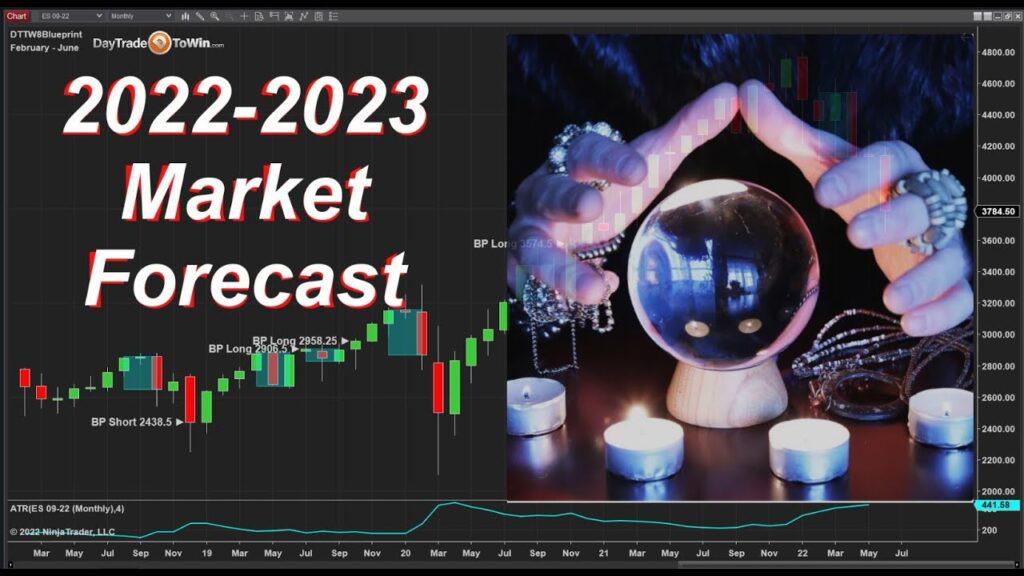
John Paul, the founder of DayTradeToWin, is in agreement with other financial analysis regarding expectations for the remainder of 2022 as well as the years 2023 and 2024. The first prediction or estimation is that 2022 price activity will continue descending while fluctuating. In other words, the expectation is a choppy gradual fall. He provides some key price points, and these are worth paying attention to. If those key points are hit, the expectation is that 2023 will end in all-time highs. An unprecedented buying opportunity could be underway. Such activity involves swing trading. Swing trading is when a trader holds a position longer-term than intraday. But when do you buy during this expected long-term bullish 2023 activity? John Paul’s suggestion is to follow the January effect, which calls for buying after price retraces 50% of the way back up to a prior high. The prediction for 2024 is that, overall, it will also be an up year. Why? Traditionally, election years are up years. Of course, you may wait for the January Effect to validate this expectation of the up year. You may find it beneficial to review the January Effect, as it describes how the month of January for each year has a history of exemplifying whether the entire year will be up or down as well as how to swing trade bullish retracements. DayTradeToWin offers many day trading methods. The focus is price action trading over other complicated or rigid methodologies. Price action focuses on what is right in front of you rather than advanced concepts or abstractions. For assessing volatility as well as determining the profit target and stop loss, the ATR (Average True Range) it utilized. With knowledge of how to use a signal and the related method, one can place and manage a trade. This includes placing the profit target, stop loss, and exiting as gracefully as possible if the fill has not happened within a given period or under other conditions. John PaulJohn Paul is the founder of DayTradeToWin, a trading education and software company established in 2008, supporting traders worldwide. His expertise focuses on price action-based futures trading strategies and structured market analysis. DayTradeToWin delivers trading education, indicators, and software tools designed to help traders apply disciplined, rule-based decision-making across global futures markets. He is the creator of multiple trading methodologies, including the Sonic System, Atlas Line, and Trade Scalper, which help traders identify structured opportunities in markets such as the E-mini S&P 500 (ES), Nasdaq (NQ), crude oil (CL), and gold (GC). Official website: https://daytradetowin.com daytradetowin.com
DayTradeToWin Review

Day Trading School for Beginners and Pros Alike

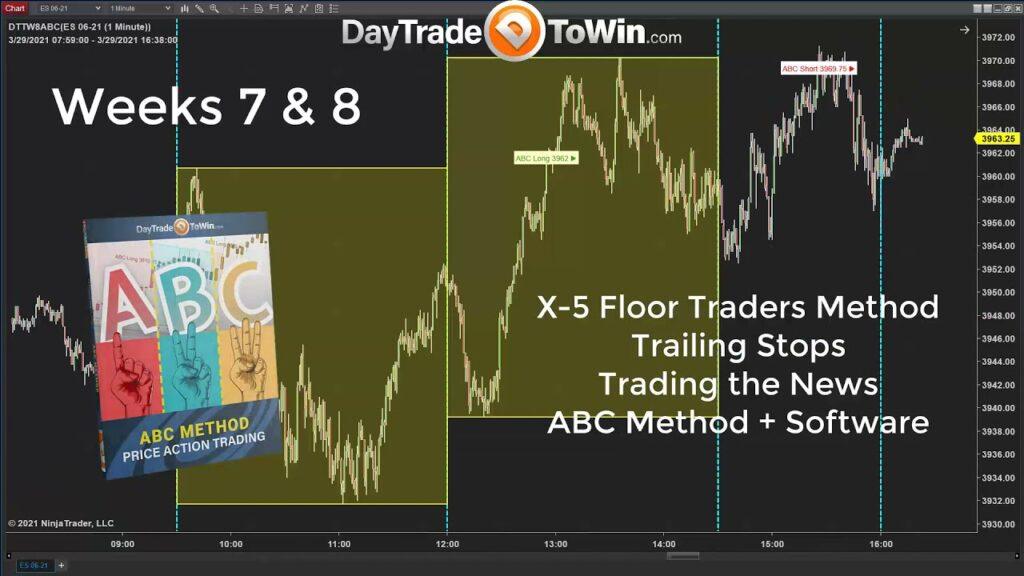
If you read our last post, you would have seen why the DayTradeToWin 8-Week Mentorship Program has been one-stop shopping for people who want to become pro day traders. This video goes even further, explaining what you’ll get (and learn) week by week. You’ll see signals for many of the methods. If you’ve been on the fence, this video may just convince you to enroll. New classes occur every month, so check out the official Mentorship page for the next class date and times. Week 1 focuses on the ATO 2 method. That will help you identify what is typically the first trade of the day. Week 2 uses a tick chart with a specific value to find Price Action Scalping opportunities. This method is exclusive to Mentorship, as it cannot be purchased standalone. Week 3’s Blueprint Method uses a 5-minute chart, typically. This is a universal price action trading method that focuses on a specific candle pattern. Week 4 moves you through everything that is the Trade Scalper. This method can be purchased standalone is highly popular. Week 5, you’ll be learning the Roadmap. For many, this is the most coveted of all the techniques taught in Mentorship. It is exclusive to Mentorship and can serve as a filter for all of the other methods. Week 6, the Atlas Line is added to your trading plan, offering yet another filter as well as a complete system to identify opportunities with signals. Week 7 & 8 are the final two weeks that teach the ABC, News, and other techniques. Review is incorporated. The focus is also to bring everything together in one complete plan. So, are you ready to change the way you trade forever? Mentorship is waiting. Take the leap that so many other traders have. It’s time to start winning and time to stop guessing and seeing patterns where there are none. May you find true success in your pursuits! John PaulJohn Paul is the founder of DayTradeToWin, a trading education and software company established in 2008, supporting traders worldwide. His expertise focuses on price action-based futures trading strategies and structured market analysis. DayTradeToWin delivers trading education, indicators, and software tools designed to help traders apply disciplined, rule-based decision-making across global futures markets. He is the creator of multiple trading methodologies, including the Sonic System, Atlas Line, and Trade Scalper, which help traders identify structured opportunities in markets such as the E-mini S&P 500 (ES), Nasdaq (NQ), crude oil (CL), and gold (GC). Official website: https://daytradetowin.com daytradetowin.com

Scroll to Top