

daytrading

inflation
Market News

Sticky Inflation? Insights from Commodities and Stocks

Tariffs and Inflation: BNY Wealth CIO Says It’s ‘Far Too Early’ to Predict Significant Impact Inflation Concerns Resurface as Investors Eye Policy ShiftsU.S. financial markets are grappling with renewed inflation fears following President-elect Donald Trump’s victory, as investors weigh the potential impact of proposed policies like tax cuts and import tariffs. These measures, some argue, could exacerbate the fiscal deficit and fuel inflation. The 10-year Treasury yield has risen 14 basis points since Nov. 6, reflecting these concerns. However, markets have shown resilience: the S&P 500 has gained over 3%, the Dow Jones Industrial Average nearly 5%, and the Nasdaq Composite around 3%, according to FactSet. Yet, uncertainty lingers as investors try to decipher mixed signals from various asset classes. Oil and Gold Respond, but Inflation’s Role Remains CloudedOil and gold prices have surged recently, although analysts attribute much of the movement to geopolitical tensions rather than inflation fears. U.S. crude oil futures jumped 6.5% last week to settle at $71.24 a barrel, while gold, often seen as an inflation hedge, posted a 5% weekly gain, closing at $2,712.20 an ounce. Brian Szytel, co-CIO at the Bahnsen Group, suggested that Trump’s pro-energy policies could increase supply and weaken the traditional link between oil prices and inflation. Value, Growth, and Small Caps: Market Shifts in FocusIn periods of inflation, value stocks often outperform growth stocks, as seen during 2022’s inflation surge. The Russell 1000 Value Index outpaced its growth counterpart last year, and it rose 2.4% last week compared to the Russell 1000 Growth Index’s 1.7% gain. However, analysts like Szytel argue that value stocks are currently attractive more for their valuation dynamics than inflation concerns. Meanwhile, small-cap stocks, which typically benefit from reflation and economic growth, have outperformed in recent weeks. The Russell 2000 Index climbed 4.5% last week, supported by optimism around Trump’s tax-cut proposals and a potential resurgence in domestic manufacturing. Tariff Impact: Too Soon to Draw ConclusionsSinead Colton Grant, CIO at BNY Wealth, cautioned that it’s “far too early” to conclude that tariffs will lead to “significantly higher inflation.” She noted that market signals across asset classes remain mixed and suggested that policy measures are unlikely to exacerbate inflation significantly, given voters’ sensitivity to rising prices. Grant also pointed out that upcoming data, including Wednesday’s personal consumption expenditures price index, could shape the market narrative. A higher-than-expected reading may dampen sentiment and challenge the stock market’s year-end rally. Key Earnings Reports AheadAs the Thanksgiving holiday approaches, the earnings calendar includes major retailers like Best Buy, Macy’s, and Nordstrom, as well as tech giants like Dell and CrowdStrike. These results could provide fresh insights into consumer sentiment and corporate performance amid lingering inflationary concerns. John PaulJohn Paul is the founder of DayTradeToWin, a trading education and software company established in 2008, supporting traders worldwide. His expertise focuses on price action-based futures trading strategies and structured market analysis. DayTradeToWin delivers trading education, indicators, and software tools designed to help traders apply disciplined, rule-based decision-making across global futures markets. He is the creator of multiple trading methodologies, including the Sonic System, Atlas Line, and Trade Scalper, which help traders identify structured opportunities in markets such as the E-mini S&P 500 (ES), Nasdaq (NQ), crude oil (CL), and gold (GC). Official website: https://daytradetowin.com daytradetowin.com
Market News

S&P 500 Surge: A Faster Bull Cycle Ahead?

Morgan Stanley’s Andrew Slimmon: ‘It’s hard to see the market correcting before year-end.’ The S&P 500 has staged a comeback from last week’s decline, which briefly erased its post-election rally, keeping the index on track for a strong finish to 2024. The November 5 election outcome may further fuel the bull market, with the S&P 500 positioned to gain over 20% for a second consecutive year, according to Andrew Slimmon, senior portfolio manager for U.S. equities at Morgan Stanley Investment Management. “This election might be pulling forward returns in the bull market as it enters its third year,” Slimmon said. Historically, bull markets last an average of 4.5 years, and he sees the current cycle continuing, with 2025 shaping up to be “a very good year for equities.” On Tuesday, the S&P 500 rose 0.4%, adding to back-to-back gains after last week’s 2.1% drop, which followed a 4.7% election-driven rally. Year-to-date, the index is up approximately 24%, including a 3.7% November gain so far, according to FactSet data. It now sits just 1.4% below its all-time high reached earlier this month. Slimmon pointed to legendary investor John Templeton’s market cycle framework: “Bull markets are born on pessimism, grow on skepticism, mature on optimism, and die on euphoria.” With economic growth exceeding expectations and optimism building after Donald Trump’s election victory, Slimmon believes the bull market is maturing, not nearing its end. Investors have shifted from recession fears earlier in 2024 to a narrative of steady economic expansion as inflation eases toward the Federal Reserve’s 2% target. The Fed kicked off its first rate-cutting cycle since 2020 in September, further supporting equities. Cyclical sectors like financials and industrials remain Slimmon’s focus, benefiting from robust economic conditions and pro-growth policies expected under Trump’s administration. However, some concerns linger about potential inflationary effects from proposed tariffs, including a 10% levy on all imports and a 60% tariff on Chinese goods. Slimmon anticipates these measures will likely be used as negotiation tools rather than implemented in ways that could derail the economy. “Seasonally, this is a time when markets typically avoid significant pullbacks,” Slimmon said, reinforcing his view that the S&P 500 is unlikely to see a correction before the end of the year. John PaulJohn Paul is the founder of DayTradeToWin, a trading education and software company established in 2008, supporting traders worldwide. His expertise focuses on price action-based futures trading strategies and structured market analysis. DayTradeToWin delivers trading education, indicators, and software tools designed to help traders apply disciplined, rule-based decision-making across global futures markets. He is the creator of multiple trading methodologies, including the Sonic System, Atlas Line, and Trade Scalper, which help traders identify structured opportunities in markets such as the E-mini S&P 500 (ES), Nasdaq (NQ), crude oil (CL), and gold (GC). Official website: https://daytradetowin.com daytradetowin.com
Profit
Market News

2025 Profit Forecasts: Risk or Opportunity?

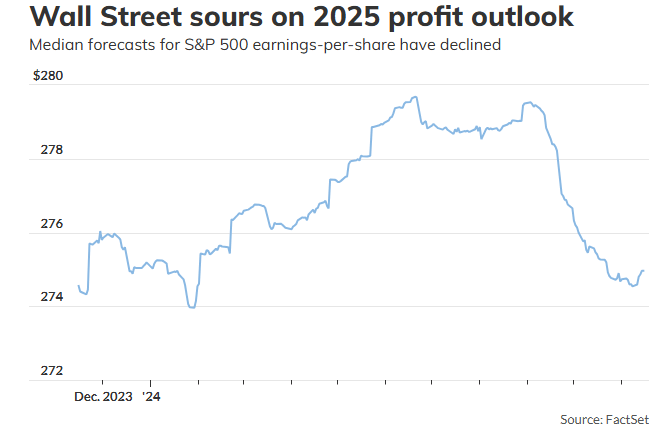
High Valuations Raise the Stakes as Q4 Earnings Forecasts Decline As the year winds down, Wall Street analysts are once again trimming their profit forecasts for the next calendar year—a common practice during the fourth quarter. By mid-November, estimates for S&P 500 earnings in 2025 had fallen to $274.96 per share, down from $279.68 in June and $276.66 in September, according to FactSet. While it’s typical for earnings projections to dip late in the year, this year’s revisions have come at a slightly faster pace than usual. Since the start of Q4, forecasts have dropped 0.6%, aligning with the 15-year average but outpacing the five-year trend, notes FactSet’s John Butters. Ordinarily, these adjustments garner little attention from investors, who focus more on actual earnings reports. However, with the S&P 500 trading at a historically high 22 times forward earnings, the stakes are elevated. Further downward revisions could sap confidence in the market’s ability to deliver double-digit profit growth. Elevated Risks Amid Lofty Valuations “The stakes are higher because valuations are higher,” says James St. Aubin, chief investment officer at Ocean Park Asset Management. Analysts are projecting S&P 500 earnings growth of 12% for 2025, compared to 9.4% for 2024. While these figures remain optimistic, any continued weakening in forecasts could amplify market pressure. Recent declines in the market underscore these concerns. Investors are grappling with the likelihood that the Federal Reserve may take a slower approach to cutting interest rates. Coupled with falling profit expectations, this dynamic could create a headwind for equities in the near term. Broader Earnings Growth Faces Challenges Optimism for a broader earnings recovery beyond Big Tech in 2025 has also dimmed. While technology and communication services companies have seen improved profit outlooks, other sectors, including healthcare, consumer staples, energy, and utilities, have faced downward revisions. This trend underscores the ongoing concentration of earnings growth among a few major players, such as Nvidia, which has led the charge in driving the S&P 500’s gains over the past year. Meanwhile, small-cap stocks, which had shown early signs of recovery, are seeing diminished profit expectations, further challenging hopes for a more inclusive market rebound. Policy and Economic Uncertainty Add to Risks Beyond earnings revisions, broader economic and policy uncertainties loom. While potential corporate tax cuts and deregulation could bolster profits, risks such as renewed trade tensions under a Trump administration could disproportionately impact large-cap companies with significant international exposure. “The risk of trade wars and tariffs could become a significant drag on multinational corporations,” warns St. Aubin. Market Sentiment at a Turning Point Looking ahead, investors face critical questions about whether companies can deliver on expectations for double-digit profit growth. Any signs of narrowing earnings beats or continued revisions downward could weigh heavily on sentiment, particularly in an environment of high valuations and macroeconomic uncertainty. “The optimism around earnings has been one of the few bright spots keeping markets afloat,” notes Josh Emanuel, CIO at Wilshire. As pressure mounts, the coming months could test the resilience of bulls in a market already facing significant headwinds. John PaulJohn Paul is the founder of DayTradeToWin, a trading education and software company established in 2008, supporting traders worldwide. His expertise focuses on price action-based futures trading strategies and structured market analysis. DayTradeToWin delivers trading education, indicators, and software tools designed to help traders apply disciplined, rule-based decision-making across global futures markets. He is the creator of multiple trading methodologies, including the Sonic System, Atlas Line, and Trade Scalper, which help traders identify structured opportunities in markets such as the E-mini S&P 500 (ES), Nasdaq (NQ), crude oil (CL), and gold (GC). Official website: https://daytradetowin.com daytradetowin.com
Fed
Market News

Fed Alert: What It Means for Investors

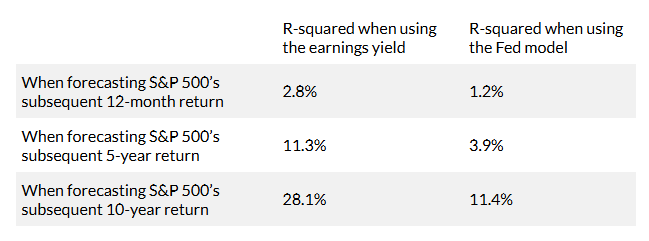
Bears Are Eyeing This Stock-Market Predictor — But It’s Rarely Right The “Fed model” isn’t about to derail the stock market, despite its recent shift into negative territory. This well-known market-timing tool compares the stock market’s earnings yield (the inverse of the P/E ratio) with the 10-year Treasury yield. According to proponents, equities are favorable when the earnings yield exceeds the Treasury yield and risky when the reverse is true. Right now, the S&P 500’s earnings yield, based on trailing 12-month earnings, is 3.90%, while the 10-year Treasury yield is higher at 4.46%. That negative spread is reminiscent of the 2008-09 financial crisis, a parallel that’s causing unease among bearish investors. But history shows the Fed model’s track record as a predictor is weak at best. The Fed Model’s Flawed Record Using data from Yale economist Robert Shiller, I analyzed the Fed model’s performance back to 1871. Specifically, I compared how well it and the simpler earnings yield predicted the inflation-adjusted total returns of the stock market over one-, five-, and ten-year periods. The earnings yield consistently outperformed the Fed model. When the Treasury yield was incorporated, the model became less reliable, not more. Why the Fed Model Falls Short The main issue is the Fed model’s comparison of two incompatible metrics: the stock market’s earnings yield, which is real (adjusted for inflation), and the 10-year Treasury yield, which is nominal (not adjusted for inflation). This mismatch undermines its conclusions. Cliff Asness, founder of AQR Capital Management, addressed this flaw in his influential paper, “Fight the Fed Model,” published two decades ago. He wrote: “The Fed model has the appearance but not the reality of common sense… [its appeal stems from] a confusion of real and nominal (money illusion).” A Misleading Signal None of this means the stock market is risk-free. There are other legitimate reasons to question its valuation or future performance. But the Fed model’s current bearish signal isn’t one of them. Its history of unreliability makes it a poor tool for predicting market trends — and an even weaker foundation for bearish bets. John PaulJohn Paul is the founder of DayTradeToWin, a trading education and software company established in 2008, supporting traders worldwide. His expertise focuses on price action-based futures trading strategies and structured market analysis. DayTradeToWin delivers trading education, indicators, and software tools designed to help traders apply disciplined, rule-based decision-making across global futures markets. He is the creator of multiple trading methodologies, including the Sonic System, Atlas Line, and Trade Scalper, which help traders identify structured opportunities in markets such as the E-mini S&P 500 (ES), Nasdaq (NQ), crude oil (CL), and gold (GC). Official website: https://daytradetowin.com daytradetowin.com

market
DayTradeToWin Review

Advanced Market Strategies for Pros

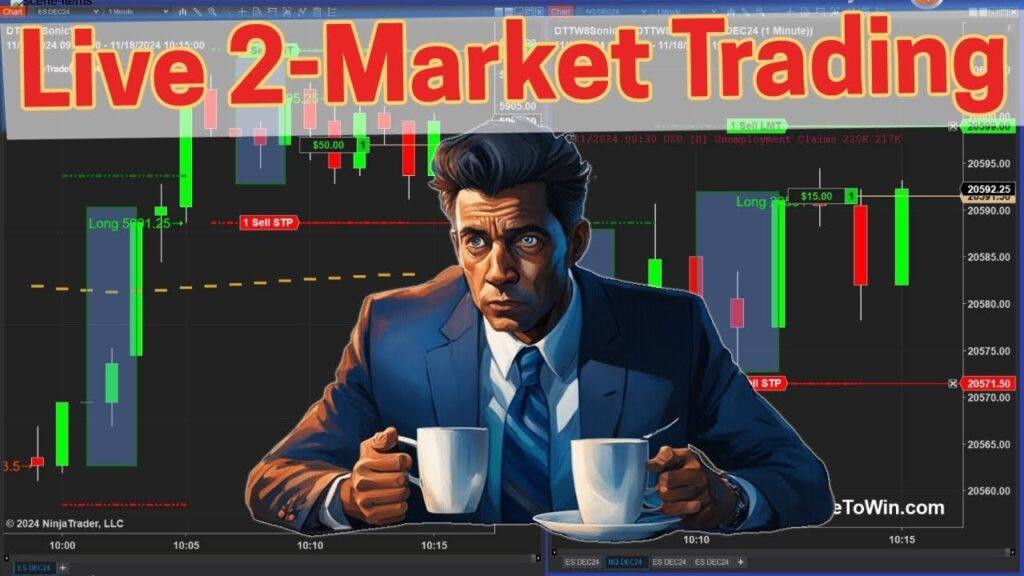
Unlock the potential of day trading with two of the most dynamic futures market: the E-mini S&P 500 (ES) and the NASDAQ 100 (NQ). In this guide, we’ll explore live price action, long entry signals, and the importance of a structured trading system to optimize profits while mitigating risks. Trading comes with significant risks, so it’s vital to only use funds you can afford to lose. A solid understanding of your risk tolerance, a well-thought-out plan, and strict adherence to your strategy are essential for success. Optimal Trading Setup: Two-Charts for Two Markets To effectively monitor these markets, set up side-by-side charts for the E-mini S&P 500 and the NASDAQ 100. This dual view allows you to identify simultaneous trading opportunities and assess market behavior in real time. Additionally, use limit orders instead of market orders. Limit orders give you greater control over your entry and exit points, improving your precision in fast-moving markets. The Sonic System: A Framework for Success The Sonic system provides a reliable, rule-based approach to day trading. Here are its core principles: Live Market Example: Executing Trades in NASDAQ & E-mini S&P 500 NASDAQ Long Entry Signal The NASDAQ presented a long signal first, with a clear target and manageable stop-loss. A limit order was placed to secure a precise entry point, adhering to the rules of the Sonic system. E-mini S&P 500 Long Entry Signal Shortly after, the E-mini S&P 500 revealed a long entry opportunity at an even better price. By carefully following the system’s principles, a limit order was placed, ensuring a strong risk-reward balance. Execution and Outcome Analysis E-mini S&P 500 Trade: NASDAQ Trade: Key Lessons for Day Traders Join a Thriving Trading Community Success in day trading is built on knowledge, practice, and a supportive network. At DayTradeToWin, we provide: Start your journey to mastering price action trading today. Visit DayTradeToWin.com and take advantage of our free resources and mentorship programs. Let’s work together to make your next trade a winning one! 🚀 John PaulJohn Paul is the founder of DayTradeToWin, a trading education and software company established in 2008, supporting traders worldwide. His expertise focuses on price action-based futures trading strategies and structured market analysis. DayTradeToWin delivers trading education, indicators, and software tools designed to help traders apply disciplined, rule-based decision-making across global futures markets. He is the creator of multiple trading methodologies, including the Sonic System, Atlas Line, and Trade Scalper, which help traders identify structured opportunities in markets such as the E-mini S&P 500 (ES), Nasdaq (NQ), crude oil (CL), and gold (GC). Official website: https://daytradetowin.com daytradetowin.com

market
Market News

Policy Uncertainty Shadows Market Relief

Stock Market Surge After Trump’s 2024 Election Victory, But Uncertainty Looms The stock market soared following Donald Trump’s victory in the 2024 U.S. presidential election. Investors cheered the result, pushing major indices to record highs. The Dow Jones Industrial Average climbed 4.6% during election week, the S&P 500 gained 4.7%, and the Nasdaq Composite surged 5.7%. However, the momentum faded quickly. By the following week, markets gave back a portion of their gains as investors began scrutinizing what Trump’s presidency could mean for the economy and corporate America. A Year of Election-Driven Volatility Election-related uncertainty dominated 2024, with investors weighing potential outcomes and their market implications. Speculative “Trump trades” and “Harris trades” reflected contrasting expectations for the candidates’ economic policies. Polling suggested a tight race, keeping anxiety high. This contributed to a 1% drop in the S&P 500 in October, extending a 20-year trend of weak performance during election years. “Market jitters during election seasons are common,” said Steven Wieting, Chief Economist at Citi Wealth. “When uncertainty clears, markets often bounce back—but this year’s rally was particularly strong.” Sectors React to Trump’s Policies Trump’s victory ignited sector-specific rallies. Cryptocurrencies exploded, with Bitcoin reaching a record $90,000 and Dogecoin doubling, fueled by Trump’s pro-crypto platform. The U.S. dollar strengthened to a one-year high, as investors anticipated protectionist trade policies like tariffs. Financial and tech stocks also climbed on hopes of deregulation and the extension of Trump’s 2017 corporate tax cuts. “The financial sector is poised to benefit the most,” said Marco Pirondini, Chief Investment Officer at Amundi. “Even partial policy implementation could significantly boost earnings.” Lingering Concerns Despite initial optimism, investors are now grappling with fresh uncertainties. Key questions surround Trump’s policies on trade, immigration, and geopolitical conflicts, including wars in Ukraine and the Middle East. “We’re in a period of adjustment,” Wieting explained, noting that markets are awaiting clarity on Trump’s early moves, including tariff policies that could affect inflation and global trade dynamics. Geopolitical tensions and fiscal challenges, such as the $1.8 trillion deficit and ballooning national debt, add to the unease. Trump has proposed a “Department of Government Efficiency,” led by Elon Musk and Vivek Ramaswamy, to address the deficit, but details remain scarce. “The debt and deficit are significant headwinds,” said Robert Conzo, CEO of The Wealth Alliance. “Wall Street is watching closely.” What’s Next? Investors are now turning their attention to key indicators, including earnings reports from Walmart, Nvidia, and Target, as well as Federal Reserve updates on inflation and interest rates. While Trump’s election initially boosted market confidence, the sustainability of the rally remains uncertain. “Markets thrive on clarity, and while some uncertainties have been resolved, many more remain,” Conzo noted. “The question now is whether this market has the legs to keep running.” For now, investors are left balancing cautious optimism with the complexities of navigating a new political and economic landscape. John PaulJohn Paul is the founder of DayTradeToWin, a trading education and software company established in 2008, supporting traders worldwide. His expertise focuses on price action-based futures trading strategies and structured market analysis. DayTradeToWin delivers trading education, indicators, and software tools designed to help traders apply disciplined, rule-based decision-making across global futures markets. He is the creator of multiple trading methodologies, including the Sonic System, Atlas Line, and Trade Scalper, which help traders identify structured opportunities in markets such as the E-mini S&P 500 (ES), Nasdaq (NQ), crude oil (CL), and gold (GC). Official website: https://daytradetowin.com daytradetowin.com

Scroll to Top