

bull market

Market News

Quackonomics: Why This Isn’t Your Ordinary Bull Market

Major U.S. equity indexes appear to be on a consistent upward trajectory, but individual stocks within these indexes tell a different story. A report from Charles Schwab & Co. highlights the disparity between the relatively steady performance of overall equity indexes and the volatile behavior of their constituent stocks. Despite the S&P 500 hitting record highs in 2024, the average stock within the index has shown significant swings. According to Kevin Gordon, a senior investment strategist at Schwab, this divergence is unusual for typical bull markets, signaling a unique market cycle. Liz Ann Sonders, another strategist at Schwab, likened the current market to a duck: seemingly calm on the surface but characterized by frenetic activity underneath. This gap is particularly notable in the Nasdaq Composite, where the index itself has experienced minimal downturns while individual Nasdaq stocks have seen substantial declines. This trend persists when analyzing performance since the start of the bull market in October 2022. Despite the S&P 500’s impressive 43% increase during this period, the average index stock has faced a 26% pullback. Similar patterns emerge in indices like the Russell 2000 and the Dow Jones Industrial Average. Gordon suggests that this volatility gap between indexes and individual stocks highlights an imbalanced market, where the outstanding performance of a few stocks masks the weaker performance of many others. Roughly half of S&P 500 constituents are trading below their January 2022 levels, an unusually high number for this stage of a bull market. However, investors tracking index funds have benefited from the exceptional performance of a select few mega-cap stocks, which have more than compensated for broader weakness. These stocks, dubbed the “Magnificent Seven,” including Nvidia, Microsoft, Apple, Amazon, Meta, Alphabet, and Tesla, have been instrumental in driving the S&P 500’s gains. While market breadth has shown recent improvements, indicating more individual stocks participating in the rally, it hasn’t been a linear progression. The proportion of stocks trading above their long-term averages has risen since the start of the year but remains below peak levels seen in December. John PaulJohn Paul is the founder of DayTradeToWin, a trading education and software company established in 2008, supporting traders worldwide. His expertise focuses on price action-based futures trading strategies and structured market analysis. DayTradeToWin delivers trading education, indicators, and software tools designed to help traders apply disciplined, rule-based decision-making across global futures markets. He is the creator of multiple trading methodologies, including the Sonic System, Atlas Line, and Trade Scalper, which help traders identify structured opportunities in markets such as the E-mini S&P 500 (ES), Nasdaq (NQ), crude oil (CL), and gold (GC). Official website: https://daytradetowin.com daytradetowin.com

Market News

Riding the Bull: How Sideline Cash Reserves Signal Continued Stock Market Growth

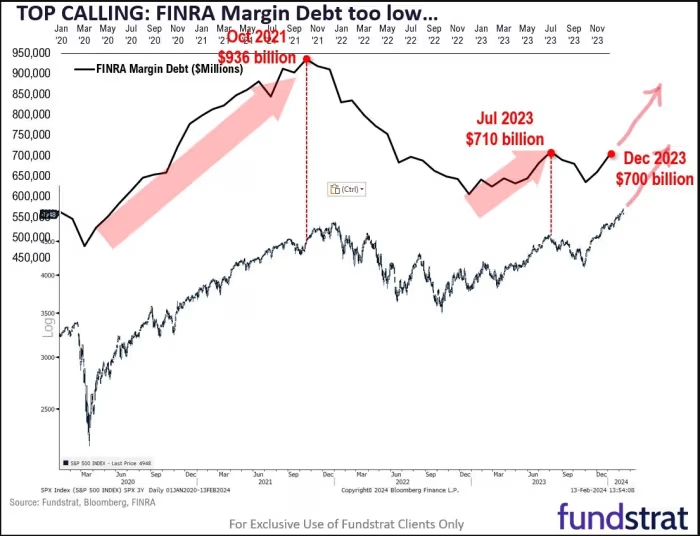
The stock market saw a sharp downturn just before Valentine’s Day, leading some to question if it was an overreaction. However, indications from stock futures suggest that bargain hunters are already on the lookout. Chris Weston, head of research at Pepperstone, explains that the market was caught off guard, lacking adequate safeguards and being overly optimistic about risk. He notes the frustration among those betting against risk, as such sell-offs often lack sustained momentum. Additionally, the Federal Reserve’s preferred inflation data is yet to be released, scheduled for February 29. Tom Lee, head of research at Fundstrat and a notable bullish figure on Wall Street, describes Tuesday’s stock plunge as an overreaction, predicting that it won’t gain traction. Lee, who accurately turned bullish in 2023 when others were bearish, believes this downturn will be temporary, though he warns investors to brace for a challenging first half of the year. Lee’s optimism is supported by several factors. Firstly, he observes that markets typically don’t falter on positive news, as was the case with Tuesday’s Consumer Price Index (CPI) data. He also notes that despite inflation concerns, the downward trend hasn’t halted. Secondly, Lee points to ample “dry powder” on the sidelines, suggesting that buying power has yet to peak. He compares the current level of NYSE margin debt to previous market tops, indicating room for further borrowing before a downturn. Furthermore, the presence of significant cash reserves, as mentioned by a BlackRock executive in November, supports the notion that the market hasn’t reached its zenith. Lee emphasizes that skepticism remains prevalent, which typically doesn’t coincide with a market peak. Lee anticipates that a significant macroeconomic event triggering a stock sell-off could signal the peak. In the meantime, he advises investors to focus on small-cap stocks, particularly through the iShares Russell 2000 ETF, which he believes will rebound as the market stabilizes. The Russell 2000 index suffered the most on Tuesday, experiencing its largest single-day decline since June 2022, yet Lee remains optimistic about its prospects once the market regains its footing. John PaulJohn Paul is the founder of DayTradeToWin, a trading education and software company established in 2008, supporting traders worldwide. His expertise focuses on price action-based futures trading strategies and structured market analysis. DayTradeToWin delivers trading education, indicators, and software tools designed to help traders apply disciplined, rule-based decision-making across global futures markets. He is the creator of multiple trading methodologies, including the Sonic System, Atlas Line, and Trade Scalper, which help traders identify structured opportunities in markets such as the E-mini S&P 500 (ES), Nasdaq (NQ), crude oil (CL), and gold (GC). Official website: https://daytradetowin.com daytradetowin.com

stock market
Market News

Bull Market Update: Brace for Potential 10% Correction

Hayes Martin, a stock market strategist, has both encouraging and discouraging news for individuals with a positive outlook on the stock market. Starting with the downside, Martin anticipates that the continuous decline in the market will ultimately lead to a decrease of 8% to 13% in the market averages. (As of August, the S&P 500 index has already gone through a drop.) On the bright side, Martin assures that this upcoming decline will not mark the end of the positive market trend or the start of a negative market trend. I often count on Martin, the head of advisory company Market Extremes, for valuable information. I always make sure to give his emails my complete attention. It is important to mention that there is no professional agreement between his advisory service and my auditing firm when it comes to calculating the performance of his services. Martin sent an email in the afternoon of August 1st. In contrast to his previous emails, where he showed belief in the market’s expansion, this time he noted that the market’s internal elements were deteriorating. He acknowledged that although he doesn’t foresee a major drop, we should be prepared for a more significant temporary setback. Consequently, he recommended adopting a defensive approach in such situations. From August 1st to August 15th, there was a 3% drop in the S&P 500 SPX, whereas the Nasdaq Composite COMP experienced a decline of 4.6%. In a later email, Martin mentioned that his research shows there is still potential for further improvement in addressing this issue, with a range of 8% to 13%. However, he observed that the market’s internal factors have only slightly worsened, in contrast to the significant decline seen in previous bull-market highs. He also predicted that once this correction comes to an end, the progress is expected to continue. Considering Martin’s analysis, it is crucial to remember his previous statements from the past year and a half. For example, during the pessimistic market period in late May and early June 2022, he correctly foresaw a market rally, particularly in the technology industry, along with a possible growth ranging from 15% to 25%. The subsequent three months saw the Nasdaq Composite increase by 16.5%, proving the accuracy of his prediction. Following the conclusion of the rally, the bear market made a strong resurgence. By early October 2022, the Nasdaq erased the entire 16.5% gain it had experienced during the rally. At this point, Martin predicted a significant “reflex bounce” in the market, although he did not foresee a new bull market. This bounce would cause the market averages to rise by 10%-15%, with the technology-dominated indexes potentially seeing gains of 15-20%. The market reached its lowest point on October 12. While Martin initially did not expect a new bull market in early October and became more optimistic later on, he should be recognized for accurately predicting a powerful rally. If you trust Martin’s analysis, it would be advisable to make changes to your stock portfolios in order to adopt a more defensive approach. John PaulJohn Paul is the founder of DayTradeToWin, a trading education and software company established in 2008, supporting traders worldwide. His expertise focuses on price action-based futures trading strategies and structured market analysis. DayTradeToWin delivers trading education, indicators, and software tools designed to help traders apply disciplined, rule-based decision-making across global futures markets. He is the creator of multiple trading methodologies, including the Sonic System, Atlas Line, and Trade Scalper, which help traders identify structured opportunities in markets such as the E-mini S&P 500 (ES), Nasdaq (NQ), crude oil (CL), and gold (GC). Official website: https://daytradetowin.com daytradetowin.com

Scroll to Top