
markets

Market News

AI Frenzy Spells Trouble: Contrarian Investor Sounds Off on Tech Stock Risks

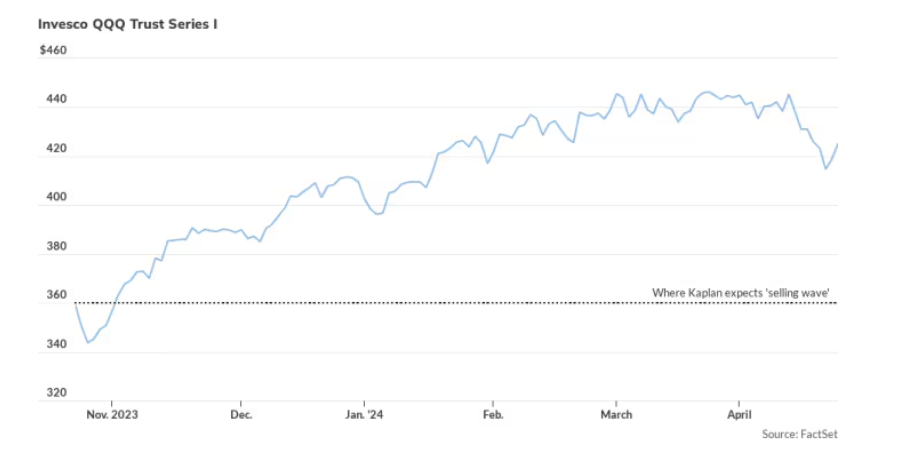
Tech stocks may be gearing up for a comeback, but Steven Jon Kaplan, CEO of True Contrarian blog and newsletter with $120 million under management, warns of a potential repeat of history. He foresees the Invesco QQQ Trust Series, which mirrors the Nasdaq-100, plummeting from its current 427 to below 300 within a year, with even grimmer prospects over three years. Kaplan suggests that the fervor for artificial intelligence (AI) in companies like Microsoft and Apple might not translate into the expected profits. Despite heavy investment in AI chips, returns have been lackluster due to the steep costs of hiring AI engineers and uncertain profitability. He cautions that investors might be overestimating these companies’ worth, drawing parallels to the irrational exuberance of the late 1990s dot-com bubble. Using law firms as an illustration, Kaplan underscores how AI adoption could lead to cost savings for clients but decreased revenues for the firms themselves. He has been betting against the QQQ since February, observing hedge funds’ behavior as they typically follow a pattern of initial enthusiasm followed by significant shorting once assets cool off. Kaplan predicts a substantial selling wave if the QQQ dips to around 360, driven by hedge fund actions. To gauge market sentiment, Kaplan looks for insider buying in tech stocks and significant outflows from U.S. stock funds. He believes that a reversal in these trends could signal a buying opportunity. Meanwhile, he favors “boring” investments like the iShares 20+ Year Treasury Bond ETF, anticipating significant gains due to undervaluation. Additionally, he anticipates a rebound for the Japanese yen, which has been suppressed due to government policies favoring exports, and holds exposure to the Invesco Currency Shares Japanese Yen Trust. John PaulJohn Paul is the founder of DayTradeToWin, a trading education and software company established in 2008, supporting traders worldwide. His expertise focuses on price action-based futures trading strategies and structured market analysis. DayTradeToWin delivers trading education, indicators, and software tools designed to help traders apply disciplined, rule-based decision-making across global futures markets. He is the creator of multiple trading methodologies, including the Sonic System, Atlas Line, and Trade Scalper, which help traders identify structured opportunities in markets such as the E-mini S&P 500 (ES), Nasdaq (NQ), crude oil (CL), and gold (GC). Official website: https://daytradetowin.com daytradetowin.com
Market News

Hold or Sell? Exploring the Case for Keeping Your Stocks

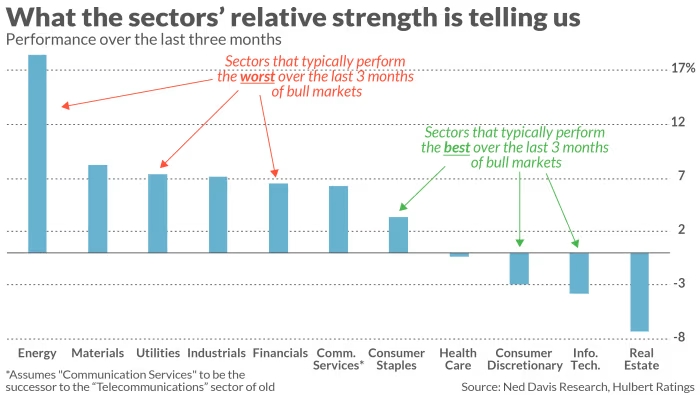
Sectors that typically experience a surge towards the end of bull markets are currently showing signs of lagging behind. Despite a week of volatile trading sessions, the primary trend in the U.S. stock market remains upward. This conclusion is supported by the sector relative-strength rankings, which have remained positive despite recent market fluctuations. My optimistic outlook is based on an analysis of sector performance during the final stages of bull markets. However, recent market behavior deviates from historical norms: sectors that usually thrive in the late stages of bull markets are struggling, while traditionally weaker sectors are unexpectedly leading the pack. This deviation is evident in the accompanying chart, which highlights the disparity between recent sector relative-strength and historical trends. While this doesn’t conclusively confirm the continuation of the bull market, it suggests that dismissing it prematurely may be unwise. The recent rally in the S&P 500 at the beginning of this week indicates that many investors share this sentiment, despite six consecutive sessions of decline last week. Twice within the past year, I’ve assessed the market using sector relative-strength rankings. In early April 2023, amidst widespread skepticism toward the nascent bull market, I contended that the rankings signaled the emergence of a new bull market rather than a correction in a bear market. Since then, the S&P 500 has surged by over 22% on a total-return basis. Similarly, in mid-August 2023, when the S&P 500 was 5% below its recent peak, I argued against interpreting the weakness as the end of the bull market. Since then, the S&P 500 has risen by 15% on a total-return basis. To gauge the extent of the current deviation from the historical pattern for bull market endings, it’s instructive to examine the rank correlation coefficient between the two. This statistic, ranging from a theoretical maximum of 1.0 (indicating identical rankings) to minus-1.0 (indicating perfect inverse rankings), currently stands at minus-0.70, one of the lowest readings in recent decades. In contrast, last August, the correlation coefficient was minus-0.01, and in April 2023, it was plus-0.31. Evidently, sector relative-strength readings are increasingly diverging from the typical pattern observed at the end of bull markets. In summary, premature reports of the bull market’s demise may be unwarranted. John PaulJohn Paul is the founder of DayTradeToWin, a trading education and software company established in 2008, supporting traders worldwide. His expertise focuses on price action-based futures trading strategies and structured market analysis. DayTradeToWin delivers trading education, indicators, and software tools designed to help traders apply disciplined, rule-based decision-making across global futures markets. He is the creator of multiple trading methodologies, including the Sonic System, Atlas Line, and Trade Scalper, which help traders identify structured opportunities in markets such as the E-mini S&P 500 (ES), Nasdaq (NQ), crude oil (CL), and gold (GC). Official website: https://daytradetowin.com daytradetowin.com

Scroll to Top