s&p 500

S&P 500
DayTradeToWin Review

S&P 500 Forecast 2025: Price Action Trading Setup

The S&P 500 forecast for 2025 remains bullish, but the path to higher prices rarely comes without pullbacks. For traders, these retracements aren’t red flags — they’re opportunities. In this guide, we’ll explore: Whether you trade E-mini S&P futures, Nasdaq, or Dow Jones, this approach applies across markets. 1. January Close: The Yearly Directional Signal One of the most reliable indicators for the S&P 500 is the January barometer: When January closes higher than it opens, the market often finishes the year higher as well. 2025 Outlook 2. The 50% Retracement Rule Markets frequently retrace about half of a prior move before resuming their trend. The 50% level is a key decision point for traders. How to Trade It 3. April 2025: A Textbook Example Earlier this year, the S&P 500 sold off sharply into April. Once price closed above the 50% retracement level, it rallied to retest — and eventually surpass — prior highs. This pattern provides a blueprint for current conditions. 4. Current Setup: August 2025 Market Snapshot What to Watch 5. Using ATR for Profit Targets The Average True Range (ATR) helps traders align targets with volatility: This method avoids unrealistic targets and keeps risk-reward ratios balanced. 6. Integrating Our Trading Systems Our proprietary systems — Atlas Line, Sonic, Trade Scalper, Roadmap, and Blueprint — follow these same price action principles: Key Takeaways Next Steps for Traders Want to learn how to apply this in real time? Final Word The bullish framework for 2025 remains intact. The current pullback could set up one of the best long opportunities of the year — provided you wait for confirmation above the 50% retracement level and manage risk with ATR-based targets.

roadmap
DayTradeToWin Review

Mastering the E-mini S&P 500 (ES) Market Open: Strategies for Success

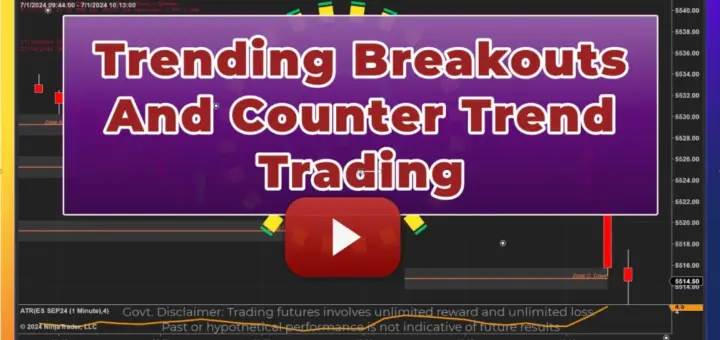
Navigating the E-mini S&P 500 (ES) market open can be both exhilarating and challenging. For traders looking to capitalize on early market movements, understanding how to effectively use breakout and counter-trend strategies is essential. In this blog post, we’ll delve into two real-world examples using the Roadmap software, demonstrating how to trade with the trend and against it. Breakout Trading: Riding the Trend When the market exhibits strong momentum, riding the trend can be highly profitable. Here’s a scenario that showcases this strategy: Example: Long Trade in a Strong Market In this scenario, the key is to stay in the trade as long as the trend remains strong. The software’s zones act as reliable indicators, helping traders make informed decisions. Counter-Trend Trading: Capturing Reversals Not all market scenarios will display a clear trend. Sometimes, the market encounters resistance and reverses. Knowing how to handle these situations can be equally rewarding. Example: Short Trade in a Reversing Market In this case, the market’s failure to break through the zone signals a potential reversal. By entering a counter-trend trade, you can take advantage of the market’s bounce and position yourself for a profitable move. Key Considerations for Successful Trading Conclusion Mastering the E-mini S&P 500 market open requires a combination of breakout and counter-trend strategies. By leveraging tools like the Roadmap software, you can confidently navigate various market conditions. Whether you’re riding a strong trend or seizing a reversal opportunity, understanding these strategies will enhance your trading skills. Join our live trading room and take advantage of our current promotions at daytradetowin.com. Learn from experienced traders, refine your strategies, and elevate your trading game. Happy trading! For more insights and to stay updated with the latest trading strategies, subscribe to the Day Trade to Win YouTube channel. Don’t miss out on our special deals on software packages, including the Roadmap, Atlas Line, Trade Scalper, and Autopilot. Visit daytradetowin.com today!

S&P 500
Market News

S&P 500 Breaks Records with Unmatched Gains in the First Half of 2024

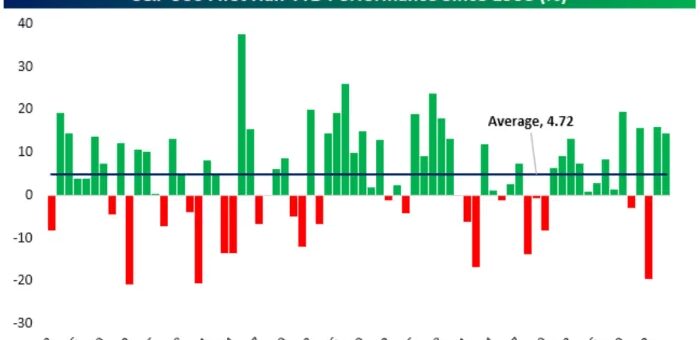
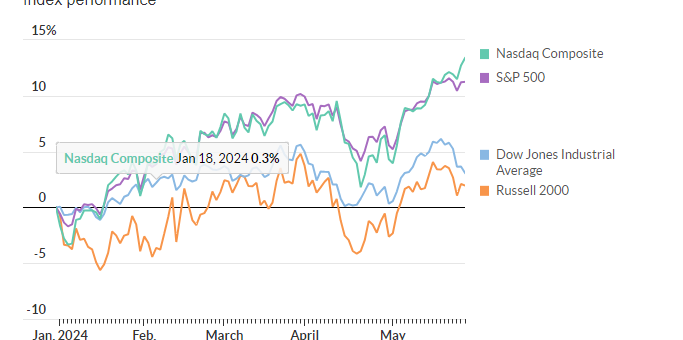
As the U.S. stock market nears the end of June, Bespoke analyzed the typical first-half performance of the S&P 500. The S&P 500 index is on track to post significant gains for the first half of 2024, poised to surpass the historical average, according to Bespoke Investment Group. “The end of the first half of 2024 is rapidly approaching,” Bespoke said in a note emailed Wednesday, with the U.S. stock market in its final week of June trading. The S&P 500 index, a measure of U.S. large-cap stocks, finished Wednesday with a modest rise, boosting its year-to-date gain to 14.8%, according to FactSet data. While the index’s first-half performance in 2024 is similar to its gains in the first six months of last year and 2021, it significantly exceeds the historical average gain of 4.72% since 1953, Bespoke found. A handful of Big Tech stocks have driven the S&P 500’s rally this year. Nvidia Corp. shares have surged around 155% in 2024, according to FactSet data. Facebook parent Meta Platforms Inc., Google parent Alphabet Inc., Amazon.com Inc., and Microsoft Corp. have all seen their shares rise more than the S&P 500 index this year through Wednesday. The U.S. stock market closed higher Wednesday, with the S&P 500 up 0.2%, the tech-heavy Nasdaq Composite climbing 0.5%, and the Dow Jones Industrial Average eking out a less than 0.1% gain. The S&P 500 gained more than 4% in the second quarter, following a 10.2% jump in the first three months of this year, according to FactSet data. The S&P 500 has risen 3.8% so far in June. Looking ahead, “July is a great time of the year for equities,” historically, according to Bespoke. “The best month of the year for the S&P 500, both since its inception and over the past 20 years, is July,” the firm said.

S&P 500
Market News

S&P 500 Futures Drop Amidst Climbing Bond Yields Concerns

How Are Stock-Index Futures Trading? On Tuesday, the Dow Jones Industrial Average dropped 217 points, or 0.55%, to 38,853. The S&P 500 edged up by 1 point, or 0.02%, to 5,306, while the Nasdaq Composite climbed 99 points, or 0.59%, to 17,020. Futures suggest that U.S. stock indices will open Wednesday’s session lower as Treasury yields hover near four-week highs. Bonds have experienced fresh sell-offs following two poorly received Treasury auctions on Tuesday. This was compounded by stronger-than-expected consumer confidence data and comments from a Federal Reserve official, indicating that it will take several more months of steady inflation before considering a rate cut. The likelihood of a September rate cut has fallen below 50%, down from nearly 60% last week. Concerns over persistently high borrowing costs are contending with optimism about major tech stocks—Nvidia reached a new record on Tuesday—affecting market sentiment, according to Susannah Streeter, head of money and markets at Hargreaves Lansdown. “Financial markets are divided in sentiment, with AI enthusiasm continuing to boost major tech stocks, while concerns about high interest rates keep investors cautious in other areas,” she said.

S&P 500
Market News

Wall Street Strategists Scramble to Update S&P 500 Projections Amid New Highs

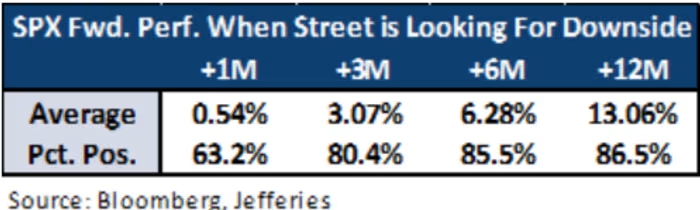
Wall Street’s top strategists have been caught off guard by the stock market’s record-setting rally, leading many to quickly revise their year-end S&P 500 targets. In 2024, at least 11 firms have raised their forecasts, with BMO Capital Markets and Deutsche Bank recently increasing their targets to 5,600 and 5,500, respectively. BMO’s forecast, the most optimistic among major banks, suggests a potential rise of more than 5% from current levels. As 2024 began, Wall Street expected modest gains after a strong 2023. Despite a brief dip in April, stocks have continued to climb, driven by significant gains in large-cap tech stocks, hitting multiple all-time highs. This surge has even turned notable bear Mike Wilson of Morgan Stanley bullish, now projecting the S&P 500 will reach 5,400 by mid-2025, a sharp shift from his previous forecast of 4,500 by year-end. Currently, J.P. Morgan’s Dubravko Lakos-Bujas stands as one of the few remaining bears, with a year-end target of 4,200, indicating a potential 21% drop from current levels. The average year-end target from strategists is now 5,289, a slight decline from current levels, up from an earlier average of 5,117. Despite some strategists revising their forecasts upward, Wall Street generally remains cautious due to the uncertain interest-rate environment. Andrew Greenebaum of Jefferies notes that historically, the S&P 500 performs well when Wall Street forecasts downside, averaging 6.3% gains over the next six months and 13% over the next year. Bottom-up estimates, which aggregate median target prices from industry analysts, are more optimistic. FactSet’s John Butters projects an 11% increase in the S&P 500 over the next 12 months, with a target price of 5,856.09. Consumer discretionary and energy sectors are expected to see the largest gains, while utilities are forecasted to lag. On Monday, U.S. stocks were mostly higher, beginning a quiet week for economic data. The Dow Jones dipped 0.5% after surpassing 40,000, while the S&P 500 rose slightly to 5,306, and the Nasdaq Composite increased by 0.6%.

S&P 500
Market News

Resist the FOMO: Navigating S&P 500 Records Without ‘Envy

When stocks are booming and bonds are lagging, as they are now, it can be tough to convince investors that diversification is still essential. With the S&P 500 up nearly 12% year-to-date in mid-May and the Dow Jones Industrial Average hitting 40,000, many investors experience “S&P 500 Envy” if their returns fall short of these benchmarks. This sentiment wasn’t an issue in recent years when both stocks and bonds were down, but a similar situation occurred in 2018, fostering the “S&P 500 Envy” concept. BlackRock even created a presentation to help financial advisers address this with clients, demonstrating that while a diversified portfolio might underperform the S&P 500 in the short term, it often yields better long-term results. A key graphic from this presentation showed that during years like 2000-2002, 2008, 2020, and 2022, when the S&P was down, a diversified portfolio also declined but by a smaller margin, leading to investor dissatisfaction. Conversely, from 2009 to 2019 and in 2023, when the S&P surged, a diversified portfolio grew more modestly, causing envy. Over the long run, however, the diversified portfolio outperformed the S&P, proving that “diversification can work, even when it feels like it’s losing.” Nicholas Olesen, a certified financial planner with Kathmere Capital Management, reinforces this point. He advises that diversification hedges against economic fluctuations and addresses recency bias, the tendency to believe recent trends will continue indefinitely. Olesen emphasizes the importance of a balanced approach tailored to individual investor needs and sticking to this plan despite market volatility. Ross Haycock, a certified financial planner with Summit Wealth Group, also champions diversification, invoking the timeless wisdom: “Don’t put all your eggs in one basket.” He notes that diversification discussions are easier with long-term clients who have experienced market cycles, while newer clients may need more reassurance during turbulent times. One common mistake investors make when shunning diversification is focusing solely on bond prices rather than yields. Despite bonds underperforming in recent years, they still generate consistent, guaranteed yields, especially when held to maturity. Olesen warns against “statement shock,” where investors see a small daily return and compare it unfavorably to the S&P’s gains without considering the overall yield and long-term value. Advisers stress the importance of following a well-considered plan and avoiding hasty decisions based on short-term market movements. By doing so, investors can avoid FOMO and ensure their portfolios are well-positioned for long-term success.

Scroll to Top