trading

At The Open
DayTradeToWin Review

Mastering Market At The Open Strategies

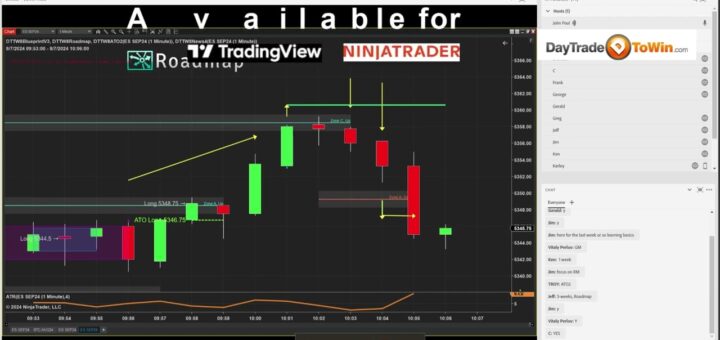
Trading during the market open is an exciting yet challenging endeavor. The first few minutes can set the tone for the day, offering significant opportunities for profit if you have the right strategy in place. Whether you’re new to trading or looking to sharpen your skills, this guide will walk you through the essential strategies to navigate the market open effectively, focusing on the “roadmap” and “at the open” methods. Understanding the Roadmap: Your Trading Compass The roadmap is a crucial tool for traders, especially during the volatile market open. It helps you identify key zones where the price might reverse or break through, allowing you to make informed trading decisions. How to Use the Roadmap At the market open, watch closely as the candles approach the roadmap zones. These zones act as potential turning points or breakout levels. Adapting to Volatility During high volatility, adjust your strategy to maintain control. Consider switching to shorter time frames, like a 20 or 30-second chart, to pinpoint more precise entry points. Key Points: The “At the Open” Strategy: Capturing Early Momentum The “At the Open” strategy is designed to help you capitalize on the initial volatility when the market opens. This method focuses on identifying a precise entry point based on early price action and placing a limit order near that level. How to Execute the “At the Open” Strategy Managing Risk with ATR and Time-Based Stops Conclusion Trading the market open requires a disciplined approach and a solid understanding of your tools. Whether you’re using the roadmap to identify key levels or applying the “At the Open” method to catch early moves, staying focused and managing risk are critical. For those looking to deepen their trading skills, consider joining our live trading room where we apply these strategies in real-time. Visit DayTradeToWin.com to create a free account, access free trading tools, and start mastering your market open strategies.

Market News

S&P 500 Projections: Wall Street’s Most Optimistic Strategist’s View

S&P 500 Energy Sector Gains Favor, as Predicted by Oppenheimer’s Stoltzfus In the midst of recent turbulence in the U.S. stock market, Oppenheimer’s Chief Investment Strategist, John Stoltzfus, maintains his optimism about the S&P 500 hitting record highs this year. Back in late July, Stoltzfus boldly projected that the S&P 500 would soar above 4,900 by the close of 2023, making it the most optimistic target among 20 Wall Street firms surveyed by MarketWatch in August. This forecast implies that the S&P 500 will surpass its previous record high of 4,796, achieved on January 3, 2022, by year-end. However, the path to this record may not be without its share of challenges. Stoltzfus and his team at Oppenheimer have noted that market bullishness remains high while the Federal Reserve has yet to reach its inflation target. They caution investors to temper their enthusiasm for a prolonged period of low interest rates or even a rate cut. Despite expectations that the Fed is nearing the end of its current interest-rate hiking cycle, concerns persist. Strong economic data and rising oil prices have raised worries that sticky inflation could lead to sustained higher borrowing costs. Investors should remain vigilant, according to Stoltzfus, even as the Fed appears to be approaching the end of its current rate-hike cycle. They believe that persistently high prices in various sectors, including food, services, and energy, warrant the Fed’s continued attention. As such, Stoltzfus and his team foresee the possibility of one more rate hike this year and potentially another in the next. However, Stoltzfus does not view these current headwinds as insurmountable obstacles that would prevent the S&P 500 from reaching his team’s ambitious target. Market participants eagerly await this month’s inflation report, which is expected to shed light on the Federal Reserve’s stance on inflation. The headline component of the consumer-price index is anticipated to rise to 0.6% in August from July’s 0.2%, while the core measure, which excludes volatile food and fuel costs, is expected to see a modest increase of 0.2% from the previous month. Furthermore, Stoltzfus acknowledges that the Wall Street volatility index, known as the CBOE Volatility Index (VIX), indicates the likelihood of “some choppiness” in the stock market in the near term. The VIX, currently at 13.82, hovers near its 12-month low and trades well below its one-year and two-year averages. Despite these challenges, Stoltzfus and his team encourage investors to seize opportunities during market weakness. They see promise in the S&P 500 Energy Sector (XX:SP500.10), particularly as policymakers in the U.S. and around the world strive to combat inflation and nurture economic growth. An improved economic outlook, combined with fiscal stimulus from domestic infrastructure projects and chip manufacturing initiatives, could enhance the profitability of the energy sector into 2024. Year-to-date data shows that the Energy Select Sector SPDR Fund (XLE), representing the energy sector within the S&P 500, has gained 3.9%. In contrast, the price of West Texas Intermediate crude oil has risen by 8.5%. While oil futures reached their peak for the year following unexpected output cut extensions by Russia and Saudi Arabia, they later settled at slightly lower levels. Stoltzfus’s prediction from late July suggested that the S&P 500 would surpass its record high by the close of 2023, with a year-end target of 4,900, representing a 9.2% increase from its current level. On Monday, U.S. equities showed positive momentum, with the technology sector leading the way. The Nasdaq Composite climbed by 1.1%, while the S&P 500 advanced by 0.7%. The Dow Jones Industrial Average closed 0.3% higher. Please note that this summary is not financial advice; it is a simplified overview of a complex financial news article. Consult with a financial advisor for investment decisions.

DayTradeToWin Review

Roadmap Trading: Your Path to Trading Success

Trading can be an exhilarating journey, full of opportunities for financial growth and independence. However, it’s vital to remember that trading carries inherent risks. Before we dive into the captivating world of the Roadmap, let’s emphasize the utmost importance of responsible trading. Please only invest funds that you can afford to lose. Introducing the Roadmap: In today’s dynamic trading landscape, having the right tools and strategies at your disposal can be a game-changer. One such formidable tool is the Roadmap, a cutting-edge trading method initially exclusive to our comprehensive Accelerated Mentorship Program. Exciting news! We’re delighted to announce that it’s now available as a standalone system, empowering traders to harness its benefits independently or as a valuable addition to their existing strategies. How Does the Roadmap Operate? For those already acquainted with the Roadmap, its potential is evident. But for newcomers, let’s break it down: The Roadmap leverages proprietary software developed by DayTradetoWin, synonymous with trading excellence. When utilizing this method, traders should anticipate one of two typical scenarios: In Conclusion In the realm of trading, possessing a reliable strategy is akin to having a compass in uncharted waters. The Roadmap is no ordinary tool; it’s a potent guide that assists traders in navigating the complexities of the market. Whether you’re new to trading or a seasoned expert, the Roadmap stands as your steadfast companion. As we make this remarkable tool available for individual use, our hope is to empower traders to make informed decisions, seize opportunities, and effectively manage risks. Remember, trading is a journey, and it demands a cautious, responsible, and eager-to-learn approach. The Roadmap is now at your fingertips. Embrace it, learn from it, and let it guide you towards success in your trading endeavors. Happy trading!

Bear market
Market News

Stock Market Rallies Onward: Hold the Celebration for the Bear’s Demise Just Yet

During premarket trading on Thursday, Apple shares saw modest gains, edging closer to a valuation of $3 trillion. Some analysts, such as Wedbush’s Dan Ives, anticipate the company could reach a $4 trillion valuation by 2025. The exact implications of such a massive valuation on market weight remain unclear. With Apple holding a 7.6% weighting in the S&P 500, the adage goes, “as goes Apple, so goes the market” (not forgetting Microsoft and its 6.8% share). According to Irene Tunkel, chief strategist at BCA Research, this momentum has contributed to the overall positive trajectory of the stock market. Other contributing factors include the Federal Reserve’s winding down of rate increases, no recession currently underway, an earnings recession nearing its end, and a substantial amount of idle cash. Nevertheless, Tunkel warns against premature celebration, pointing to several red flags. One such concern is the anticipated decline in consumer spending on services, which has been essential in supporting the economy thus far. Additionally, consumers’ excess savings are waning and are projected to decrease even more once student loan repayments resume. Following the debt ceiling agreement, fiscal stimulus is expected to decrease. Coupled with a cautious banking sector limiting lending, this could expose a weakening job market. Regarding market valuations, Tunkel notes the current high valuations and incorporation of optimistic projections make the market seem expensive. She challenges the notion that only top-performing stocks are overvalued. Regarding technical factors, Tunkel observes the market is in overbought territory. The AAII investor sentiment survey shows the highest level of optimism since 2021, and the CBOE VIX is below 14. Tunkel believes these factors may signal a potential mean reversion. Tunkel ultimately concludes, “While the rally can persist longer, driven by all the positive aspects, eventually a black swan event will emerge, triggering a rapid acceleration of developments – due to the overvalued index, multiples will contract dramatically, leading to a major market downturn.”

Roller Coaster
Uncategorized

Navigating the Market Maze ?: Harnessing Options Strategies to Embrace Uncertainty ?️

As the quarter nears its end, the stock market appears to be losing steam amid speculations that investors are coming to terms with the potential delay of a Fed rate hike in 2023. Both the S&P 500 and Nasdaq Composite have experienced five losing sessions in the last six. In the past three months, the S&P index surpassed the critical resistance level of 4,200 in June, setting the stage for a battle between bulls and bears and creating uncertainty for investors. A team at Evercore ISI, led by Julian Emanuel, observed this development. Nonetheless, they urge investors to “embrace the uncertainty” and offer insights on managing the potential direction of stocks this summer. According to Emanuel and his team, the breakout above 4,200 led to an influx of funds into stocks and a significant covering of record S&P 500 short futures positions. They highlighted that all these “new longs” would be “underwater” at 4,200, providing the following chart as evidence: Conversely, the pullback at 4,450 highlights the common and volatile nature of momentum market corrections, as observed in 2021 and 1999. Strategists suggest that a return to 4,450 could rekindle the “chase” similar to the 127% rise in the Nasdaq 100 after the 14.1% decline in 1999. In essence, the stock market may see another clash between bears and bulls this summer. For investors hesitant to take sides, Evercore proposes employing a strangle options strategy. This approach involves holding calls and put options with different strike prices but the same expiration dates and underlying assets. To recap, calls are options contracts that give the holder the right (but not the obligation) to buy the underlying security at a predetermined price by a specific deadline, while puts

Wall St
Market News

Today’s Stock Market Insights: Wall Street’s Hushed Tones Ahead of Powell’s Testimony

In expectation of Federal Reserve Chair Jerome Powell’s testimony to Congress, the American stock markets have experienced a slight drop. During the testimony, Powell is expected to respond to inquiries about the central bank’s efforts to tackle inflation by adjusting interest rates. On Wednesday morning, the United States markets remained relatively unchanged as they awaited Federal Reserve Chair Jerome Powell’s testimony before Congress. The expectation is that Powell will address inquiries regarding the central bank’s strategies for managing inflation through interest rate policies. Before the commencement of trading on Wednesday, the futures for the Dow Jones Industrial Average and S&P 500 exhibited a dip of roughly 0.1%. There was no alteration in the pricing of oil. The economic sector is concerned that the Federal Reserve might recommence raising interest rates in the forthcoming month and may have to maintain them at high levels for an extended duration. This may result in considerable economic pressure and potentially trigger a downturn. Powell has a scheduled appearance to give testimony to two committees, one in the House on the coming Wednesday and the other in the Senate on Thursday. Recently, the Federal Reserve decided to maintain its primary lending rate, which was the first time in over a year that there was no indication of an increase. However, it also warned that it may hike rates twice before the year ends. Stephen Innes, employed at SPI Asset Management, stated that investors are becoming apprehensive as they await more speeches from the Federal Reserve, given the limited availability of economic data. He said that investors might need to see proof of favorable inflation trends that bring the Federal Reserve’s predictions closer to the market’s expectations before they can feel confident about making more progress in the U.S. stock markets, given how central banks tolerate inflation currently. There are suggestions that inflation is lowering to a point where the Federal Reserve may stop raising interest rates, causing the stock market to improve. Also, some technology companies have seen a rise in their stock prices due to a heightened interest in artificial intelligence. FedEx experienced a decrease of more than 2% in its stock value before the start of trading on Wednesday. Even though it achieved profits higher than expectations for the fourth quarter, Wall Street investors predicted a more significant increase in its guidance for the fiscal year 2024. Consequently, the company’s stock value decreased, leading to a 1% decrease in UPS’s stock value too. The Bank of England has a planned meeting on Thursday to deliberate on interest rate policies, like other locations around the world. Central banks in different countries are tackling inflation fears in individual ways while simultaneously managing challenges presented by a weak global economy. At approximately midday in Europe, there was a decline of approximately 0.2% in the DAX of Germany, Paris’ CAC 40, and the FTSE 100 of Britain. In Asia on Wednesday, the Nikkei 225 index in Tokyo increased by 0.3% and reached 33,575.14 points. However, the Hang Seng index in Hong Kong decreased by 2% and reached 19,218.35 points. Similarly, the Shanghai Composite index declined by 1.3% and reached 3,197.90 points, while the Kospi index in Seoul dropped by 0.9% and reached 2,582.63 points. The Australian S&P/ASX 200 index decreased by 0.6% to end at a value of 7,314.90. Bangkok’s SET index also dropped by 1.1%. On the other hand, India’s Sensex index rose by 0.3%. The price of U.S. benchmark crude oil decreased slightly on Wednesday compared to the previous day. It was traded at $71.21 per barrel on the New York Mercantile Exchange, which is 74 cents lower than Tuesday’s closing price of $71.19 per barrel. One unit of the globally recognized Brent crude was priced at $75.88. The US dollar’s worth went up from 141.43 to 141.76 Japanese yen, whereas the euro experienced a slight increase in value from $1.0922 to $1.0924. On Tuesday, the American stock market faced a fall after giving indications of progress due to positivity about the economy’s potential to escape a recession. The S&P 500 decreased by 0.5%, the Dow decreased by 0.7%, and the Nasdaq composite fell by 0.2%.

Scroll to Top