
The volatility index hints at a period of calm, but recent corporate earnings have sparked unpredictability in individual stocks. Brace yourself for potential market turbulence making a comeback sooner than expected.
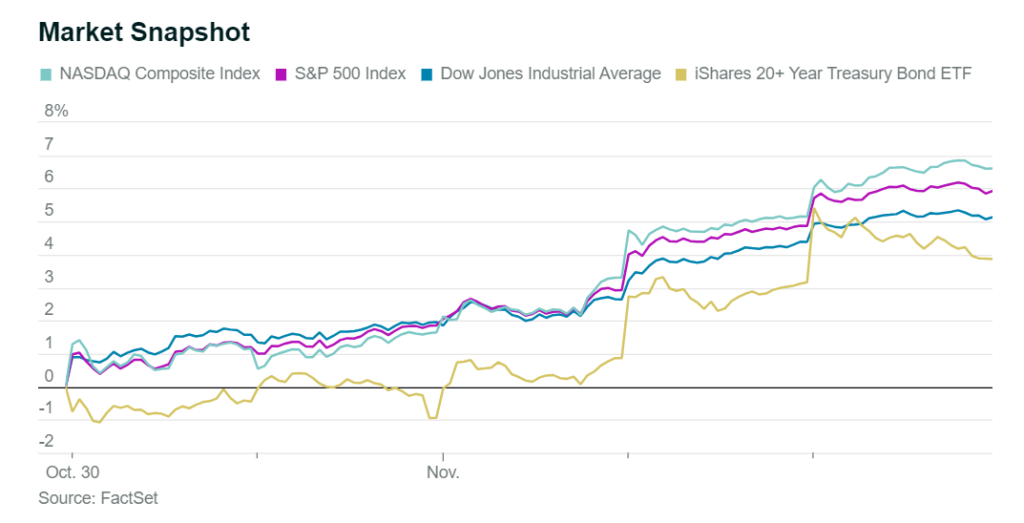
The past week witnessed significant market upswings, with the S&P 500 index soaring by 5.9%, marking its most substantial increase since November 2022. The Dow Jones Industrial Average and Nasdaq Composite also surged by 5.1% and 6.6%, respectively. This surge followed the Federal Reserve’s decision to hold off on interest rate hikes and a notable slowdown in the labor market, as evident in the recent payrolls report.
While the Cboe Volatility Index (VIX), a measure of expected S&P 500 volatility, declined to 14.9 from its peak of nearly 22 in October, this shift suggests a change in investor sentiment—from a brief panic to renewed confidence in the market.
However, contrasting this are individual stocks’ reactions to earnings, showcasing significant volatility. Some companies, like Roku, Shopify, and Palantir Technologies, soared by more than 20% post-earnings, while others such as Paycom Software, ON Semiconductor, and Estée Lauder plummeted by 19% or more.
Despite reduced market volatility, the response to earnings remains highly erratic. Companies surpassing earnings and sales expectations have seen only marginal stock increases, around 0.3%, on average. Conversely, those missing forecasts experienced a significant 4.8% decline—widening the disparity compared to historical averages.
The concern arises from the fact that while earnings have mostly exceeded estimates, the market has already factored in this growth for the future. Spencer Hakimian, founder of Tolou Capital Management, highlights the risk if projected growth doesn’t materialize in the coming years.
Instances like ON Semiconductor’s discouraging profit guidance, attributed to weakening automotive chip demand, resulted in a 22% stock drop. The trend of companies providing cautious forward guidance is a cause for concern, potentially adding to market volatility.
The behavior of the bond market is currently influencing stock markets. Although the 10-year Treasury yield witnessed a significant decline, there remain worries about persistently high interest rates potentially impacting future earnings in 2024 and 2025, hinting at a possibly volatile market ahead.
David Miller, co-founder of Catalyst Capital Advisors, foresees a higher VIX level in the near future, suggesting a bumpier market ride and calling for preparedness to navigate potential increased turbulence.

John Paul is the founder of DayTradeToWin, a trading education and software company established in 2008, supporting traders worldwide. His expertise focuses on price action-based futures trading strategies and structured market analysis.
DayTradeToWin delivers trading education, indicators, and software tools designed to help traders apply disciplined, rule-based decision-making across global futures markets.
He is the creator of multiple trading methodologies, including the Sonic System, Atlas Line, and Trade Scalper, which help traders identify structured opportunities in markets such as the E-mini S&P 500 (ES), Nasdaq (NQ), crude oil (CL), and gold (GC).
Official website: https://daytradetowin.com