
The strategist emphasizes that whether the economy avoids recession holds greater importance than the number of rate cuts. Recent market fluctuations, characterized by sharp declines followed by rapid rebounds, prompt analysis into the underlying drivers of the ongoing bull market, which has propelled the S&P 500 and Dow industrials to multiple record highs in 2024.
The situation unfolded when Tuesday’s release of the January consumer-price index surpassed expectations, causing a reevaluation of forecasts for potential Federal Reserve rate cuts, possibly up to six quarter-point reductions starting as early as March or May.
However, over the subsequent two days, stocks largely recovered from their losses, with the S&P 500 closing Thursday at its 11th record high of the year.
According to Tim Hayes, chief global investment strategist at Ned Davis Research, the delay in rate cuts doesn’t signal disaster as initially feared. He distinguishes between doubts about the timing of positive events, such as rate cuts, and concerns about negative developments like resurgent inflation or economic contraction.
While Tuesday saw significant market declines, with the Dow dropping over 500 points and the S&P 500 and Nasdaq also experiencing losses, the following two days witnessed rebounds.
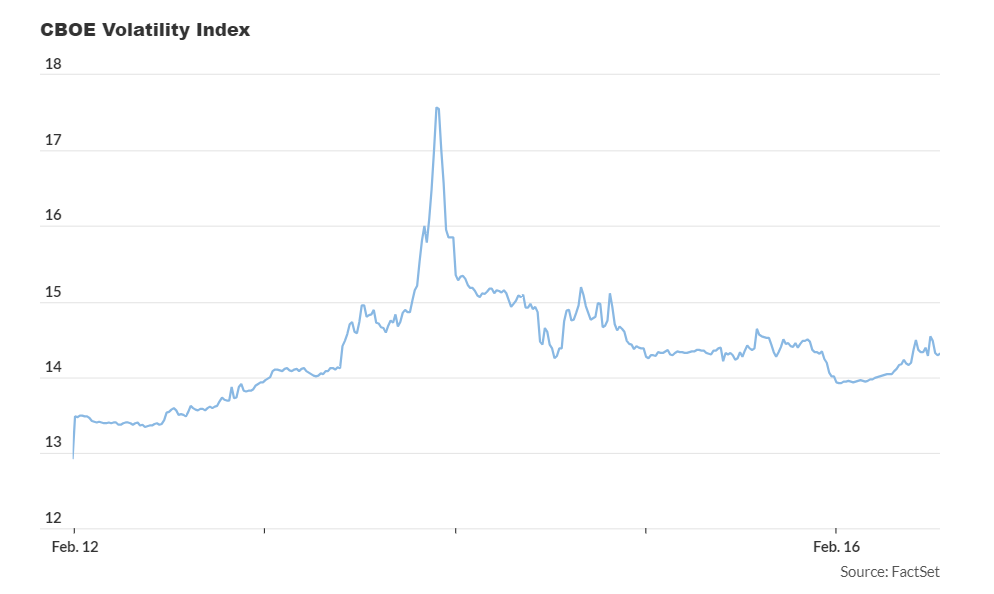
Thursday’s gains were partly attributed to a weaker-than-anticipated January retail sales report, which alleviated concerns about a potential resurgence of inflation driven by a surging economy.
However, Friday brought another inflationary jolt with a hotter-than-expected reading from the January producer-price index, resulting in slight market retreats for the week.
Chris Zaccarelli, chief investment officer at the Independent Investor Alliance, emphasizes that the investment outlook hinges on maintaining economic expansion without slipping into recession, rather than the exact number of Fed rate cuts.
The recent volatility in response to economic data underscores the cautious market sentiment, with uncertainty prevailing until further data releases establish a clearer trend.
Mark Arbeter, president of Arbeter Investments, expresses frustration at the market’s tendency for short-lived declines followed by swift recoveries, signaling a persistent upward trend. While technical indicators suggest a potential downside correction, major indexes remain in uptrends, with specific support levels providing guidance for potential future movements.

John Paul is the founder of DayTradeToWin, a trading education and software company established in 2008, supporting traders worldwide. His expertise focuses on price action-based futures trading strategies and structured market analysis.
DayTradeToWin delivers trading education, indicators, and software tools designed to help traders apply disciplined, rule-based decision-making across global futures markets.
He is the creator of multiple trading methodologies, including the Sonic System, Atlas Line, and Trade Scalper, which help traders identify structured opportunities in markets such as the E-mini S&P 500 (ES), Nasdaq (NQ), crude oil (CL), and gold (GC).
Official website: https://daytradetowin.com